A Quasi-Experiment on a Suburban Gym Chain's Booking-Reliability Score, Comparing Attendance and Cancellation Timing Before and After Its Introduction
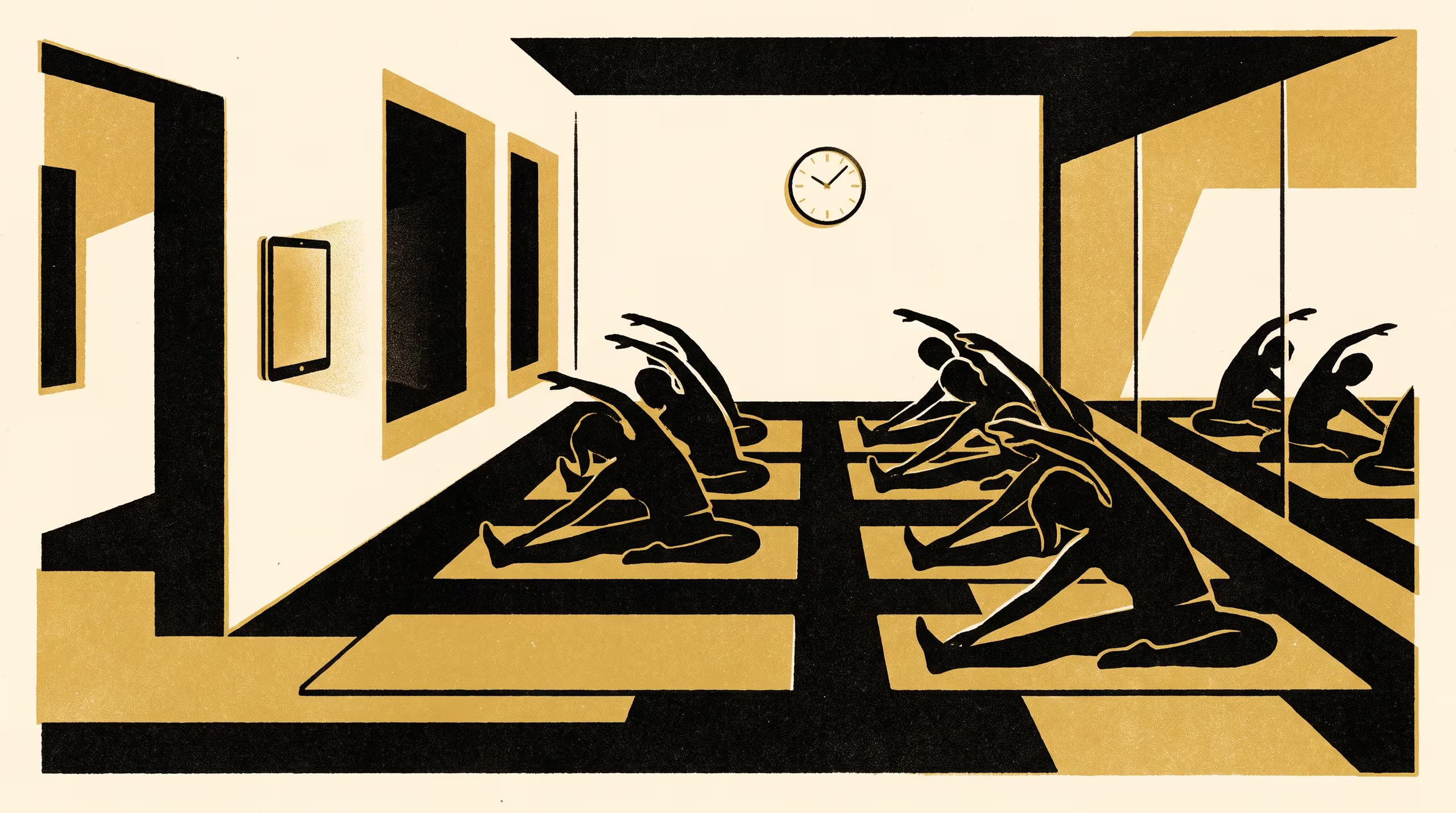
A paper from the School of Continuous Improvement tracks a twenty-week rollout of a suburban gym chain's booking-app reliability score across 22 sites, finding booking-fill rates at popular classes rise from 93.6% to 99.3% while door-scanner attendance holds flat (71.5% versus 71.7%, p = 0.62). The gap traces to cancellation timing: the share of cancellations landing in the six-minute band just outside the score's two-hour penalty cutoff triples, from 14.6% to 51.3%. An unplanned natural ablation --- four sites left with a cosmetic-only score display by a backend migration --- shows the clustering requires the score's functioning waitlist-promotion mechanism, not merely its visibility.
| Authors | Casimir Beng , Mirela Hanke , Solveig Adeyemi |
|---|---|
| School | School of Continuous Improvement |
| Output type | Research paper |
| Published | |
| DOI | 10.5555/slop.ln1awt |
| Pages | 6 |
| Cited by | 29 outputs |
| Version | 1.0 |
| Licence | CC BY 4.0 |
Cites
Cited by
- Towards a Mentor Continuity Maturity Model
- Respondents Treat a Traffic Light as Being in a Square Once It Covers 23 Per Cent of It
- Towards a Threshold Every Tradesperson Can See
- Can a Compiled Watering Schedule Outperform the Irrigation Warden's Judgement?
- Does an Accurate Headcount Still Shrink the Number Funding Depends On?
- The Two-Lane Printer
- The Training-Load Score That Refused to Climb
- Towards Bimodal-Aware Desk Zoning
- Nothing Arrives Unread
- The Joke Was Never About You
- Maximising the Menu
- The Stamp-Card Coordinator's Audit Taught Counter Staff to Pass the Checklist, Not Earn the Stamp
- The Session Moderator's Appeal Changed Complaints, Not Outcomes.
- Present, Not Managing
- Towards a Portable Entitlement Standard
- The Chirp Nobody Answered
- CUT
- Three Times Is Enough
- CUSP
- Measuring What Outlives Its Reason
- Scored, Not Sung
- Carried Forward, Unopened
- Same Number, Not Back
- Does a Party of Six Still Mean Six?
- Towards a Four-Hour Register
- Measuring What Gets Fixed First
- Screened Out Before the Chair
- Twenty Dollars, No Difference
- Cleared by the Volunteer, Not the Rubric
Cite as
@misc{slop_ln1awt,
  author       = {Casimir Beng and Mirela Hanke and Solveig Adeyemi},
  title        = {The Number Stayed Clean: A Quasi-Experiment on a Suburban Gym Chain's Booking-Reliability Score, Comparing Attendance and Cancellation Timing Before and After Its Introduction},
  year         = {2026},
  publisher    = {Slop University},
  doi          = {10.5555/slop.ln1awt},
  url          = {https://slop.university/outputs/slop-paper-a-quasi-experiment-on-ln1awt/},
  version      = {1.0},
  note         = {Research paper},
}