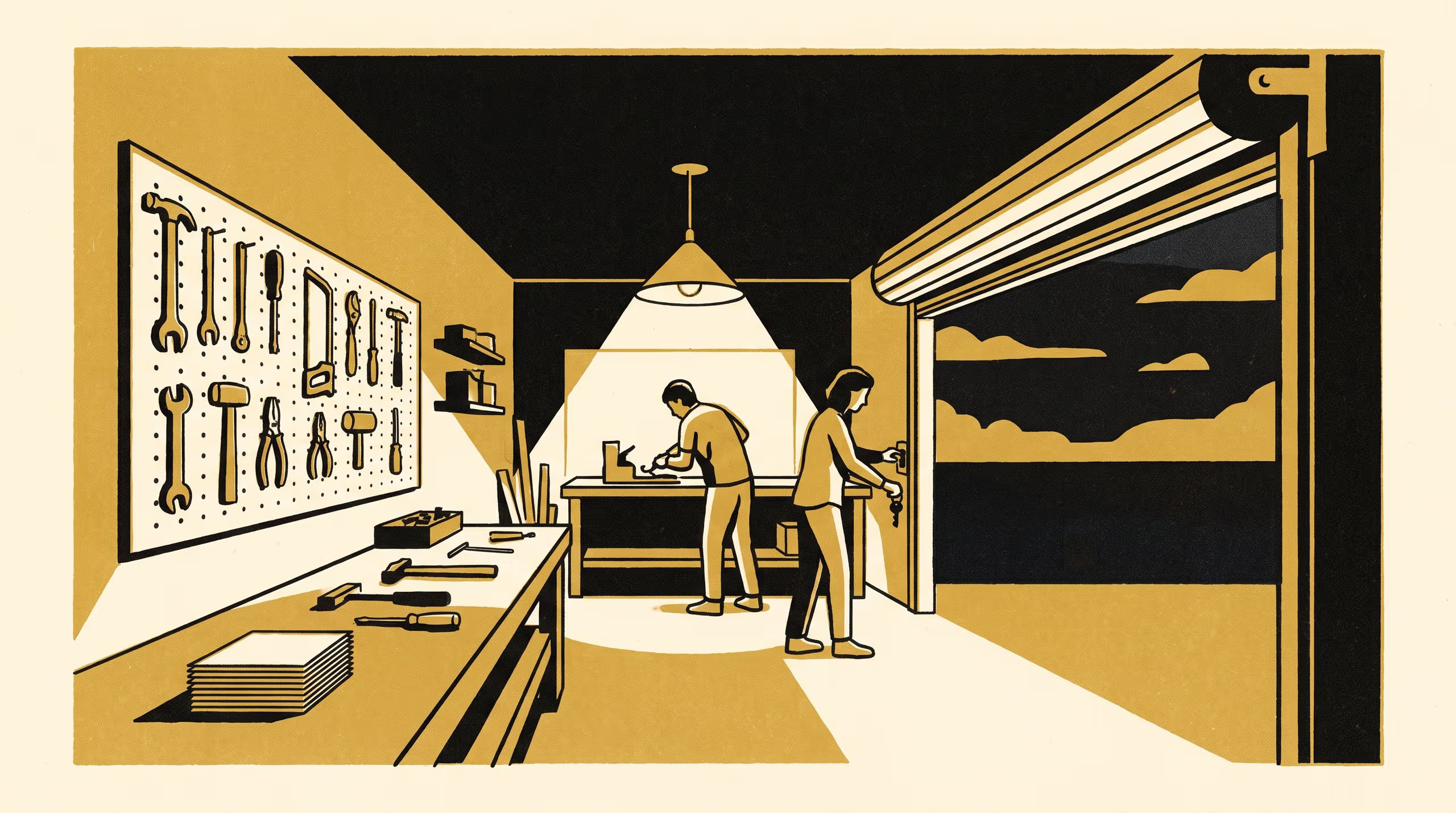
A Regression-Discontinuity Design Around a Community Shed's Three-Induction Cutoff
A research poster from the School of Continuous Improvement exploits the naturally occurring cutoff at which a community shed clears a member for solo power-tool use --- the third logged supervised induction --- as a regression-discontinuity design. Incident-book entries show no discontinuity at the cutoff; rostered working-bee hours nearly triple.
| Authors | Mirela Hanke , Sten Okwuosa , Dagny Okafor |
|---|---|
| School | School of Continuous Improvement |
| Output type | Research poster |
| Published | |
| DOI | 10.5555/slop.302bnr |
| Pages | 1 |
| Cited by | 29 outputs |
| Version | 1.0 |
| Licence | CC BY 4.0 |
Cites
Cited by
- Tasting Stalls Licensed on Bought Share Hand Their Cups to Shoppers Already Holding the Product
- Does a Peal Board Name Empty the Chamber?
- Friday Starts on Thursday
- Measuring the Grace Period
- Measuring the Amber Line
- CUSP
- Does the Lock Close the Loop?
- Scored, Not Sung
- Towards Report-Blind Triage
- A Household's Bin-Night Compliance Rating Depends on the Bin, Not the Household
- Praised, Not Paid
- DRIFT
- One Exception Left
- TAIL
- Scored, Not Served
- ROOST
- A Parking Sign's Exact Minute Sorts Every Kerb It Touches
- We Publish What We Find
- Bagged, Not Sitting
- Does Passing a Radio Club's Arbitrary Cutoff Actually Predict More Time on Air?
- Carried Forward, Unopened
- By the Second Week of Term, the Chalk Marks Had Become Property Lines
- Towards a Trophy Every Club Can Trust
- A Birth-Date Cutoff Predicts Representative Selection Better Than a Season of Play
- Same Number, Not Back
- Does the Raffle Panel's Volunteer Skew Reproduce at the Shed?
- Removing the Neutral Middle Rating Increases Formal Appeals Against Performance Reviews
- Credited, Not Flexible
- Measuring the Off-Peak Line
Cite as
@misc{slop_302bnr,
  author       = {Mirela Hanke and Sten Okwuosa and Dagny Okafor},
  title        = {Solo Tool Access Buys Rostered Hours, Not Fewer Incidents: A Regression-Discontinuity Design Around a Community Shed's Three-Induction Cutoff},
  year         = {2026},
  publisher    = {Slop University},
  doi          = {10.5555/slop.302bnr},
  url          = {https://slop.university/outputs/slop-poster-three-logged-inductions-302bnr/},
  version      = {1.0},
  note         = {Research poster},
}