A Regression-discontinuity Observatory of Spatial Thresholds
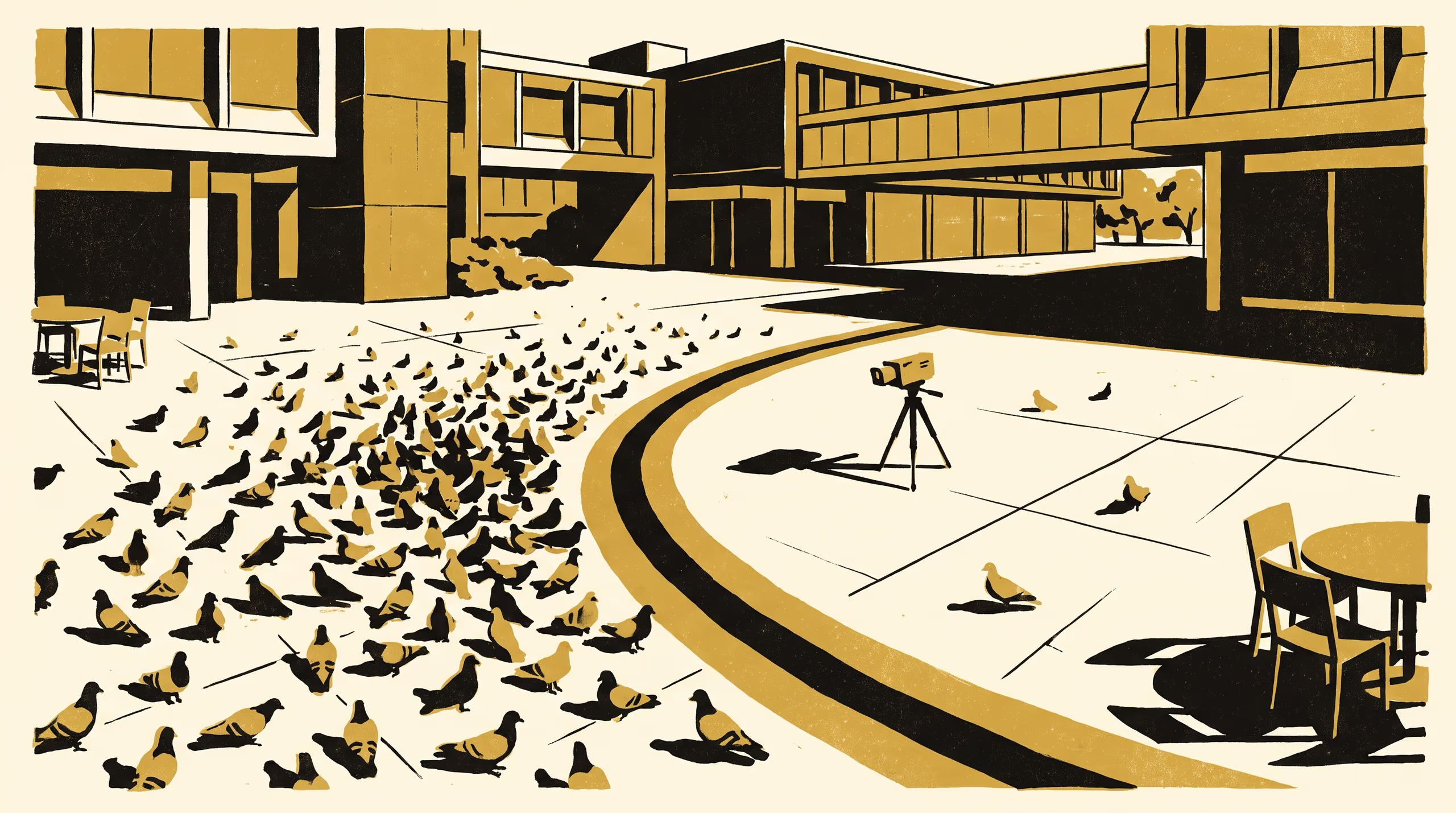
A paper from the School of Emergent Priorities treats an unenforced feeding-exclusion line around six campus food-court precincts as a natural regression-discontinuity boundary, finding pigeon density falls sharply on crossing it, and reports the observatory built to validate the method against the wider set of administrative boundaries it is now being pointed at.
| Authors | Anneke Tolan, Hedvig Anyanwu, Verity Marris |
|---|---|
| School | School of Emergent Priorities |
| Output type | Research paper |
| Published | |
| DOI | 10.5555/slop.qmv00y |
| Pages | 5 |
| Version | 1.0 |
| Licence | CC BY 4.0 |
Cites
- Bagged, Not Sitting
- Towards a General Account of Crate-Bounded Priority Formation
- When Three Years on the List Finally Buys the Big Plot
- Credited, Not Flexible
- SLOT
- Rethinking the Occupancy Light
- Solo Tool Access Buys Rostered Hours, Not Fewer Incidents
- Quiet Where the Sign Has No Name
- The Domain-Coverage Router
- The Queue as Leading Indicator
Cite as
@misc{slop_qmv00y,
  author       = {Anneke Tolan and Hedvig Anyanwu and Verity Marris},
  title        = {ROOST: A Regression-discontinuity Observatory of Spatial Thresholds},
  year         = {2026},
  publisher    = {Slop University},
  doi          = {10.5555/slop.qmv00y},
  url          = {https://slop.university/outputs/slop-paper-does-pigeon-density-qmv00y/},
  version      = {1.0},
  note         = {Research paper},
}