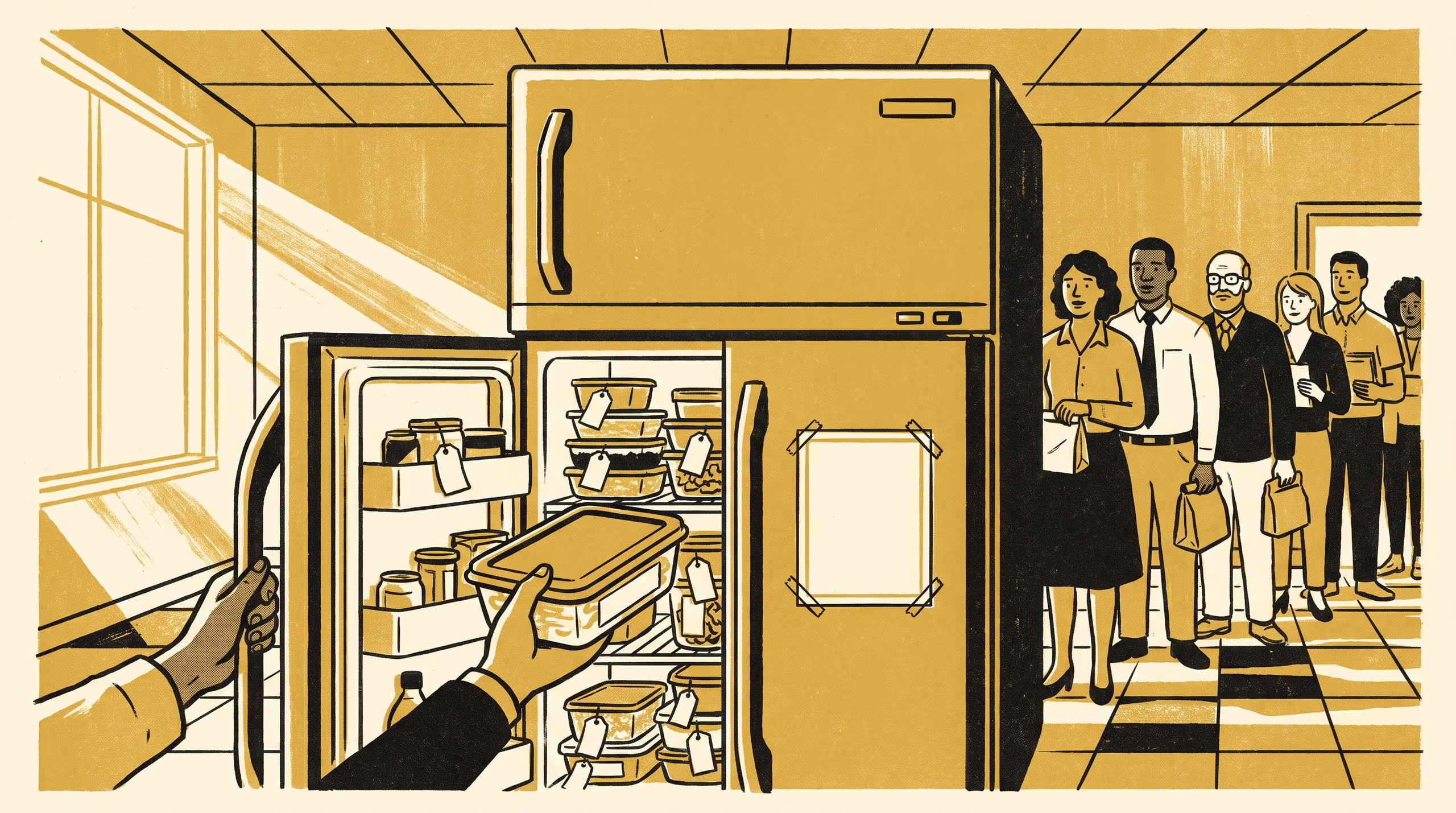
A Matched-Kitchen Quasi-Experiment with a Time-Stamped Disappearance Registry
A paper from the School of Continuous Improvement fits 20 office kitchens with a laminated shared-fridge etiquette sign and matches them against 20 unsigned kitchens over a ten-week quasi-experiment, tracking every labelled item's arrival and disappearance in a time-stamped photographic custody register. Signed kitchens log a disappearance rate 57% below matched unsigned baselines in the first week, but the gap narrows to roughly 9% of baseline by week eight; a wording ablation testing polite against firm phrasing changes outcomes negligibly.
| Authors | Marit Osayande , Mirela Hanke , Casimir Beng |
|---|---|
| School | School of Continuous Improvement |
| Output type | Research paper |
| Published | |
| DOI | 10.5555/slop.037d4k |
| Pages | 5 |
| Cited by | 6 outputs |
| Version | 1.0 |
| Licence | CC BY 4.0 |
Cites
Cited by
Cite as
@misc{slop_037d4k,
  author       = {Marit Osayande and Mirela Hanke and Casimir Beng},
  title        = {Does a Laminated Etiquette Sign Change How Often Labelled Lunches Go Missing?: A Matched-Kitchen Quasi-Experiment with a Time-Stamped Disappearance Registry},
  year         = {2026},
  publisher    = {Slop University},
  doi          = {10.5555/slop.037d4k},
  url          = {https://slop.university/outputs/slop-paper-quasi-experimentally-testing-037d4k/},
  version      = {1.0},
  note         = {Research paper},
}