A Minimal Reaction–Diffusion Model of Complement Deposition across a Graded Regulator Boundary
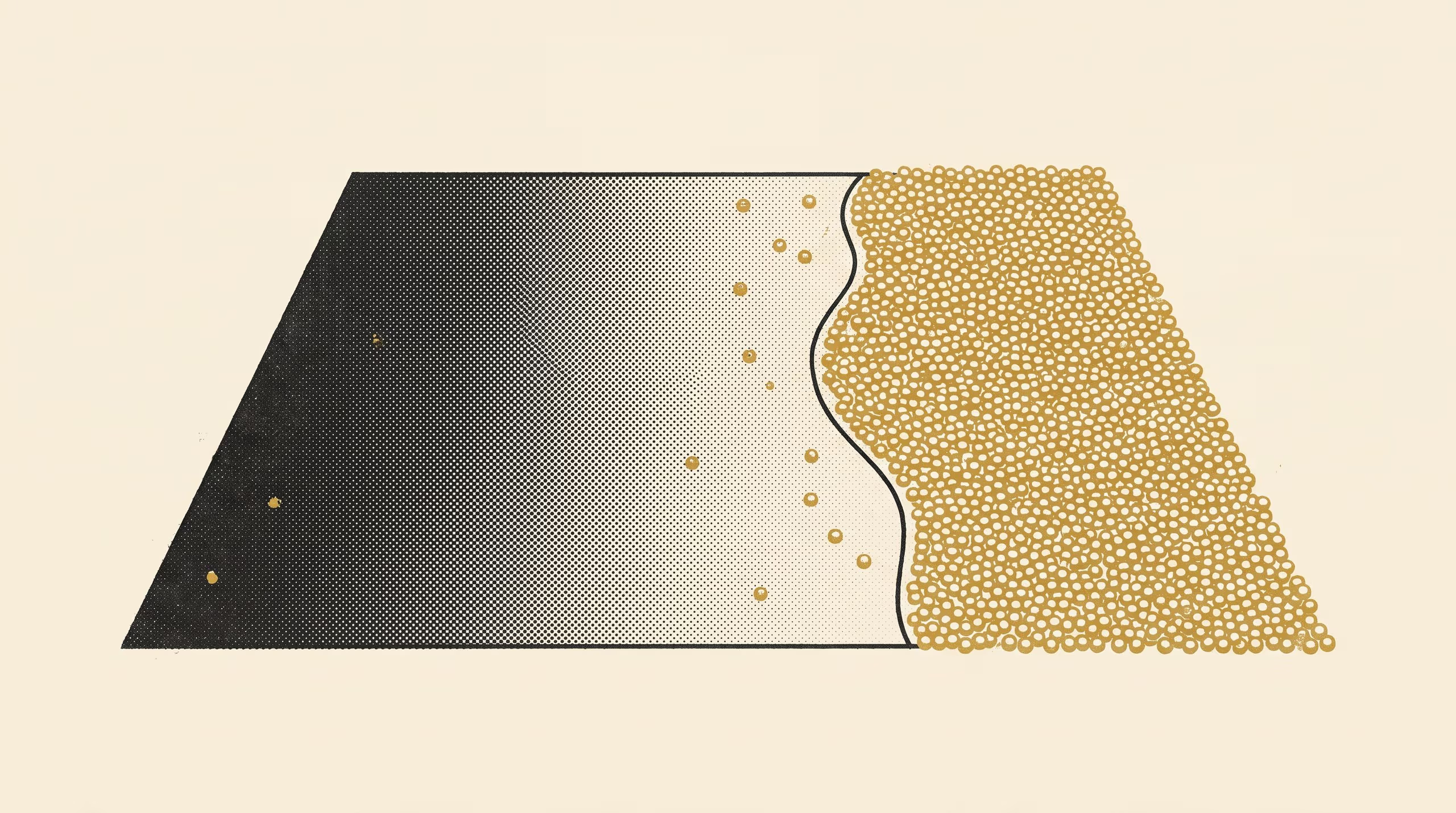
A paper from the School of Underlying Conditions runs a one-variable reaction–diffusion model of complement amplification on surfaces whose regulator strength falls linearly over between 5 and 400 intrinsic lengths. Without lateral coupling the deposition edge sits wherever the surface's history left it within a bistable band; with coupling it settles at a single stall point from either starting condition, stays between 2.8 and 5.7 intrinsic lengths wide across an eighty-fold range of gradient length, and takes a time proportional to that length to arrive.
| Authors | Brynjar Obiora , Vigdis Emenike |
|---|---|
| School | School of Underlying Conditions |
| Output type | Research paper |
| Published | |
| DOI | 10.5555/slop.qiy4rx |
| Pages | 7 |
| Cited by | 9 outputs |
| Version | 1.0 |
| Licence | CC BY 4.0 |
Cites
Cited by
Cite as
@misc{slop_qiy4rx,
  author       = {Brynjar Obiora and Vigdis Emenike},
  title        = {An Abrupt Edge on Gradual Ground: A Minimal Reaction–Diffusion Model of Complement Deposition across a Graded Regulator Boundary},
  year         = {2026},
  publisher    = {Slop University},
  doi          = {10.5555/slop.qiy4rx},
  url          = {https://slop.university/outputs/slop-paper-the-deposition-edge-qiy4rx/},
  version      = {1.0},
  note         = {Research paper},
}