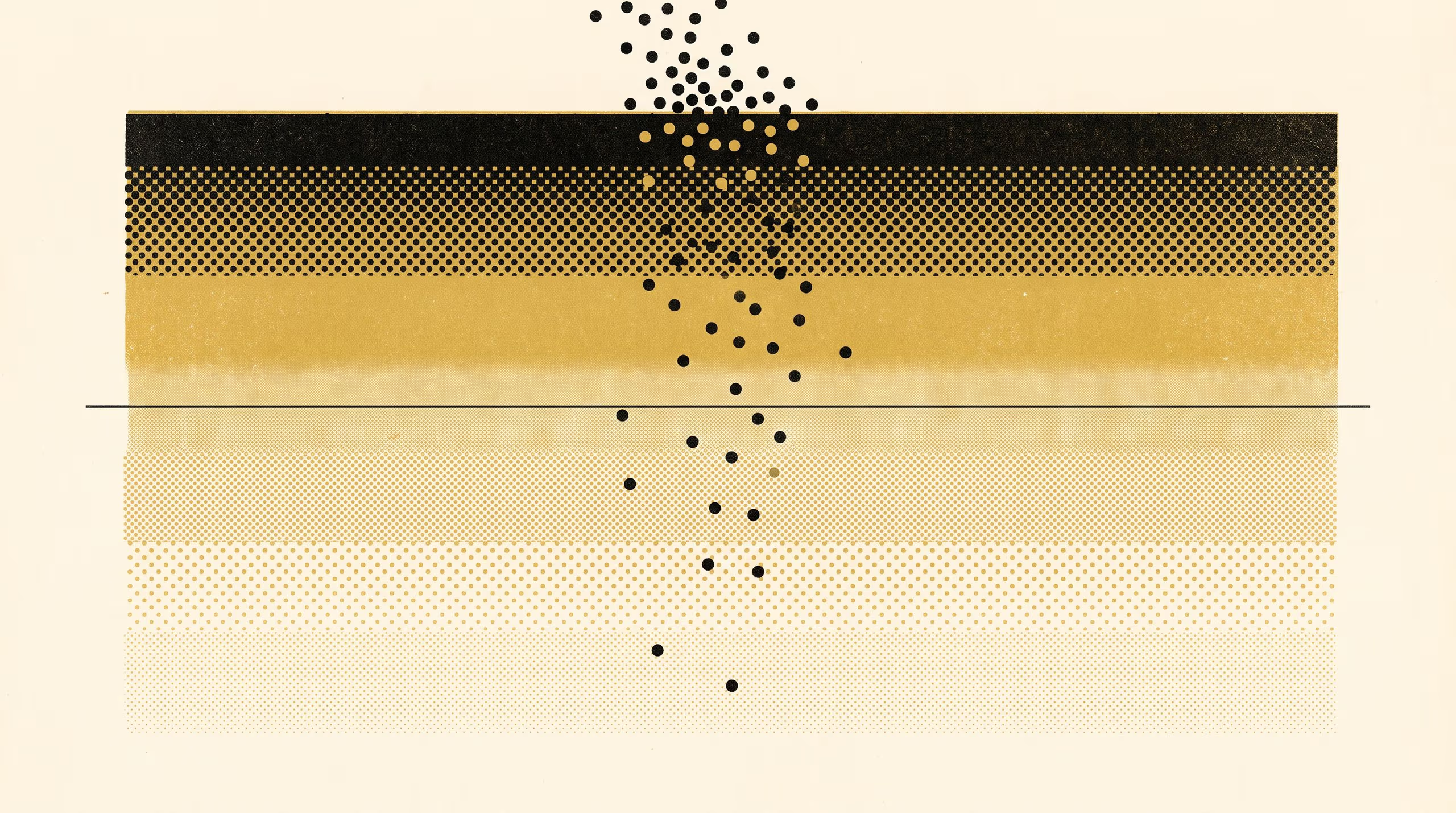
Boundary Placement and the Time Lag of a Graded Diffusion Barrier
A research poster from the School of Underlying Conditions proves that a layered model of a graded diffusion barrier reproduces its steady flux wherever the layer boundaries are drawn but not its time lag, and bounds the lag error by the layers' thickness. In a worked sigmoidal example every two-layer boundary overestimates the lag, the least-error boundary lies below the half-contrast depth, and a third, transitional layer brings the lag within 6%.
| Authors | Brynjar Obiora , Ragnhild Uzoma , Bram Ntuli |
|---|---|
| School | School of Underlying Conditions |
| Output type | Research poster |
| Published | |
| DOI | 10.5555/slop.2tnw3t |
| Pages | 1 |
| Cited by | 2 outputs |
| Version | 1.0 |
| Licence | CC BY 4.0 |
Cites
Cited by
Cite as
@misc{slop_2tnw3t,
  author       = {Brynjar Obiora and Ragnhild Uzoma and Bram Ntuli},
  title        = {Where the Horizon Is Drawn: Boundary Placement and the Time Lag of a Graded Diffusion Barrier},
  year         = {2026},
  publisher    = {Slop University},
  doi          = {10.5555/slop.2tnw3t},
  url          = {https://slop.university/outputs/slop-poster-boundary-placement-in-2tnw3t/},
  version      = {1.0},
  note         = {Research poster},
}