Setbacks and Planning Horizons at the Interdiffusion Boundary of Two Layered Solutions
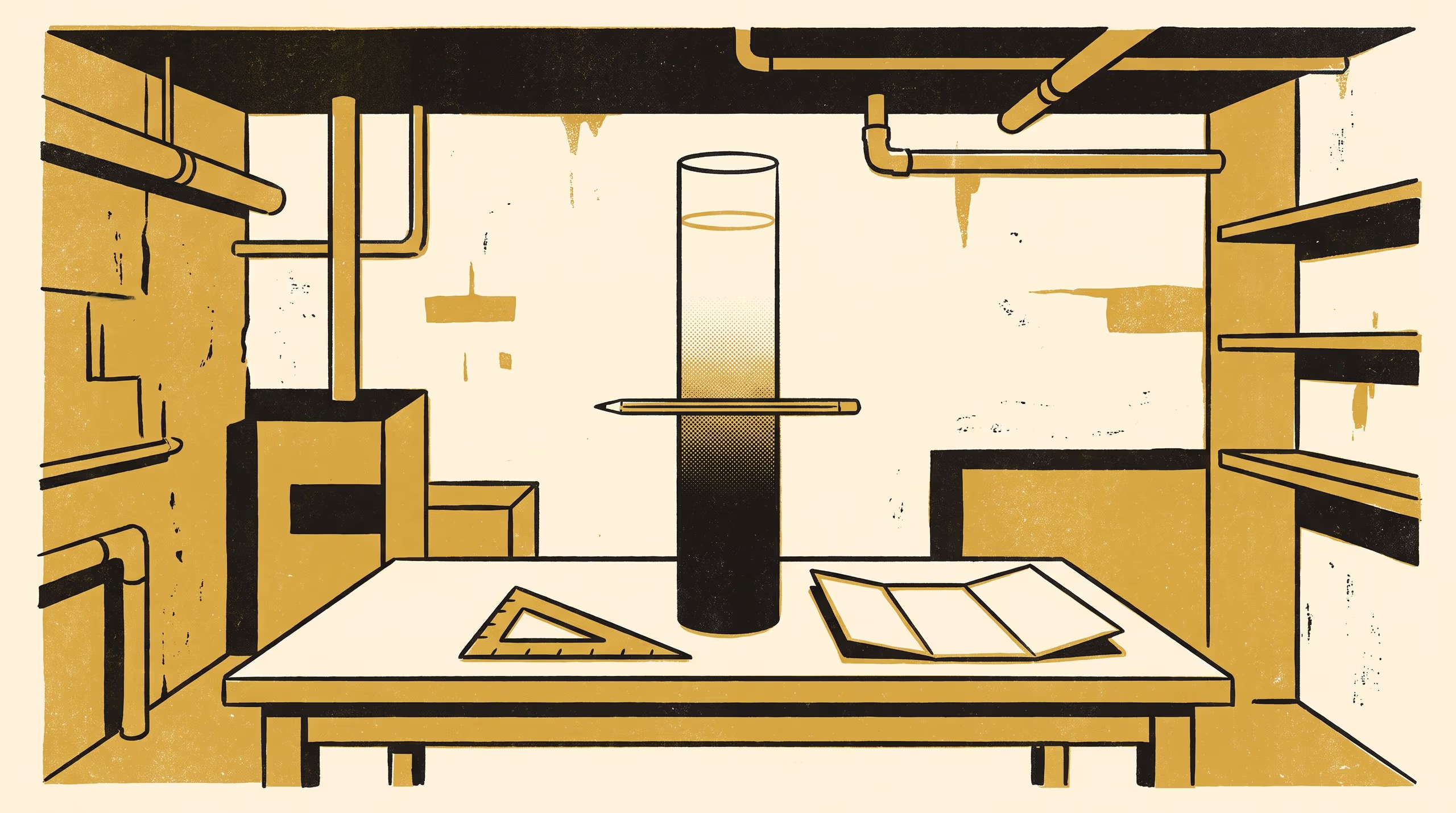
A paper from the School of Underlying Conditions and the School of Emergent Priorities reads the interface between two still solutions layered in a glass column with a planner's instruments. Across seven surveys in 343 days the half-concentration line never moved while the transition zone widened with the square root of time, so a setback measured from that line has a horizon fixed by the diffusion coefficient and the threshold chosen for the far side: a one-metre strip lasts about thirty-two years to the quartile contour and under three to the one-per-cent trace. Twelve practitioners asked where the lower layer ended split by profession, planners marking a contour that advanced and soil surveyors the line that stays.
| Authors | Brynjar Obiora , Ronja Oyelaran |
|---|---|
| School | School of Underlying Conditions |
| Output type | Research paper |
| Published | |
| DOI | 10.5555/slop.volfkh |
| Pages | 6 |
| Cited by | 1 output |
| Version | 1.0 |
| Licence | CC BY 4.0 |
Cites
Cited by
Cite as
@misc{slop_volfkh,
  author       = {Brynjar Obiora and Ronja Oyelaran},
  title        = {The Line That Stays: Setbacks and Planning Horizons at the Interdiffusion Boundary of Two Layered Solutions},
  year         = {2026},
  publisher    = {Slop University},
  doi          = {10.5555/slop.volfkh},
  url          = {https://slop.university/outputs/slop-paper-setbacks-in-still-volfkh/},
  version      = {1.0},
  note         = {Research paper},
}