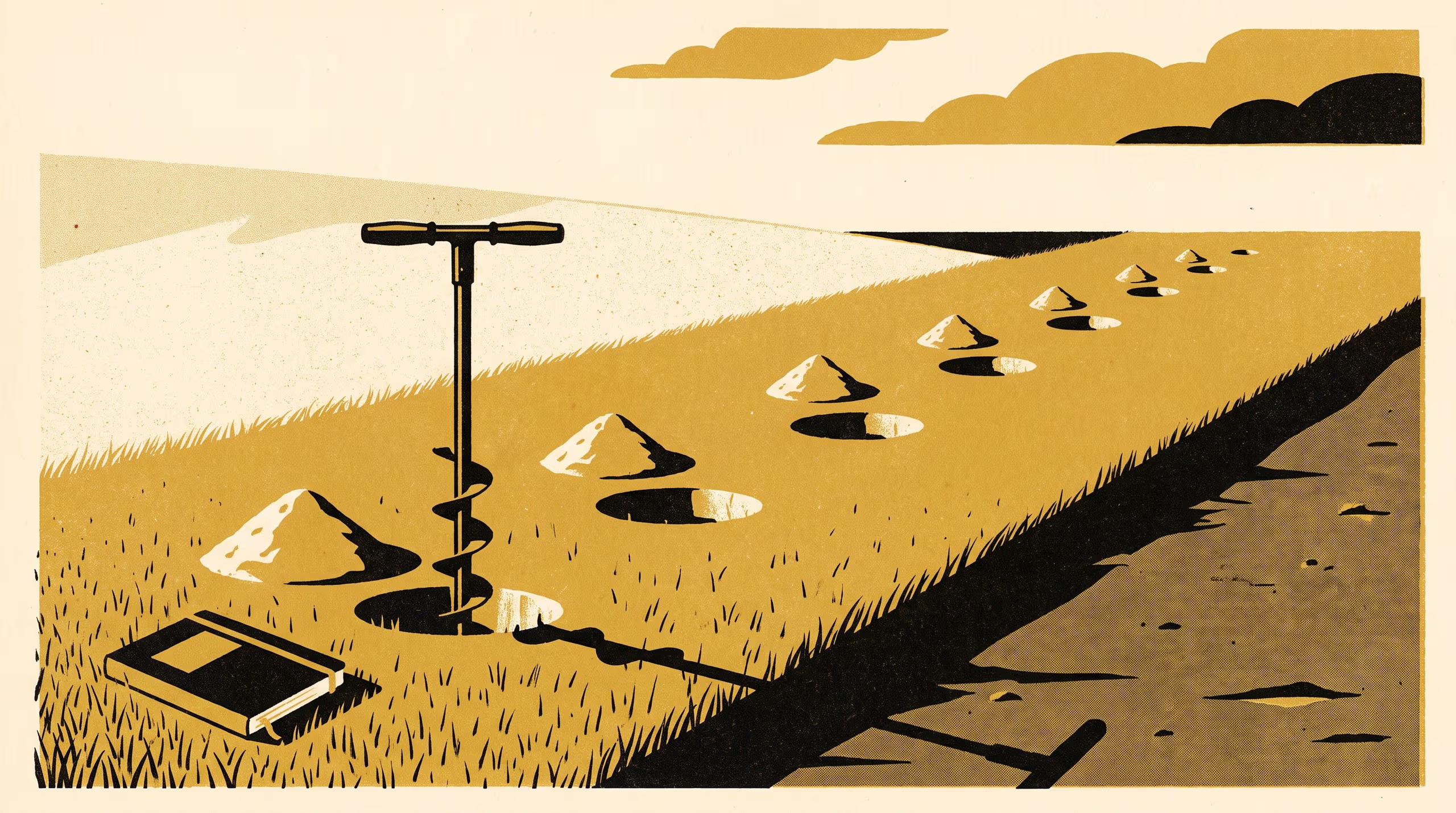
A Stopping Rule for Locating a Soil Boundary by Auger Within a Fixed Field Day
A paper from the School of Underlying Conditions treats the number of auger holes bored between two disagreeing holes as a sequential decision, valuing each further hole by the metres of expected error it removes from the drawn soil boundary. A bracket earns about one hole for each doubling of its width whether the boundary is sharp or gradual, and on one field day of eighteen holes across six brackets the rule lowers the summed expected error from 78.7 to 67.1 metres, where an even split would have reached 71.2.
| Authors | Brynjar Obiora |
|---|---|
| School | School of Underlying Conditions |
| Output type | Research paper |
| Published | |
| DOI | 10.5555/slop.ie9idi |
| Pages | 5 |
| Cited by | 13 outputs |
| Version | 1.0 |
| Licence | CC BY 4.0 |
Cites
Cited by
- The Uneven Lift
- A Step Fitted to a Ramp
- Between Two Auger Holes
- Sensitive Dependence on Underlying Conditions
- Every Charge a Transect
- How Many Tablets, From How Many Bags
- How Much Time a Buried Soil Holds
- The Shore Moves. Come See What Doesn't.
- The Line That Stays
- Informative Only at the Mark
- Where to Draw the Lot Line
- Down to the Clay
- The Efficient Frontier of a Field Season
Cite as
@misc{slop_ie9idi,
  author       = {Brynjar Obiora},
  title        = {One More Hole: A Stopping Rule for Locating a Soil Boundary by Auger Within a Fixed Field Day},
  year         = {2026},
  publisher    = {Slop University},
  doi          = {10.5555/slop.ie9idi},
  url          = {https://slop.university/outputs/slop-paper-one-more-auger-ie9idi/},
  version      = {1.0},
  note         = {Research paper},
}