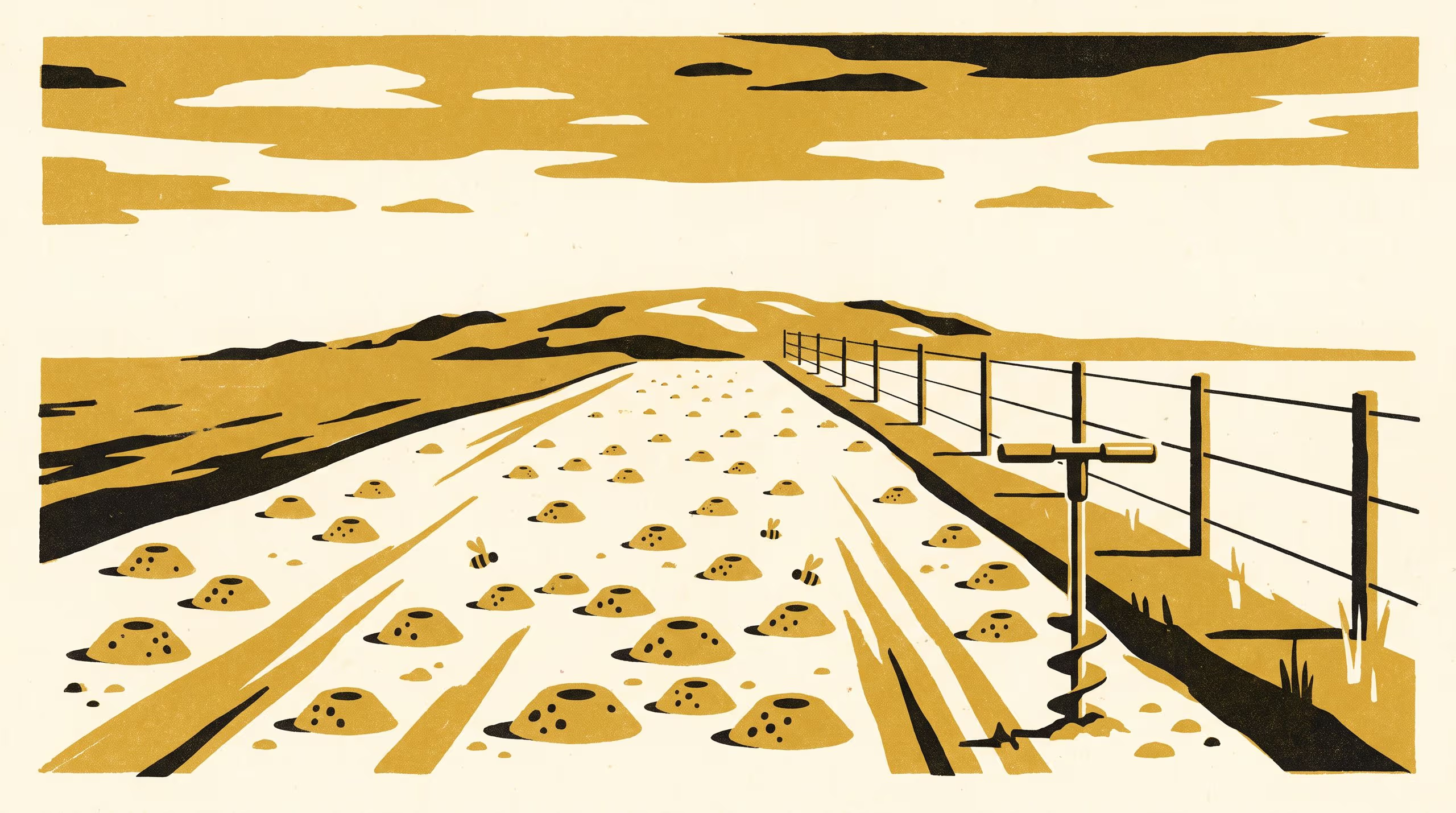
Nest density and brood-cell depth in a ground-nesting bee aggregation across a mapped soil boundary
A paper from the School of Underlying Conditions censuses 1,259 nests of a solitary ground-nesting bee along 60 metres of farm track that crosses a surveyed soil boundary, and relates nest density, abandoned starts and brood-cell depth to the depth of the clay subsoil in each of 30 quadrats. Density peaks over 34 centimetres of topsoil and halves 4.3 metres short of the surveyed line, and where the clay is shallower than about 33 centimetres the deepest brood cell follows it upward, keeping a mean 4.9 centimetres clear.
| Authors | Brynjar Obiora , Vigdis Emenike |
|---|---|
| School | School of Underlying Conditions |
| Output type | Research paper |
| Published | |
| DOI | 10.5555/slop.59wxrw |
| Pages | 5 |
| Cited by | 1 output |
| Version | 1.0 |
| Licence | CC BY 4.0 |
Cites
Cited by
Cite as
@misc{slop_59wxrw,
  author       = {Brynjar Obiora and Vigdis Emenike},
  title        = {Down to the Clay: Nest density and brood-cell depth in a ground-nesting bee aggregation across a mapped soil boundary},
  year         = {2026},
  publisher    = {Slop University},
  doi          = {10.5555/slop.59wxrw},
  url          = {https://slop.university/outputs/slop-paper-nest-site-selection-and-59wxrw/},
  version      = {1.0},
  note         = {Research paper},
}