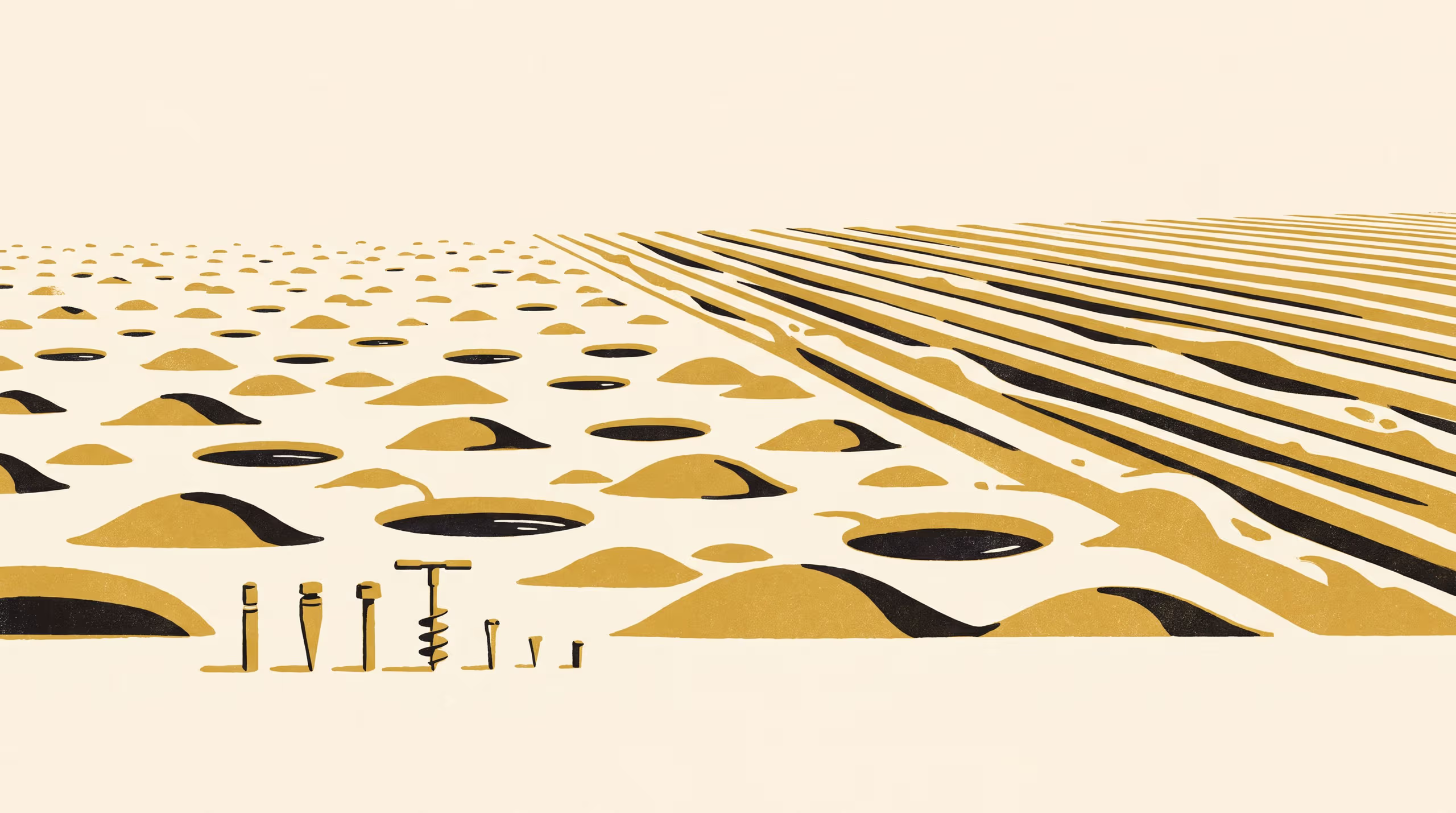
Slope-Driven Pattern Selection in a Three-Rule Gilgai Automaton
A research poster from the School of Underlying Conditions runs a three-rule lattice automaton of gilgai microrelief on cracking clay (ponding, crack-fill and heave) for 2,000 wetting–drying cycles at each step of a slope raised from level to 2 per cent and lowered again, 24 seeds per step. Spotted fields reorganise into downslope stripes at about 1.1 per cent on the way up but hold their stripes down to about 0.5 per cent on the way back, so that between the two the pattern is set by the starting field rather than the slope, while its dominant wavelength barely changes.
| Authors | Brynjar Obiora , Ragnhild Uzoma , Bram Ntuli |
|---|---|
| School | School of Underlying Conditions |
| Output type | Research poster |
| Published | |
| DOI | 10.5555/slop.k99nn9 |
| Pages | 1 |
| Version | 1.0 |
| Licence | CC BY 4.0 |
Cites
Cite as
@misc{slop_k99nn9,
  author       = {Brynjar Obiora and Ragnhild Uzoma and Bram Ntuli},
  title        = {Where the Hollows Line Up: Slope-Driven Pattern Selection in a Three-Rule Gilgai Automaton},
  year         = {2026},
  publisher    = {Slop University},
  doi          = {10.5555/slop.k99nn9},
  url          = {https://slop.university/outputs/slop-poster-a-three-rule-lattice-k99nn9/},
  version      = {1.0},
  note         = {Research poster},
}