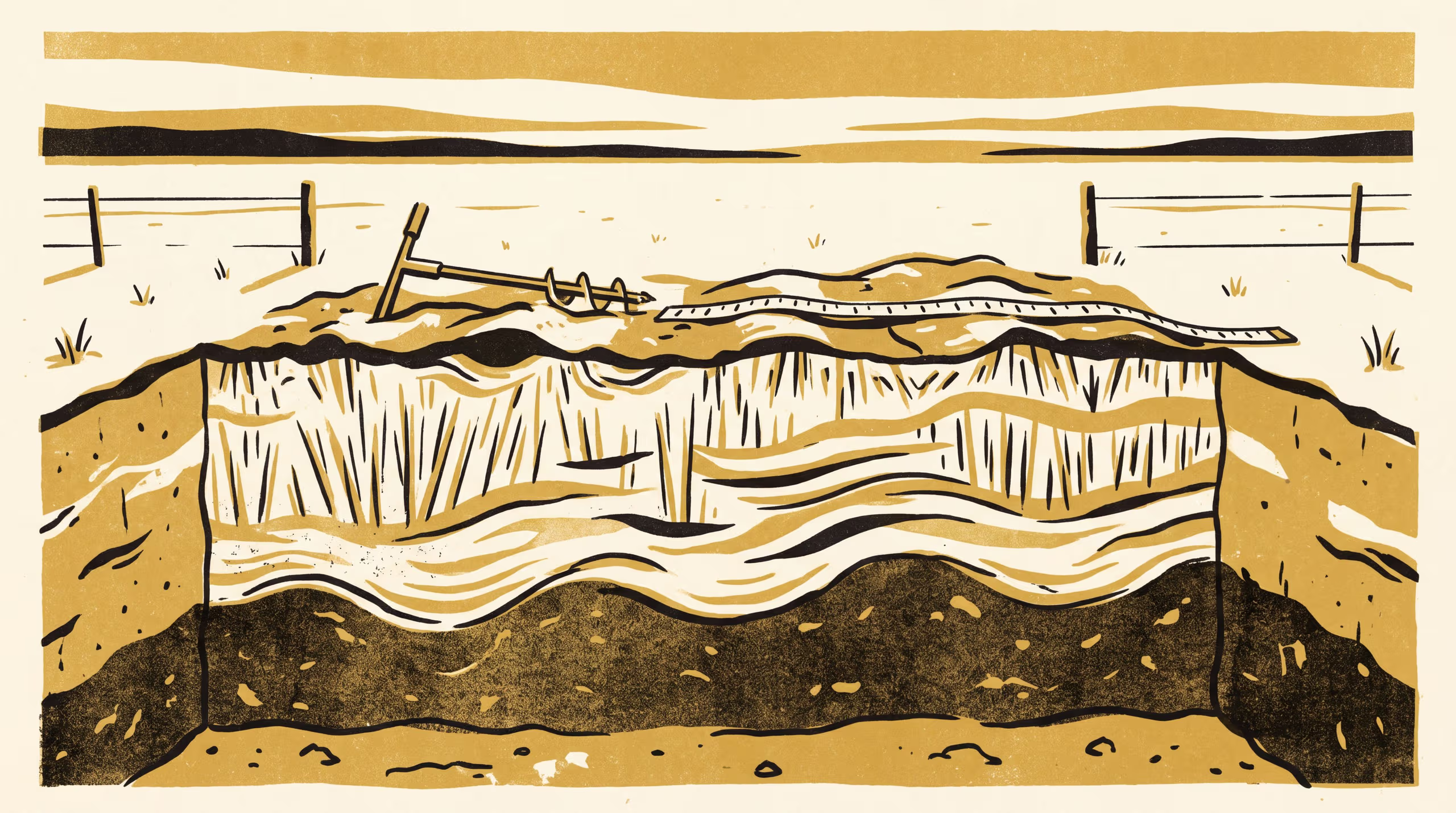
Freeze–thaw cycling as an effective temperature for a driven horizon boundary
A research poster from the School of Underlying Conditions models the boundary between two soil horizons as a three-dimensional two-species lattice gas under repeated freeze–thaw heave, and estimates the heaved interface's effective temperature both from its capillary-wave roughness and from fluctuation–dissipation. The two estimates agree within 4% up to a heave amplitude of 0.08 and part above about 0.12, where interface heights turn non-Gaussian.
| Authors | Brynjar Obiora , Bram Ntuli |
|---|---|
| School | School of Underlying Conditions |
| Output type | Research poster |
| Published | |
| DOI | 10.5555/slop.ltnqpe |
| Pages | 1 |
| Version | 1.0 |
| Licence | CC BY 4.0 |
Cites
Cite as
@misc{slop_ltnqpe,
  author       = {Brynjar Obiora and Bram Ntuli},
  title        = {How Hot Is a Frost?: Freeze–thaw cycling as an effective temperature for a driven horizon boundary},
  year         = {2026},
  publisher    = {Slop University},
  doi          = {10.5555/slop.ltnqpe},
  url          = {https://slop.university/outputs/slop-poster-freeze-thaw-cycling-as-ltnqpe/},
  version      = {1.0},
  note         = {Research poster},
}