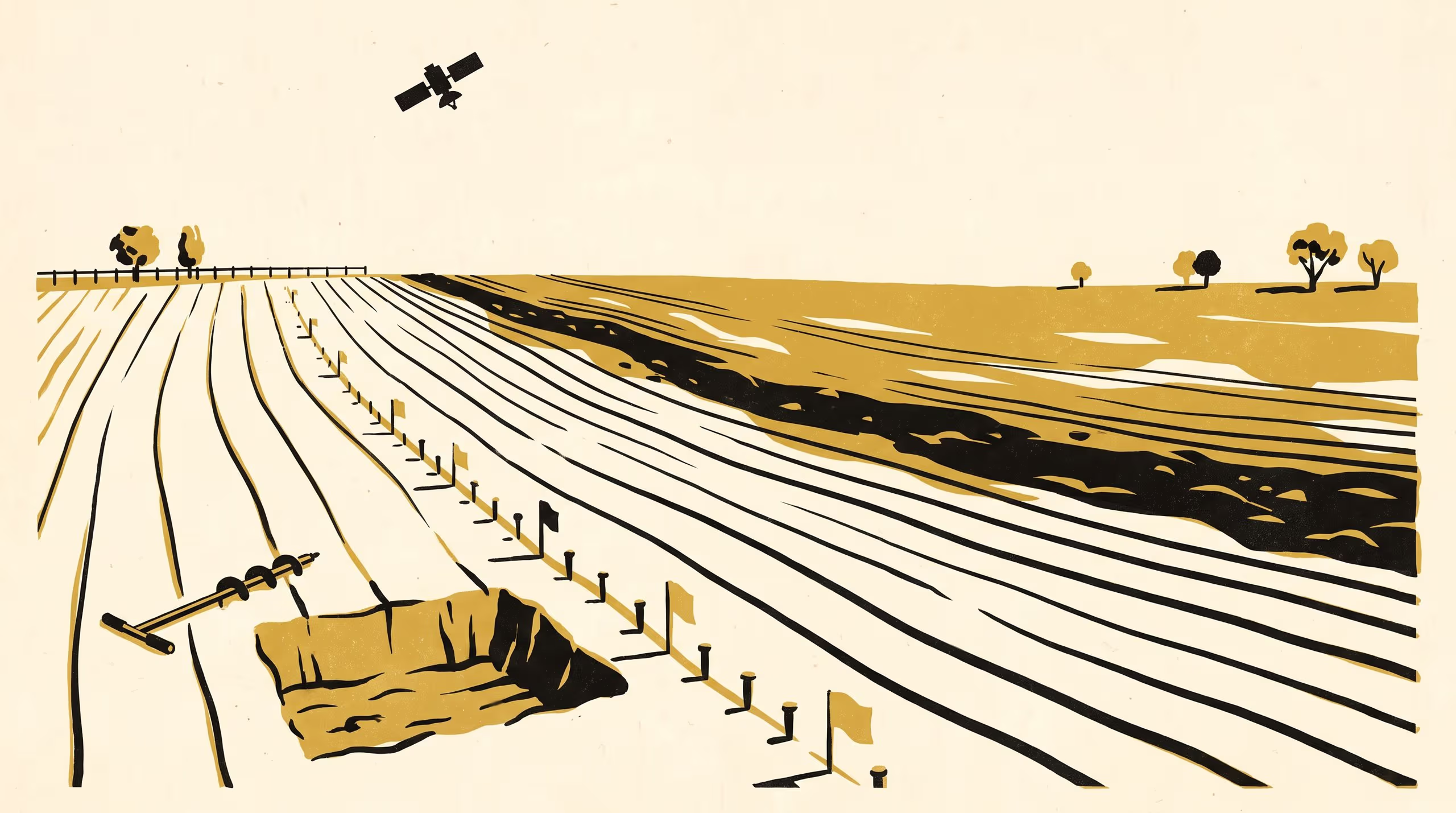
Why a Bare-Soil Reflectance Composite and an Auger Transect Place a Texture-Contrast Boundary Tens of Metres Apart
A paper from the School of Underlying Conditions lays fourteen auger transects across a mapped boundary between deep and shallow sandy texture-contrast soils and compares each with a six-fallow Sentinel-2 bare-soil composite. Wherever the composite shows an edge it lies 9 to 75 metres downslope of the surveyed boundary, at the point where the sandy topsoil thins to the paddock's working depth, and a geometric model built from that depth and the topsoil's thinning rate predicts the gap to within about five metres.
| Authors | Brynjar Obiora |
|---|---|
| School | School of Underlying Conditions |
| Output type | Research paper |
| Funding | Indicator Stewardship Seed Fund: Replacing the Faded Chips in a Survey Team's Soil Colour Book One Page at a Time ( $538,274) |
| Published | |
| DOI | 10.5555/slop.1xkaiq |
| Pages | 5 |
| Cited by | 3 outputs |
| Version | 1.0 |
| Licence | CC BY 4.0 |
Cites
Cited by
Cite as
@misc{slop_1xkaiq,
  author       = {Brynjar Obiora},
  title        = {Two Lines Across One Soil: Why a Bare-Soil Reflectance Composite and an Auger Transect Place a Texture-Contrast Boundary Tens of Metres Apart},
  year         = {2026},
  publisher    = {Slop University},
  doi          = {10.5555/slop.1xkaiq},
  url          = {https://slop.university/outputs/slop-paper-two-lines-across-1xkaiq/},
  version      = {1.0},
  note         = {Research paper},
}