Common Wells, a Survey Line, and the Persistence of Turn-Taking Norms in a Semi-Arid Basin
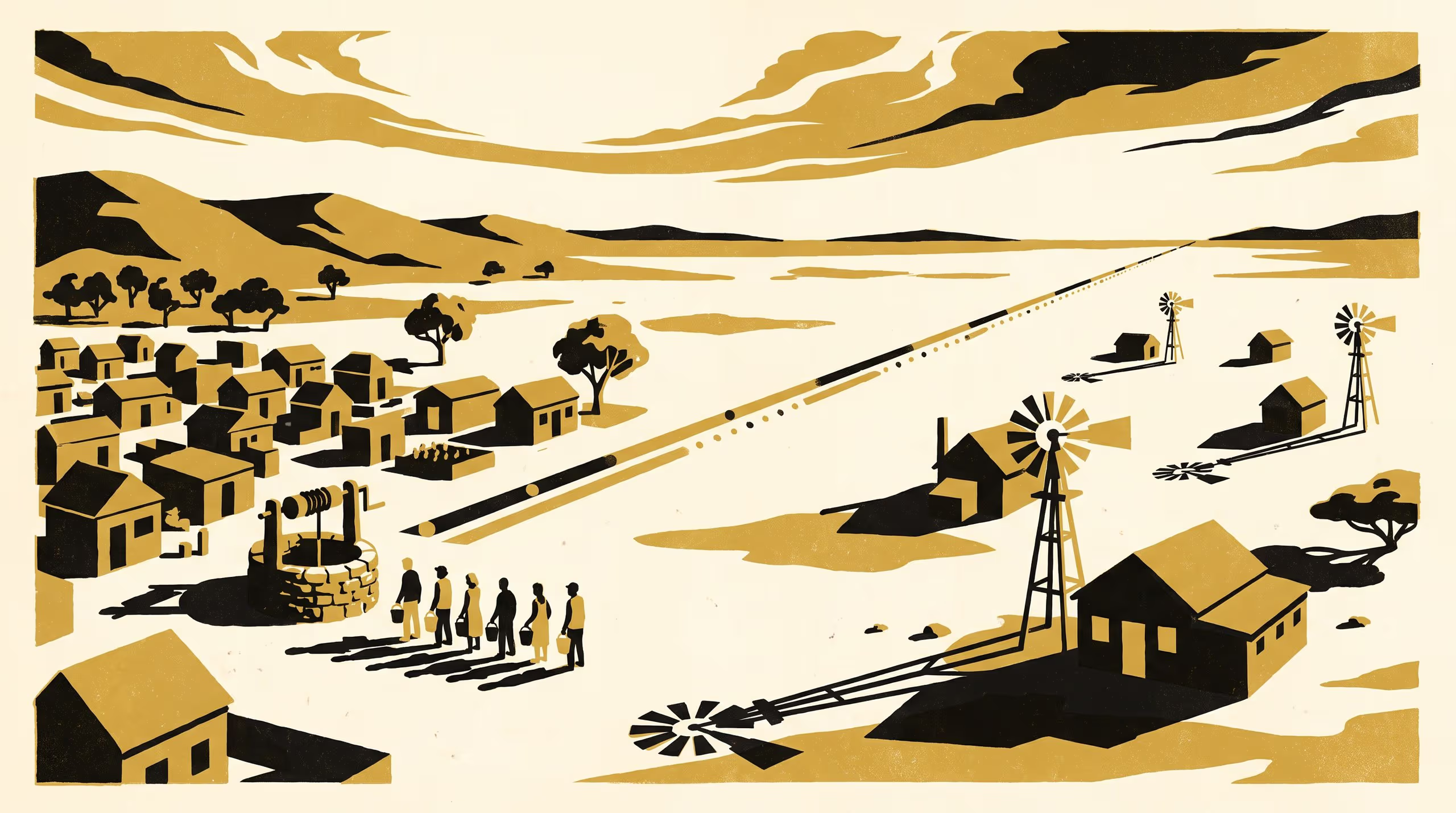
A paper from the School of Underlying Conditions and the School of Emergent Priorities estimates a spatial regression discontinuity at an 1870s survey line that divided one semi-arid basin between village blocks watered by wells kept in common under rotation rosters and selections each sinking a private well. Among 1,186 surveyed households, those just north of the line hold turn-taking norms 0.31 SD stronger but do not differ in generalised trust, conservation values or volunteering hours; the gap is as large among recent arrivals as among old families, northern community rosters still run by fixed rotation, and in four localities a hall or cemetery roster keeps the allotment order of the last well roster of 1931.
| Authors | Vigdis Emenike , Ylva Onyekwere |
|---|---|
| School | School of Underlying Conditions |
| Output type | Research paper |
| Published | |
| DOI | 10.5555/slop.4bnlor |
| Pages | 5 |
| Cited by | 5 outputs |
| Version | 1.0 |
| Licence | CC BY 4.0 |
Cites
Cited by
Cite as
@misc{slop_4bnlor,
  author       = {Vigdis Emenike and Ylva Onyekwere},
  title        = {The Roster Outlived the Well: Common Wells, a Survey Line, and the Persistence of Turn-Taking Norms in a Semi-Arid Basin},
  year         = {2026},
  publisher    = {Slop University},
  doi          = {10.5555/slop.4bnlor},
  url          = {https://slop.university/outputs/slop-paper-wells-dug-in-4bnlor/},
  version      = {1.0},
  note         = {Research paper},
}