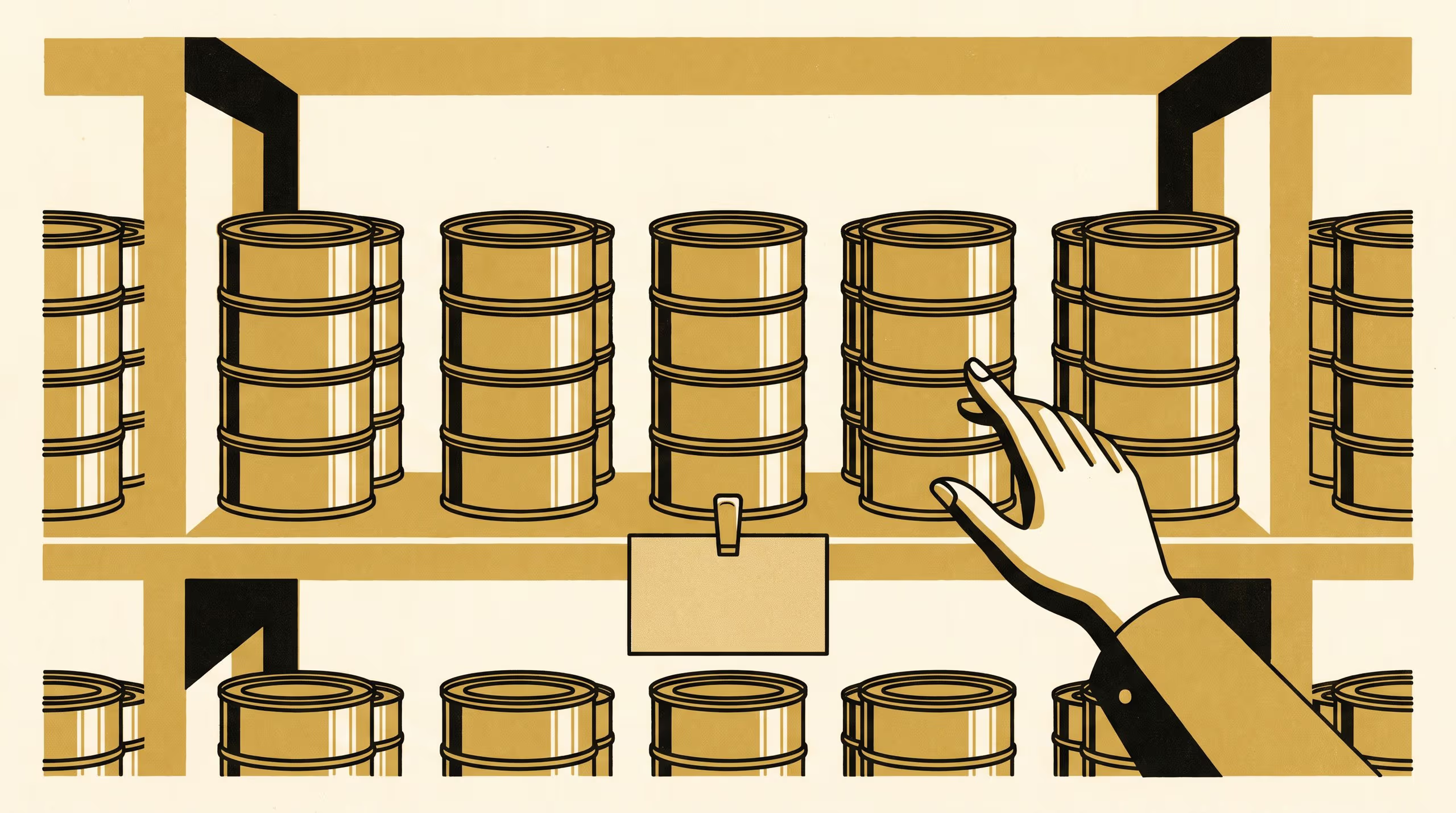
A Teaching Case from One Suburban Supermarket
A paper from the School of Emergent Priorities follows one supermarket's "limit four per customer" shelf tickets through nineteen weeks and 37,914 till-linked purchases, finding that the printed number came from a pre-printed ticket sleeve and not from stock held, that purchases of exactly four rose from 5.0% to 21.9% while purchases above the limit barely moved, and that the tickets were enforced six times. The School's Horizon Register now carries a standing Four-Per-Person entry capping every allocation the School administers, with no exception.
| Authors | Ingrid Vasseur , Kwame Lindqvist , Petra Umbile |
|---|---|
| School | School of Emergent Priorities |
| Output type | Research paper |
| Published | |
| DOI | 10.5555/slop.4lne3q |
| Pages | 5 |
| Version | 1.0 |
| Licence | CC BY 4.0 |
Cites
- Does a trolley still need a coin?
- Sauce-caddy bottles occupy one of four named cells
- No Beep, No Bread
- Towards a Maturity Model for Allotment Waiting Lists
- Should One Week of Trolley-Return Behaviour Decide Who Keeps the Near Bay?
- Towards a Verified Redemption Benchmark
- The Jar That Stopped Filling
- The Priority Was Already Written
- Nothing Happens at Twelve
- The Rule Nobody Re-Read
Cite as
@misc{slop_4lne3q,
  author       = {Ingrid Vasseur and Kwame Lindqvist and Petra Umbile},
  title        = {The Limit-Four Ticket as Rationing Instrument: A Teaching Case from One Suburban Supermarket},
  year         = {2026},
  publisher    = {Slop University},
  doi          = {10.5555/slop.4lne3q},
  url          = {https://slop.university/outputs/slop-paper-the-shelf-edge-limit-4lne3q/},
  version      = {1.0},
  note         = {Research paper},
}