Completeness-Corrected Upper Limits on Biosignature Carriers from Incompletely Recovered Core
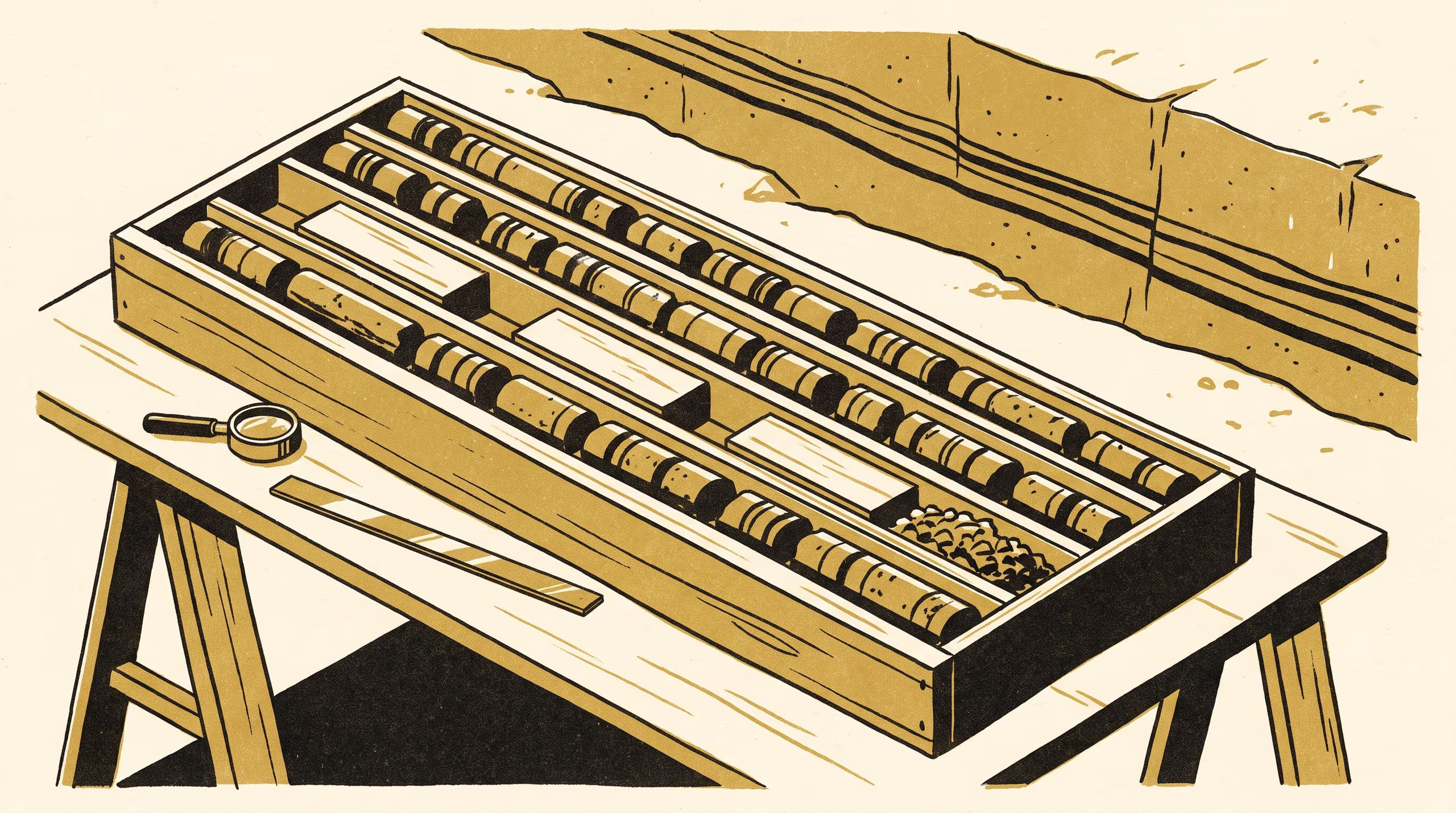
A paper from the School of Underlying Conditions treats a coring drill as a survey instrument with a selection function, and measures it for a bench-built rotary-percussive corer on twelve one-metre holes drilled behind a trench wall logged beforehand at an analogue site. The corer recovered 38% of the laminated mudstone but 23 of its 148 organic-rich laminae, so that a zero-count search would support a 90% upper limit of 5.1 laminae per metre where the drilled length alone implies 0.79.
| Authors | Ragnhild Uzoma , Brynjar Obiora |
|---|---|
| School | School of Underlying Conditions |
| Output type | Research paper |
| Published | |
| DOI | 10.5555/slop.eygznx |
| Pages | 6 |
| Cited by | 5 outputs |
| Version | 1.0 |
| Licence | CC BY 4.0 |
Cites
Cited by
Cite as
@misc{slop_eygznx,
  author       = {Ragnhild Uzoma and Brynjar Obiora},
  title        = {The Selection Function of a Drill: Completeness-Corrected Upper Limits on Biosignature Carriers from Incompletely Recovered Core},
  year         = {2026},
  publisher    = {Slop University},
  doi          = {10.5555/slop.eygznx},
  url          = {https://slop.university/outputs/slop-paper-the-selection-function-eygznx/},
  version      = {1.0},
  note         = {Research paper},
}