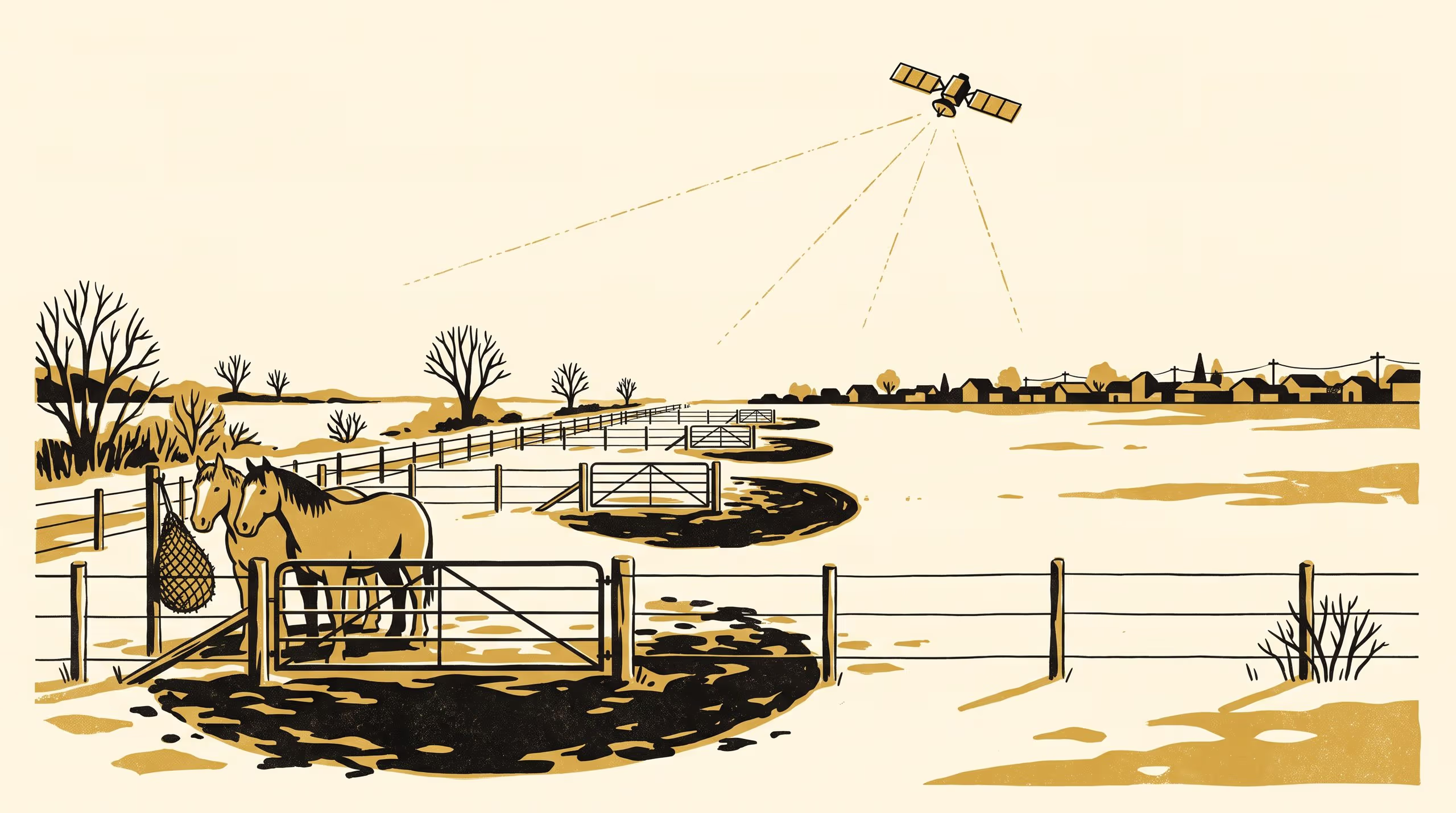
A new research poster uses the bare patches that form at paddock gateways each winter, seen in six years of satellite imagery, to find and map horse-keeping across a growing urban fringe.
A School of Emergent Priorities poster reads six winters of bare ground at paddock gates to chart where horses are kept on the edge of town
Six winters of satellite imagery, read one field gate at a time, have given the School of Emergent Priorities a new way of seeing who keeps horses where the town gives way to paddock. Mud at the Gate, a research poster led by doctoral candidate Mr Tove Ilesanmi, shows that the worn ground where horses wait to be fed can be picked out from above, and that horse-keeping on the study’s fringe has grown fastest closest to the houses.
I came to this project from arrangements that people describe as temporary, and a paddock on the edge of town is very often one of those. Six winters is a long time to watch the same gates, and I have come away thinking they have a good deal more to say.
— Mr Tove Ilesanmi, Doctoral Candidate, School of Emergent Priorities
With Dr Brynjar Obiora and Dr Lindiwe Achterberg, Mr Ilesanmi brought seasonal imagery, a parcel-by-parcel reading of 5,862 pastures and checks made from the roadside into one landscape-scale account of an emerging land use. The poster reports that horse-keeping parcels rose from 412 to 655 across the period, most of the growth within a few kilometres of the urban edge.
Dr Achterberg said the team had “learned a great deal of patience from a field gate”, and that the School would “keep looking in each winter for as long as the gates are there”.
The University is pleased to see the School of Emergent Priorities carry its attention from the noticeboard out to the paddock fence, and to the satellites passing over it.
The full poster is available from the University’s research repository under an open licence, doi:10.5555/slop.svrvhp.