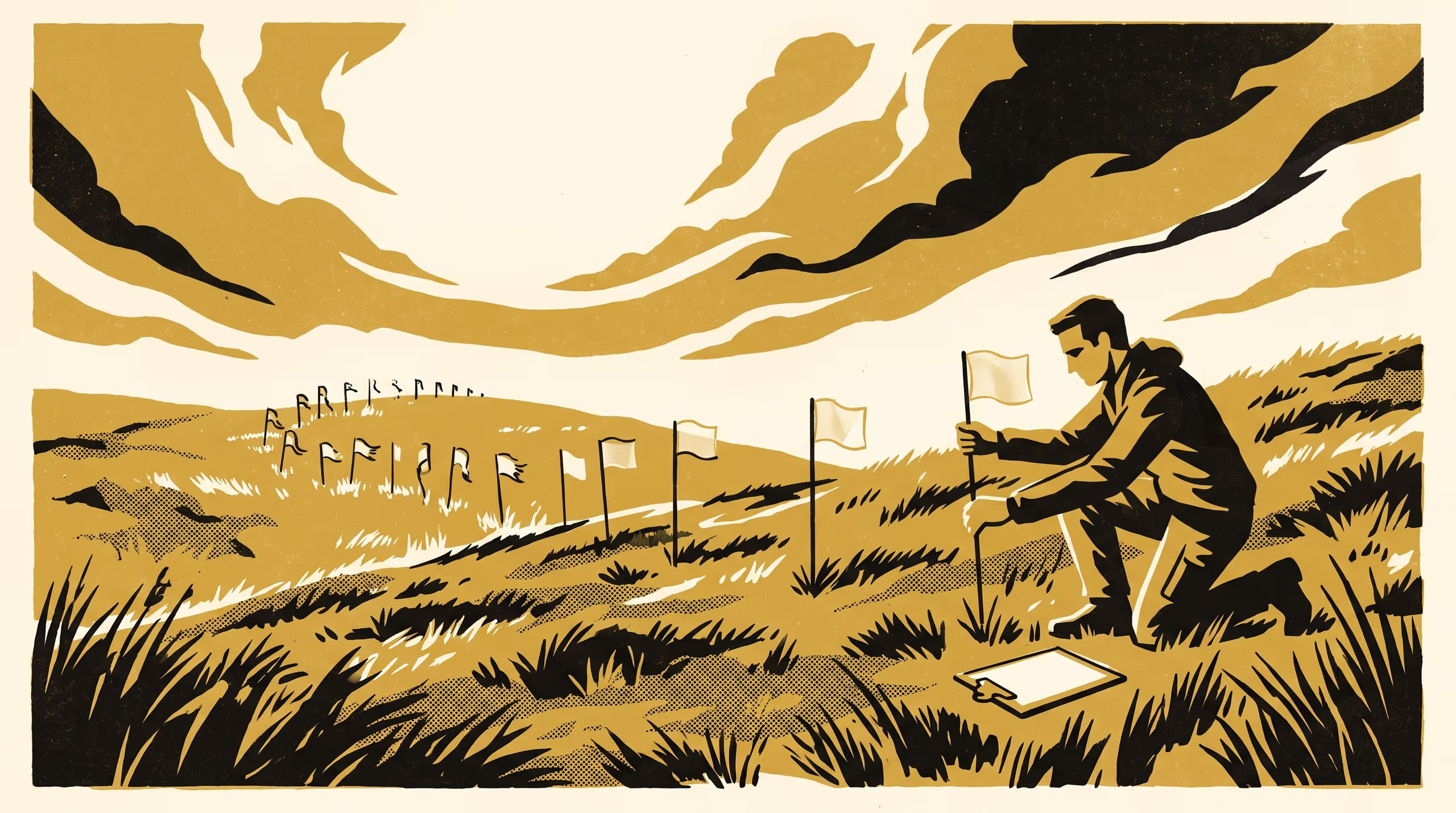
A new paper reports a sixteen-week field deployment of survey flags made from dissolving silk film, in which nine mappers came to use the silk for provisional boundaries and plastic for confirmed ones, carrying the field map's distinction between observed and inferred lines out onto the ground.
A season-long design study gives mappers a silk survey flag built to dissolve, and finds them keeping it for the boundaries they are not yet sure of
Two of the University’s schools have pooled their field practice and their design methods in The Flag Became the Dash, a new paper by Associate Professor Ragnhild Uzoma, Lead of the Basement Relations Group, and Dr Brynjar Obiora, Senior Research Fellow, both of the School of Underlying Conditions, with Eskil Nwabueze, Doctoral Candidate in the School of Continuous Improvement.
The team developed a survey flag whose pennant is a thin film of silk, prepared to soften and dissolve over a mapping season, and placed it in the hands of nine field mappers for sixteen weeks alongside their usual plastic stock. Across 517 flags, the mappers reserved the silk for boundaries still in question and the plastic for those they had confirmed, and their written notes on each material diverged accordingly.
Most of us have left a line of flags on a hillside and wondered about it on the drive home. It is good to have spent a season wondering about it properly, and in company.
— Associate Professor Ragnhild Uzoma, Lead, Basement Relations Group, School of Underlying Conditions
The paper situates material transience within a broader conversation about provisional knowledge, translating a fieldwork habit into an interaction-design framework that the authors expect to inform future approaches to marking, recording and revisiting the ground. The University regards the study as a fine example of what becomes possible when a school’s instruments are handed to another school’s questions. “The mappers were far ahead of us from the first week,” said Nwabueze, “and the most useful thing we did was keep notes.”
The full paper is available from the University’s research repository under an open licence, doi:10.5555/slop.ms4c4l.