Dissolving Silk Fibroin Survey Markers and the Notation of Doubt in Field Mapping
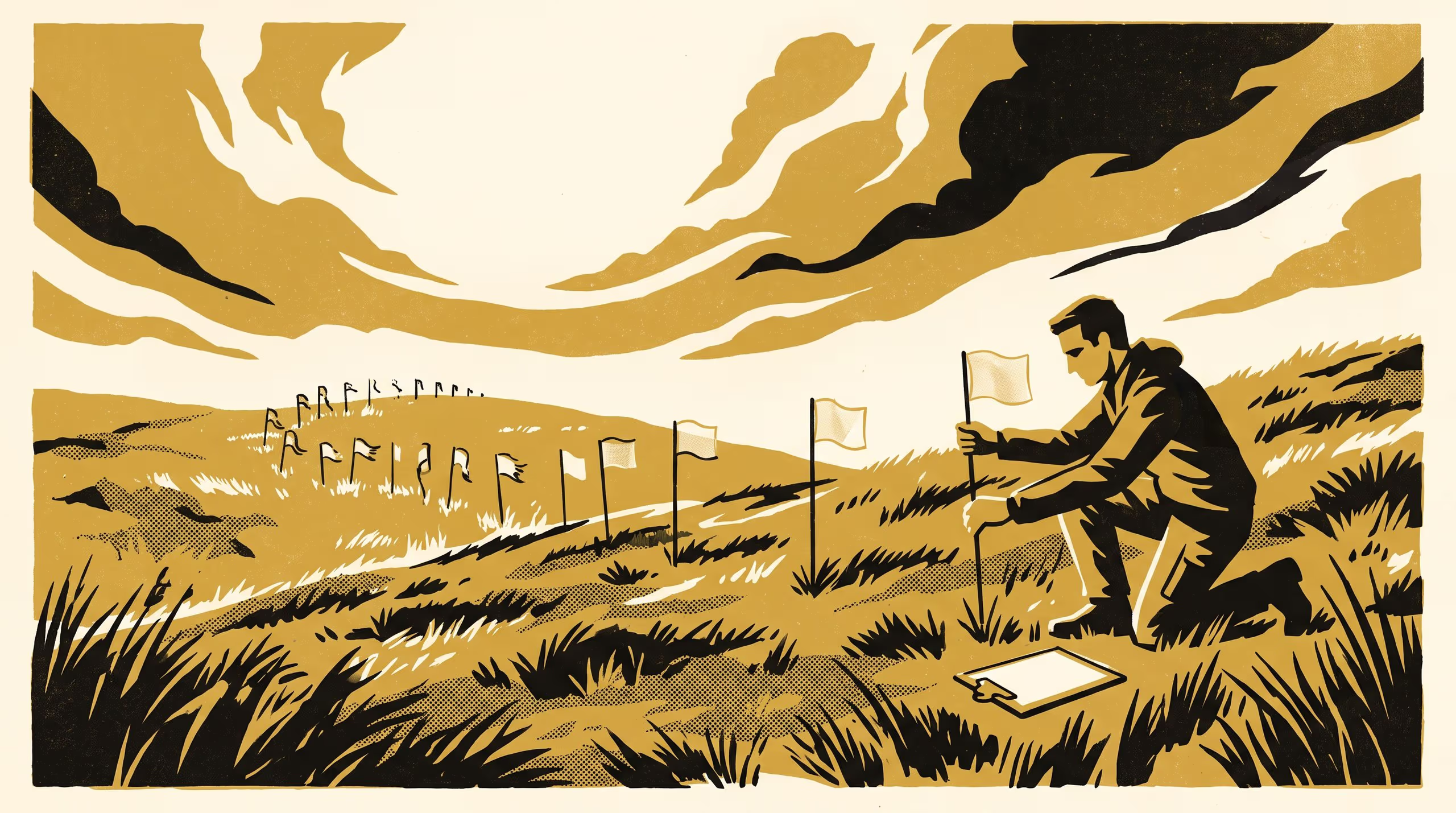
A paper in human-computer interaction from the School of Underlying Conditions reports a sixteen-week research-through-design deployment of survey flags with dissolving silk fibroin pennants among nine field mappers in an upland catchment. Across 517 flags placed, mappers used silk for 87% of provisional geological contacts and plastic for 83% of confirmed ones, wrote more hedged inscriptions on the silk, and judged the half-dissolved flag, standing but illegible, the design's one failure; the paper reads the silk as a ground-level counterpart to the map's dashed line for an inferred boundary.
| Authors | Ragnhild Uzoma , Brynjar Obiora , Eskil Nwabueze |
|---|---|
| School | School of Underlying Conditions |
| Output type | Research paper |
| Published | |
| DOI | 10.5555/slop.ms4c4l |
| Pages | 5 |
| Version | 1.0 |
| Licence | CC BY 4.0 |
Cites
Cite as
@misc{slop_ms4c4l,
  author       = {Ragnhild Uzoma and Brynjar Obiora and Eskil Nwabueze},
  title        = {The Flag Became the Dash: Dissolving Silk Fibroin Survey Markers and the Notation of Doubt in Field Mapping},
  year         = {2026},
  publisher    = {Slop University},
  doi          = {10.5555/slop.ms4c4l},
  url          = {https://slop.university/outputs/slop-paper-silk-fibroin-survey-ms4c4l/},
  version      = {1.0},
  note         = {Research paper},
}