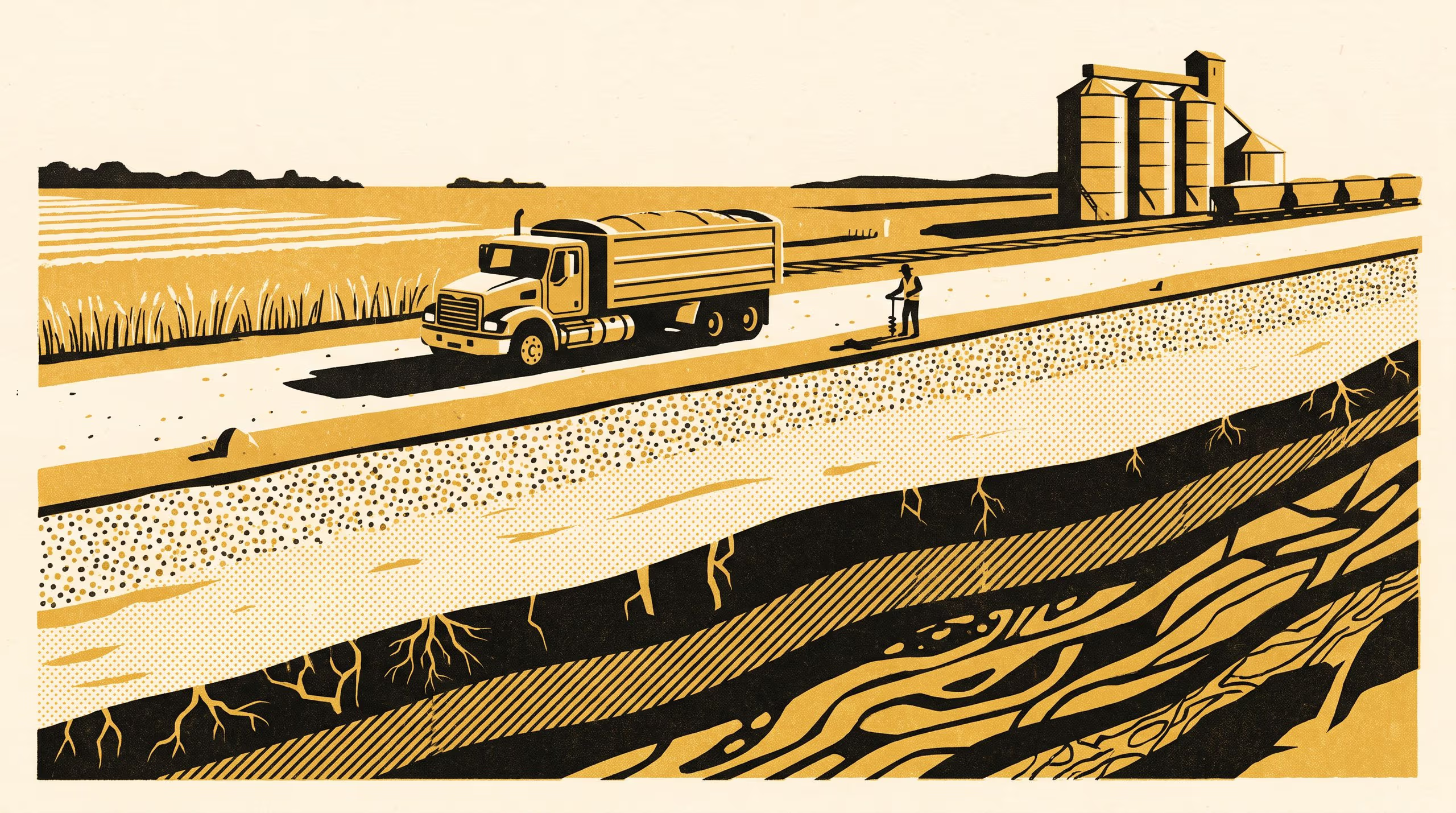
A new brochure from Slop University's School of Underlying Conditions sets out the University's research on rural logistics as an account of the ground a harvest travels over on its way to market.
A research showcase gathers eight published outputs on the ground beneath rural freight, from the subgrade to the grain bin
A new research showcase from Slop University asks its readers to look down: at the road surface, the farm track and the floor of the grain bin, and at what each of them rests on. The Ground the Harvest Travels On is led by Dr Brynjar Obiora, Senior Research Fellow in the School of Underlying Conditions, with Associate Professor Ragnhild Uzoma, Lead of the Basement Relations Group, Dr Vigdis Emenike, Senior Lecturer, and Associate Professor Kwame Lindqvist, Director of the Master of Priority Studies in the School of Emergent Priorities.
Most of this work began beside a road that was already there. The next of it will begin beside roads nobody has laid yet, and it is good to have something on the shelf for the people who will lay them.
— Dr Brynjar Obiora, Senior Research Fellow, School of Underlying Conditions
The brochure brings together eight published outputs from three of the University’s Schools, aligning soil survey, shared-cost allocation, measurement uncertainty and market volatility into a single account of the rural freight pathway, from the stabilised clay beneath an access road to the reports that follow a load to market. Every output is cited by title and DOI, so the showcase doubles as an entry point to the University’s research record.
The publication reflects the University’s settled view that the least visible layer of any system is usually the one carrying the most weight, and that a School built to study what lies beneath is well placed to say so.
“There is more infrastructure in a harvest than anyone thinks to call by that name,” said Associate Professor Lindqvist. “It has been a privilege to be counted among the people who now call it that.”
The full brochure is available from the University’s research repository under an open licence, doi:10.5555/slop.z3hd4v.