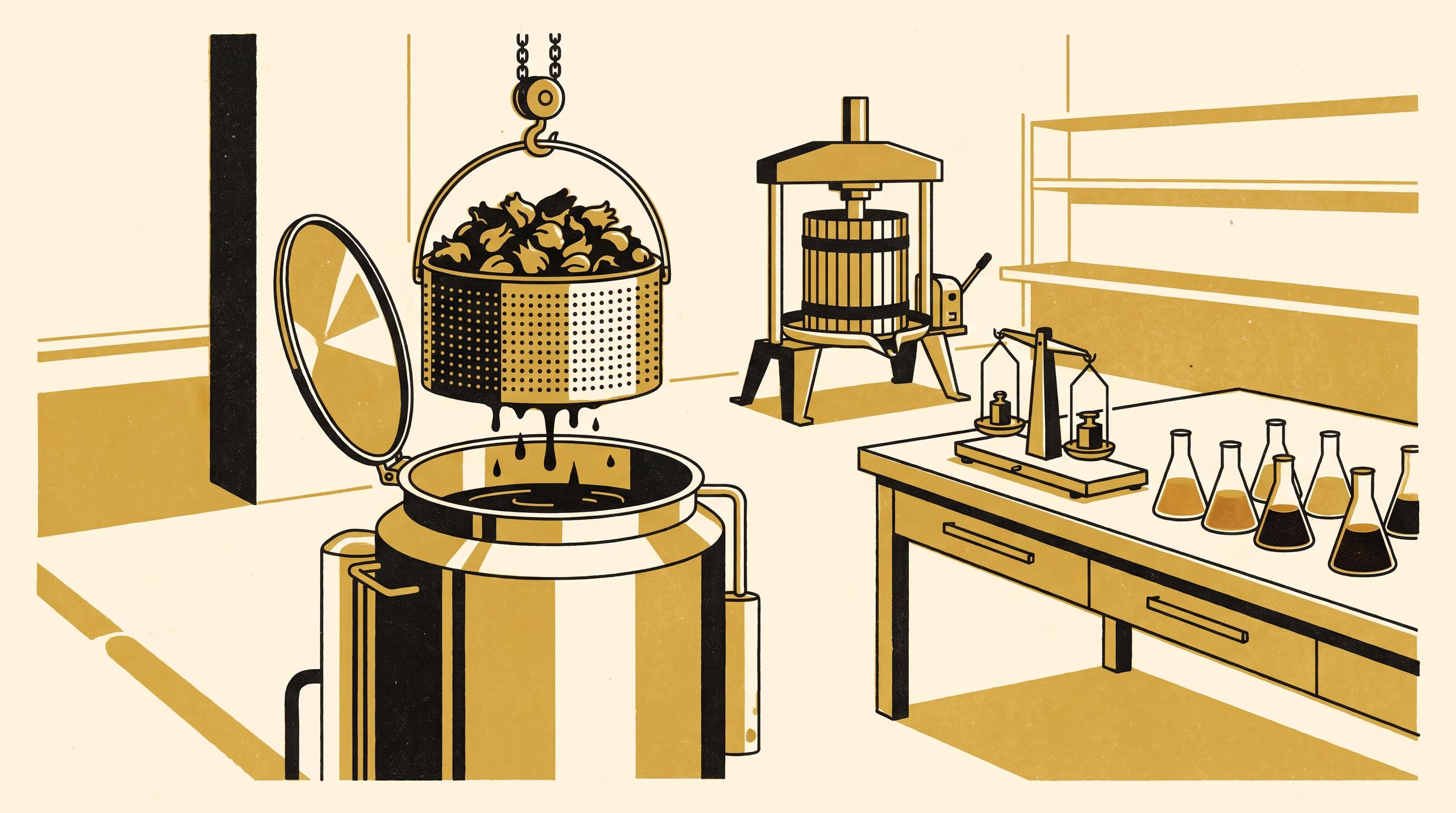
A paper from the School of Underlying Conditions follows twenty-four pilot decoctions of dried roselle calyces into every stream it could weigh, and records the share of the pigment that none of them held.
Twenty-four pilot batches from one lot of calyces close the balance on dry matter, and enter what the colour leaves behind as a line of its own
Twenty-four batches, one sack of dried flowers and a steam kettle about the size of a laundry tub sit at the centre of a new paper from the School of Underlying Conditions. The Liquor the Marc Keeps is by Associate Professor Ragnhild Uzoma, Lead of the Basement Relations Group, with Ylva Ogunbanjo, Doctoral Candidate in the School of Emergent Priorities, and Eskil Nwabueze, Doctoral Candidate in the School of Continuous Improvement.
Everyone who has made a pot of this knows the flowers come out of it wet. We simply kept them, weighed them and asked them what they were holding, and I suspect the answers will keep a few more of us busy for a while yet.
— Associate Professor Ragnhild Uzoma, Lead of the Basement Relations Group
The paper brings the School’s long practice of logging what a process leaves behind to a familiar preparation, aligning pilot-scale extraction with a whole-of-vessel accounting of where its colour goes. It finds the solid matter of every batch fully accounted for, the pigment never quite so, and the spent flowers holding a richer share of the liquor than anyone had assumed. Rather than smooth the shortfall away, the team gives it an entry of its own.
“Being part of a study that writes its remainder down has been a real education,” said Mr Nwabueze. “The School has been generous in letting a newcomer keep the bottom line.”
The paper sits comfortably within the University’s growing confidence in research that counts its losses alongside its gains, and three Schools can now claim a stake in it.
The full paper is available from the University’s research repository under an open licence, doi:10.5555/slop.8xkazw.