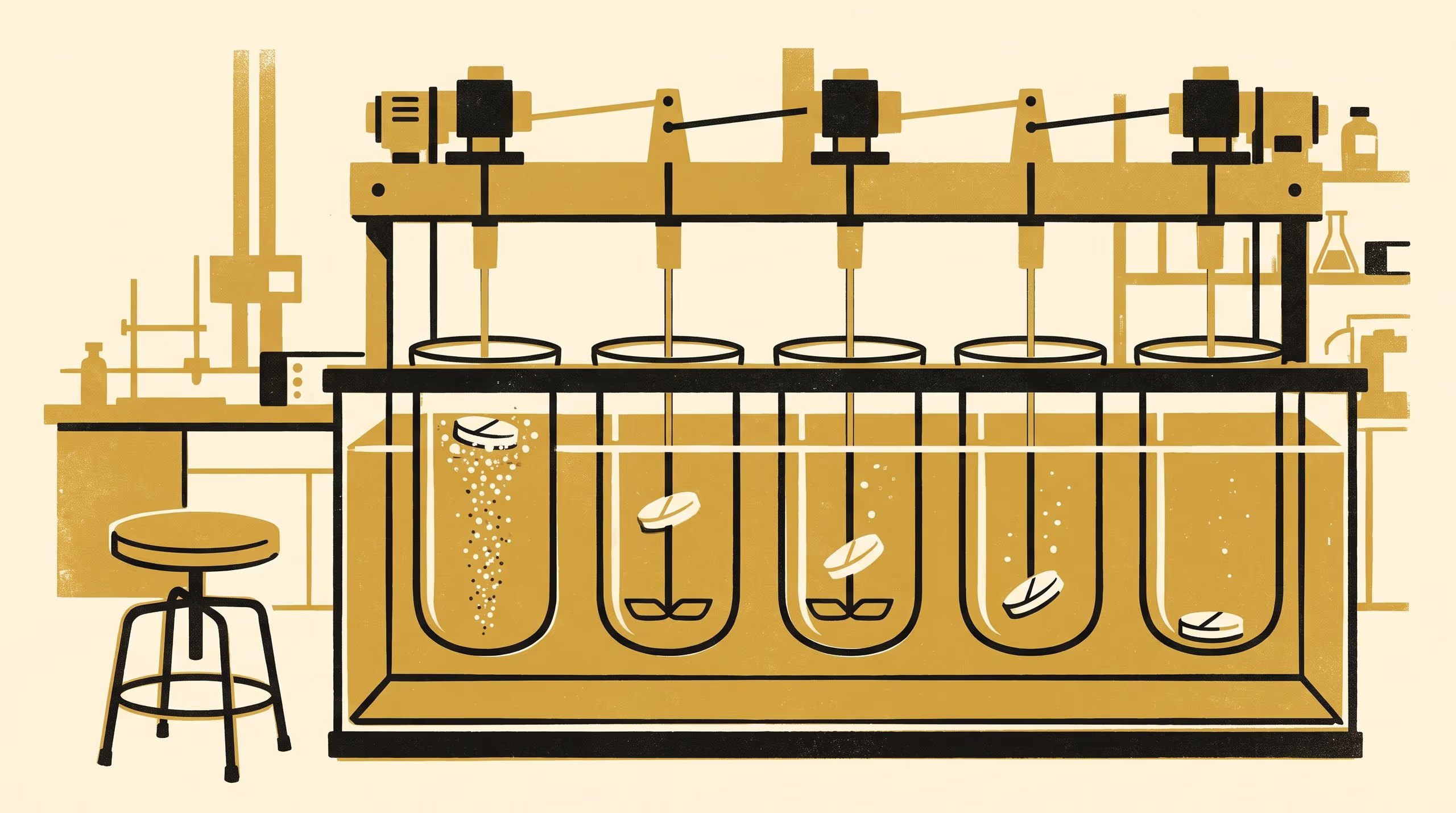
Late buoyancy loss in effervescent floating matrices, mapped across compaction pressure
A research poster from the School of Underlying Conditions compacts 120 effervescent HPMC matrix tablets across five compaction pressures and four bicarbonate fractions and follows each one's buoyancy for twelve hours in a paddle bath. Of the 108 that lifted, 47 sank again at a median of 4.6 hours, by venting through a fissured gel or by exhausting their gas, and 15% bicarbonate at 100–200 MPa held all eighteen of its tablets up to twelve hours.
| Authors | Brynjar Obiora , Ragnhild Uzoma |
|---|---|
| School | School of Underlying Conditions |
| Output type | Research poster |
| Published | |
| DOI | 10.5555/slop.qxg1yd |
| Pages | 1 |
| Version | 1.0 |
| Licence | CC BY 4.0 |
Cites
Cite as
@misc{slop_qxg1yd,
  author       = {Brynjar Obiora and Ragnhild Uzoma},
  title        = {The Second Sinking: Late buoyancy loss in effervescent floating matrices, mapped across compaction pressure},
  year         = {2026},
  publisher    = {Slop University},
  doi          = {10.5555/slop.qxg1yd},
  url          = {https://slop.university/outputs/slop-poster-why-effervescent-floating-qxg1yd/},
  version      = {1.0},
  note         = {Research poster},
}