A resolution limit for Laplace inversion of slug-test recovery curves
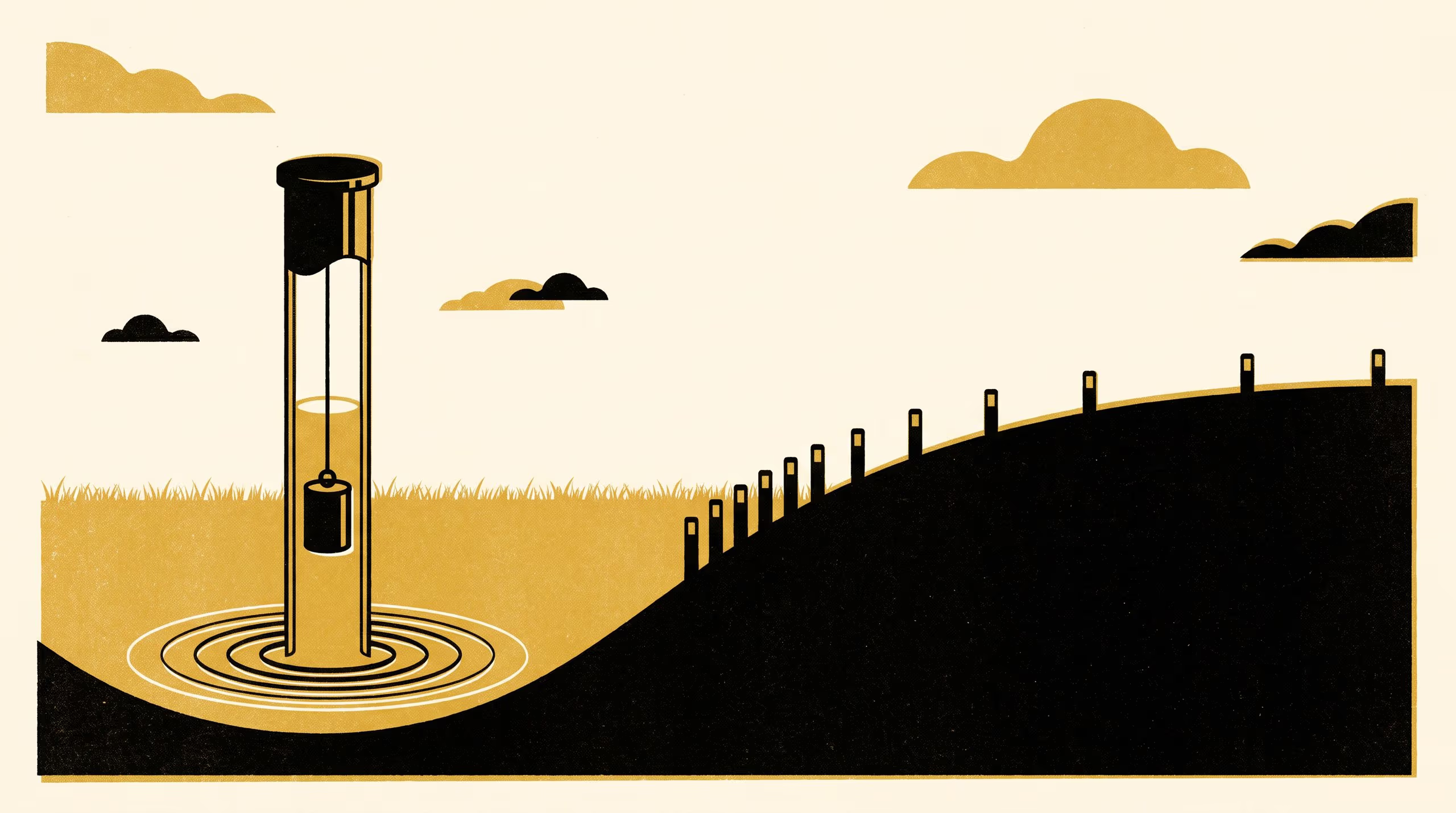
A research poster from the School of Underlying Conditions treats a slug test's recovery curve as the Laplace transform of a spectrum of relaxation rates and works in logarithmic time, where the inversion's kernel decays exponentially with frequency, to derive the reading density beyond which further readings resolve nothing more: about 0.47 ln(1/ε) readings per decade of elapsed time, or 3.2 at a relative noise of one part in a thousand. Inversions of 4,000 synthetic recoveries reach their error floor at that density, and 38 logger records from the School's piezometer nest, thinned from one reading a second to four a decade, give back the same recovered modes.
| Authors | Vigdis Emenike , Ragnhild Uzoma |
|---|---|
| School | School of Underlying Conditions |
| Output type | Research poster |
| Published | |
| DOI | 10.5555/slop.xuwi1c |
| Pages | 1 |
| Cited by | 2 outputs |
| Version | 1.0 |
| Licence | CC BY 4.0 |
Cites
Cited by
Cite as
@misc{slop_xuwi1c,
  author       = {Vigdis Emenike and Ragnhild Uzoma},
  title        = {Three Readings a Decade: A resolution limit for Laplace inversion of slug-test recovery curves},
  year         = {2026},
  publisher    = {Slop University},
  doi          = {10.5555/slop.xuwi1c},
  url          = {https://slop.university/outputs/slop-poster-the-resolution-limit-xuwi1c/},
  version      = {1.0},
  note         = {Research poster},
}