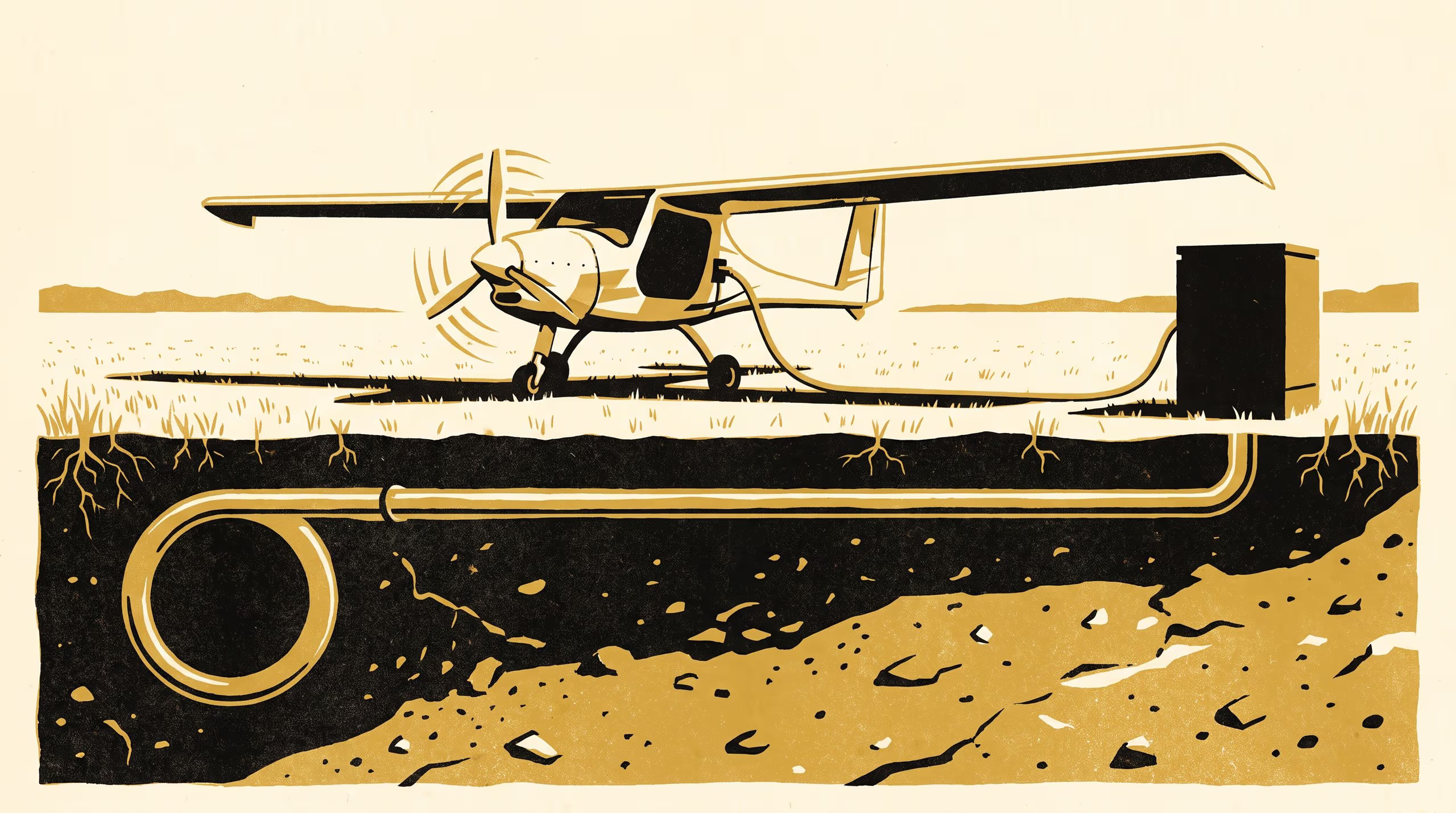
Ground-coupled heat rejection for electric-aircraft charging across a mapped soil boundary
A research poster from the School of Underlying Conditions surveys soil thermal conductivity at twelve stations along the 120-metre ground loop that cools an electric-aircraft charger at a grass airstrip, where the trench passes from red loam into cracking clay. Expressed at the loop's single design conductivity, the trench is equivalent to 100 metres in February and 140 metres in August, and reversing the direction of flow made no measurable difference to the return temperature.
| Authors | Brynjar Obiora , Vigdis Emenike , Casimir Beng |
|---|---|
| School | School of Underlying Conditions |
| Output type | Research poster |
| Published | |
| DOI | 10.5555/slop.qjzhbx |
| Pages | 1 |
| Cited by | 7 outputs |
| Version | 1.0 |
| Licence | CC BY 4.0 |
Cites
Cited by
Cite as
@misc{slop_qjzhbx,
  author       = {Brynjar Obiora and Vigdis Emenike and Casimir Beng},
  title        = {The Trench Crosses a Line: Ground-coupled heat rejection for electric-aircraft charging across a mapped soil boundary},
  year         = {2026},
  publisher    = {Slop University},
  doi          = {10.5555/slop.qjzhbx},
  url          = {https://slop.university/outputs/slop-poster-sizing-a-buried-qjzhbx/},
  version      = {1.0},
  note         = {Research poster},
}