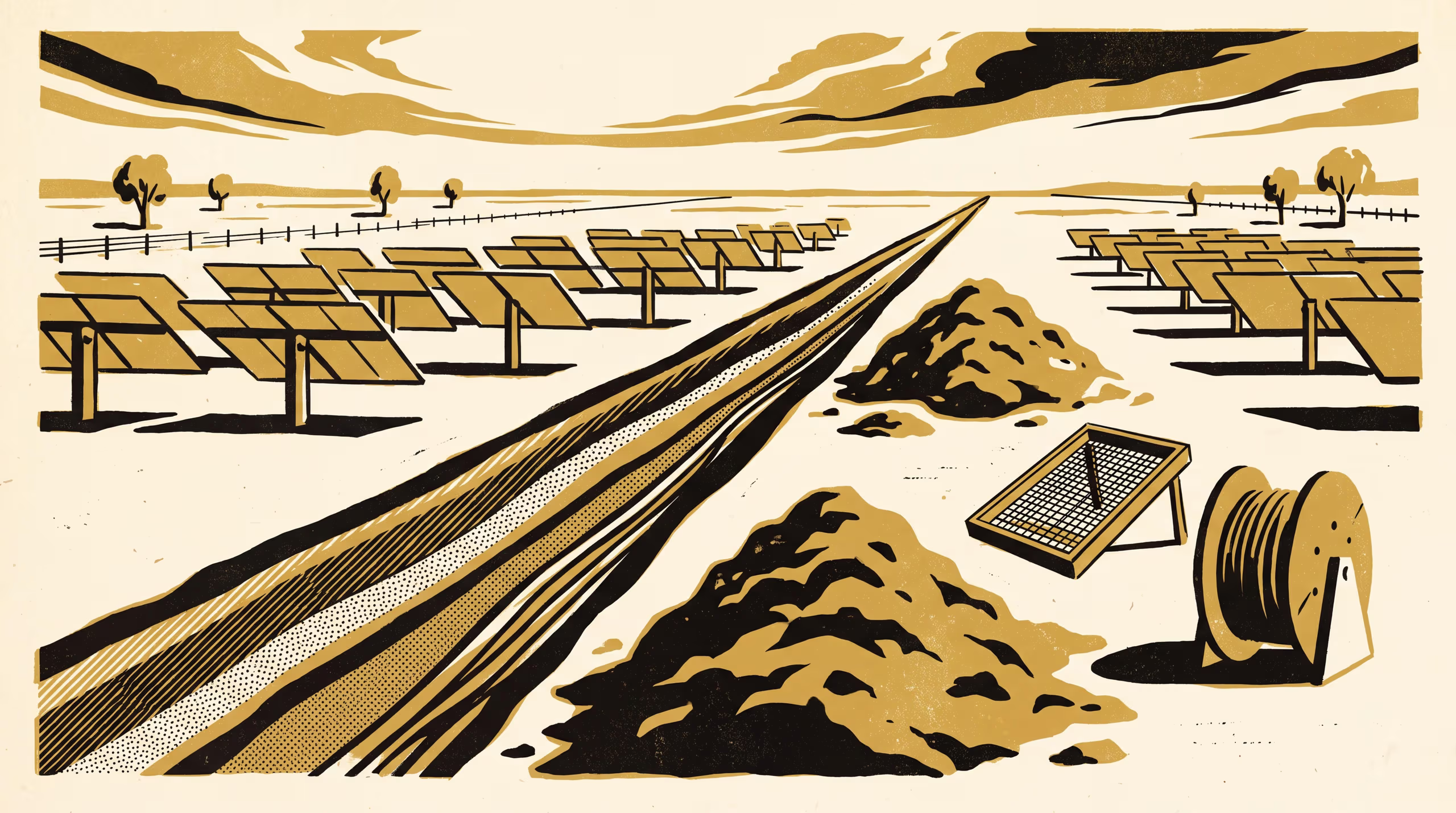
Native-Soil Backfill for a Solar Farm's 33 kV Collector Cables, Sorted by Soil Unit
A research poster from the School of Underlying Conditions sorts the 14 trench sections of a solar farm's 33 kV collector network by mapped soil unit, backfills nine with their own screened spoil and five with imported thermal sand, and follows the surround's thermal resistivity at cable depth through two summers. Seven of the nine native sections stay under the 1.2 K·m/W design value at their driest; a sandy loam the survey had passed reaches 1.41 in both summers, and a cracking clay fails only in the second, once shrinkage cracks reach the cable.
| Authors | Brynjar Obiora , Marit Osayande , Bram Ntuli |
|---|---|
| School | School of Underlying Conditions |
| Output type | Research poster |
| Published | |
| DOI | 10.5555/slop.nz6cwk |
| Pages | 1 |
| Version | 1.0 |
| Licence | CC BY 4.0 |
Cites
Cite as
@misc{slop_nz6cwk,
  author       = {Brynjar Obiora and Marit Osayande and Bram Ntuli},
  title        = {Back Into the Trench It Came From: Native-Soil Backfill for a Solar Farm's 33 kV Collector Cables, Sorted by Soil Unit},
  year         = {2026},
  publisher    = {Slop University},
  doi          = {10.5555/slop.nz6cwk},
  url          = {https://slop.university/outputs/slop-poster-reusing-excavated-native-nz6cwk/},
  version      = {1.0},
  note         = {Research poster},
}