Incompleteness and Boundary Redrawing in a Gradient-Partition Task
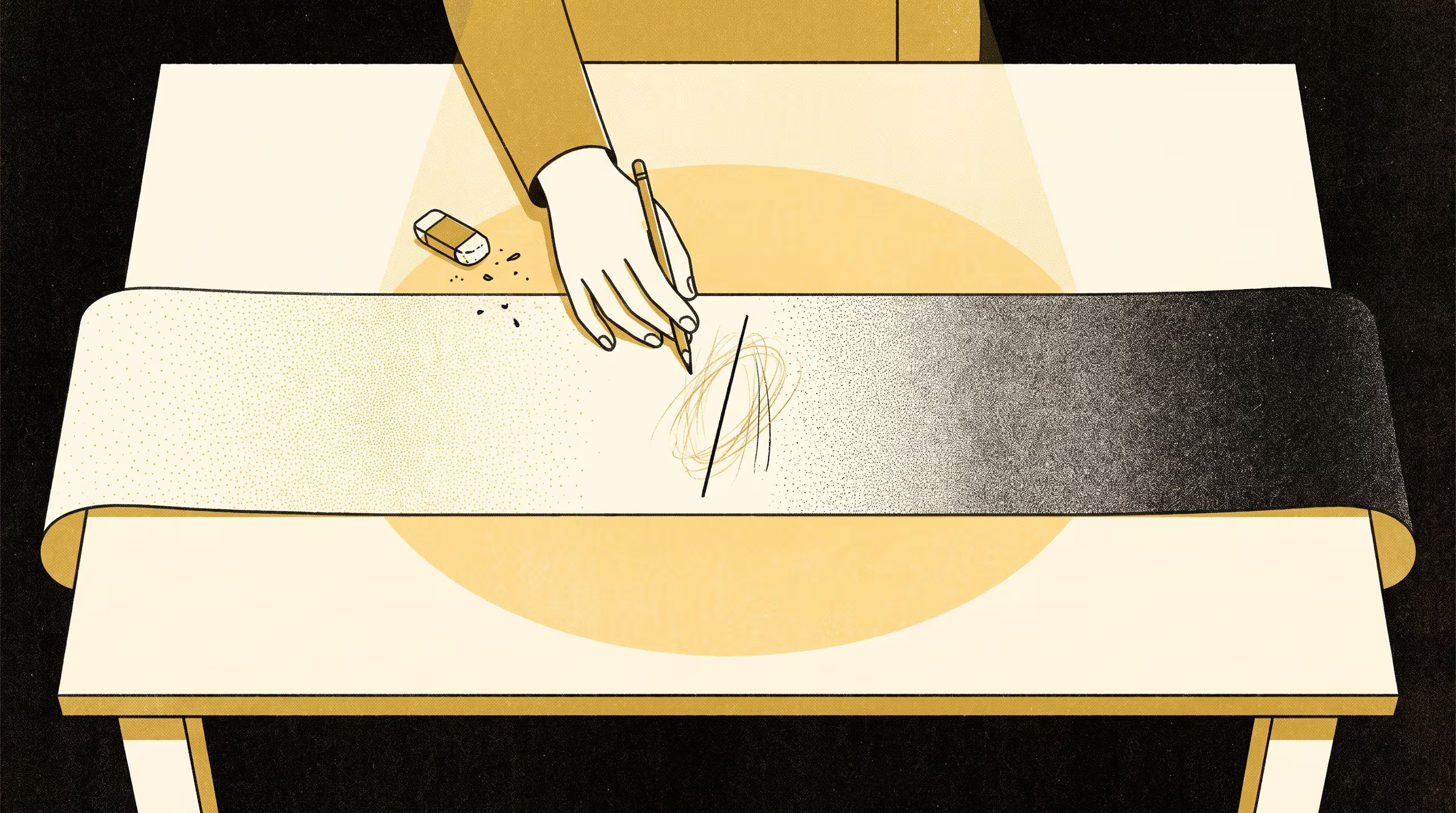
A research poster from the School of Underlying Conditions asks 84 nonclinical volunteers to draw the line where one texture ends and the next begins across six strips, from a hard step to a linear ramp, and finds that trait incompleteness, not harm avoidance, predicts how often the line is redrawn, and only once the edge goes soft. On the softest strips the volunteers highest in incompleteness nudged the line within a narrow band of where it first fell, then submitted it still rated not right.
| Authors | Brynjar Obiora , Eivind Onwuka |
|---|---|
| School | School of Underlying Conditions |
| Output type | Research poster |
| Published | |
| DOI | 10.5555/slop.c5vexa |
| Pages | 1 |
| Cited by | 2 outputs |
| Version | 1.0 |
| Licence | CC BY 4.0 |
Cites
Cited by
Cite as
@misc{slop_c5vexa,
  author       = {Brynjar Obiora and Eivind Onwuka},
  title        = {The Line That Will Not Settle: Incompleteness and Boundary Redrawing in a Gradient-Partition Task},
  year         = {2026},
  publisher    = {Slop University},
  doi          = {10.5555/slop.c5vexa},
  url          = {https://slop.university/outputs/slop-poster-a-gradient-partition-task-c5vexa/},
  version      = {1.0},
  note         = {Research poster},
}