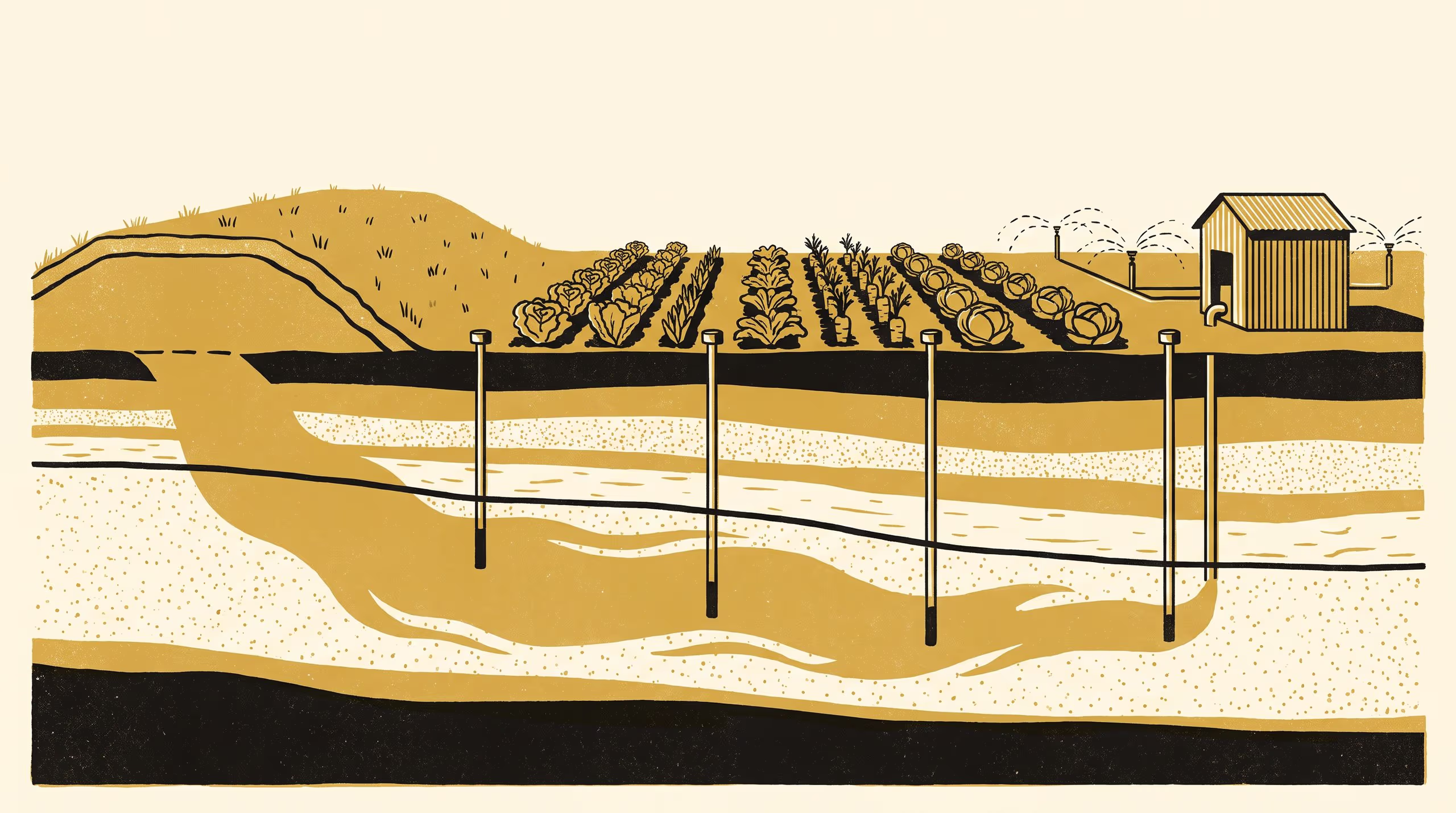
Seasonal swing of the hydraulic gradient and the apparent spreading of a closed landfill's leachate plume
A research poster from the School of Emergent Priorities combines six water years of monthly dips at 26 monitoring bores with a transient groundwater model to show that the hydraulic gradient beneath a closed landfill's chloride plume swings 50 to 120 degrees from its regional bearing at each summer peak, as an up-gradient irrigation bore field pumps. A steady-flow fit needs a transverse dispersivity of about 4.2 m to match the plume's width and a transient one about 0.5 m, so the poster attributes some seven-eighths of the plume's transverse variance to the seasonal swing rather than to dispersion.
| Authors | Fenna Okoro , Vigdis Emenike , Brynjar Obiora |
|---|---|
| School | School of Emergent Priorities |
| Output type | Research poster |
| Published | |
| DOI | 10.5555/slop.ul3hnf |
| Pages | 1 |
| Cited by | 2 outputs |
| Version | 1.0 |
| Licence | CC BY 4.0 |
Cites
Cited by
Cite as
@misc{slop_ul3hnf,
  author       = {Fenna Okoro and Vigdis Emenike and Brynjar Obiora},
  title        = {Most of Its Width Is Summer: Seasonal swing of the hydraulic gradient and the apparent spreading of a closed landfill's leachate plume},
  year         = {2026},
  publisher    = {Slop University},
  doi          = {10.5555/slop.ul3hnf},
  url          = {https://slop.university/outputs/slop-poster-a-closed-landfill-s-ul3hnf/},
  version      = {1.0},
  note         = {Research poster},
}