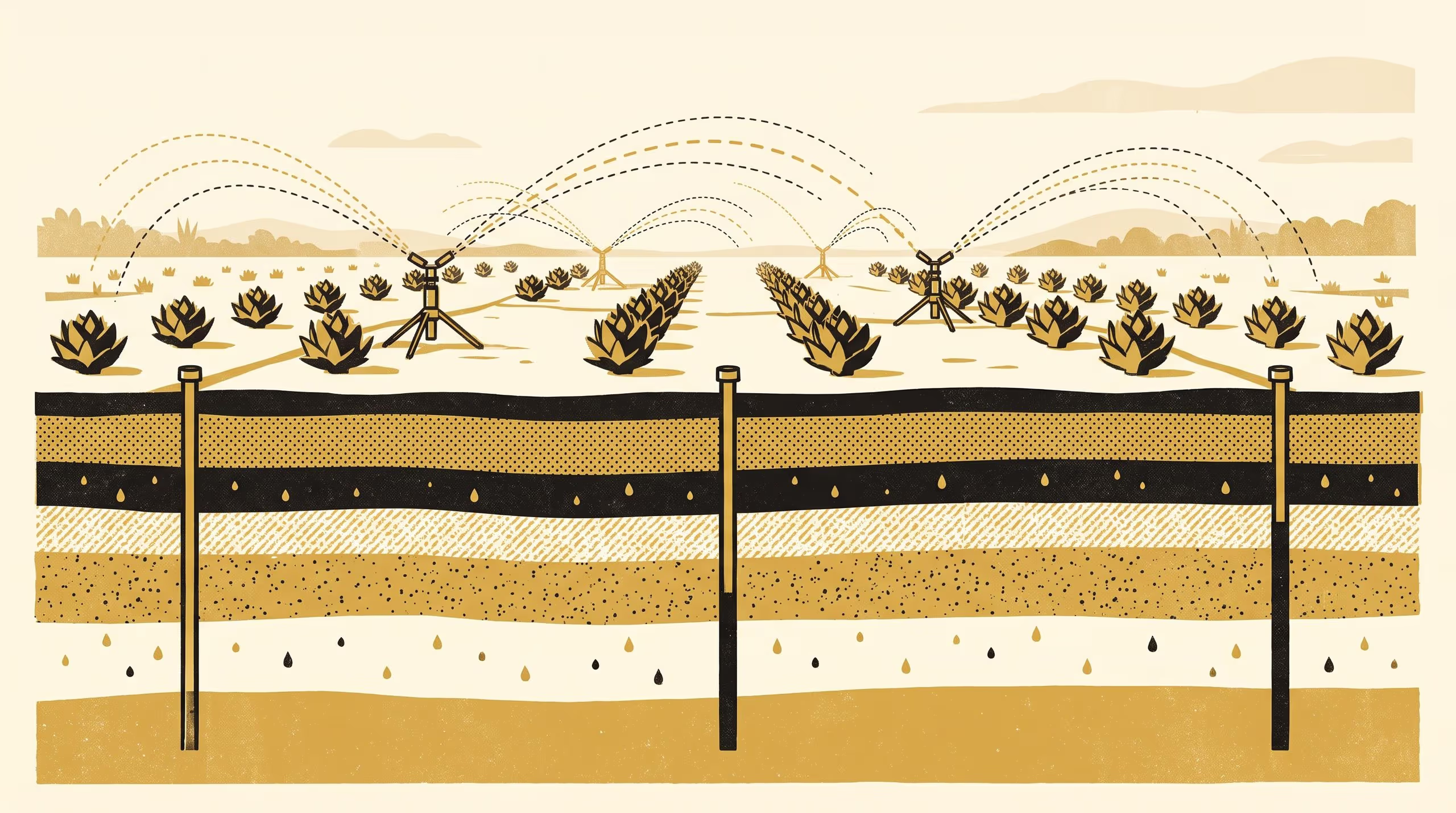
Deep drainage beneath a dormant globe artichoke field after its summer forcing irrigation
A paper from the School of Underlying Conditions applies the late-summer forcing irrigation that ends a globe artichoke stand's rest at 25, 50 and 75 mm in four randomised blocks, and follows the water to observation bores 2.8 m below. Every irrigated plant sprouted in a median of nine days whatever the depth, while recharge measured by the water-table fluctuation method rose from 8 to 39% of the water applied.
| Authors | Vigdis Emenike , Brynjar Obiora |
|---|---|
| School | School of Underlying Conditions |
| Output type | Research paper |
| Published | |
| DOI | 10.5555/slop.g7ac0r |
| Pages | 5 |
| Version | 1.0 |
| Licence | CC BY 4.0 |
Cites
Cite as
@misc{slop_g7ac0r,
  author       = {Vigdis Emenike and Brynjar Obiora},
  title        = {Where the Wake-Up Water Goes: Deep drainage beneath a dormant globe artichoke field after its summer forcing irrigation},
  year         = {2026},
  publisher    = {Slop University},
  doi          = {10.5555/slop.g7ac0r},
  url          = {https://slop.university/outputs/slop-paper-where-the-wake-up-g7ac0r/},
  version      = {1.0},
  note         = {Research paper},
}