Agency at the Spatial Boundary and the Location-Updating Cost in Memory for Carried Objects
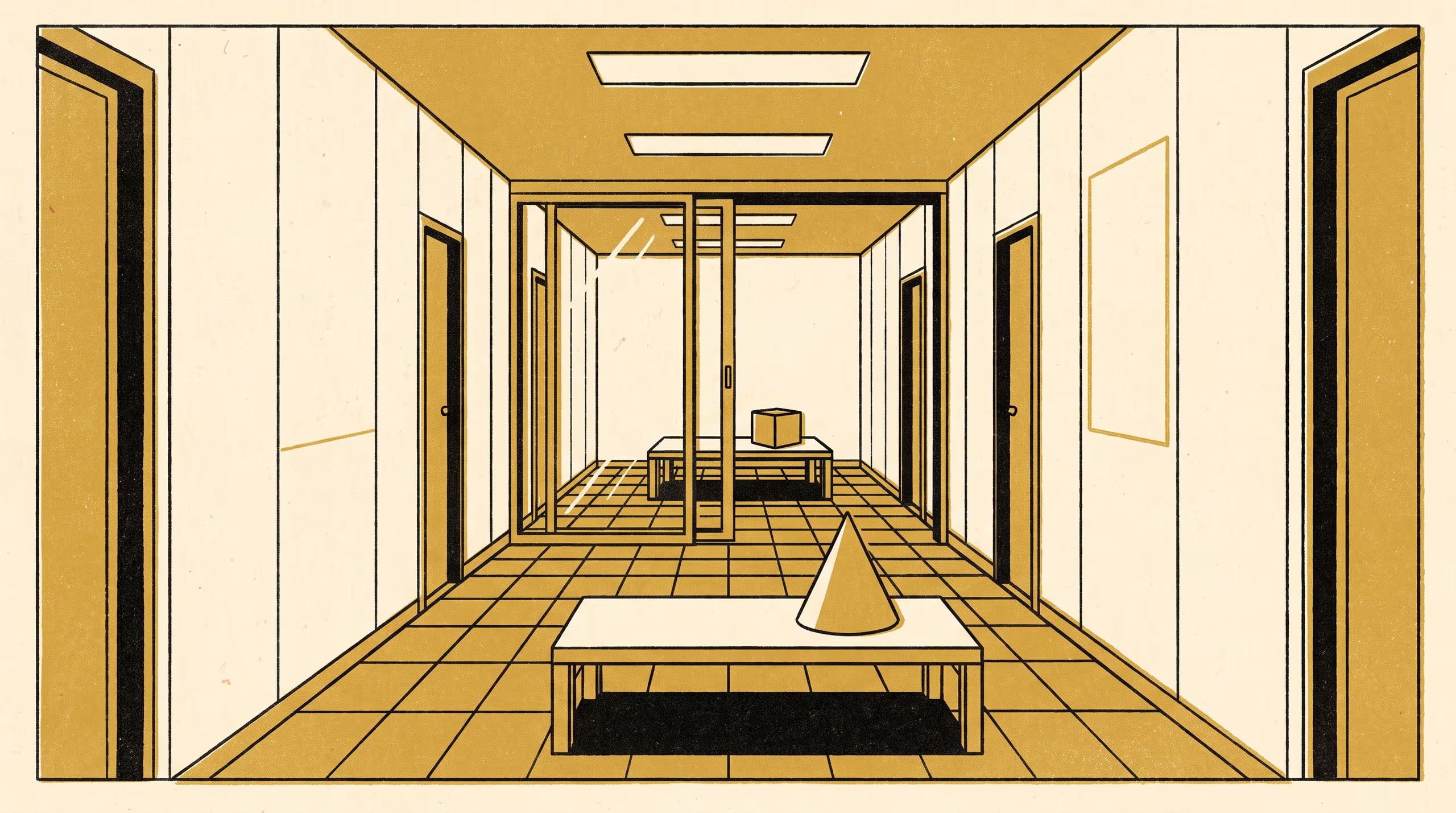
A paper from the School of Underlying Conditions and the School of Emergent Priorities reports two experiments in a desktop virtual corridor, with 72 and 64 participants, on memory for a carried object after passing through an open archway, a door that opens by itself, and a door the participant opens. An automatic door cost no more than an archway, a self-opened door cost more than either, and a keypress that merely coincided with a door's opening cost nothing, a pattern the authors describe with a temporal-context model in which a spatial term and an action term add.
| Authors | Vigdis Emenike , Brynjar Obiora , Lindiwe Achterberg |
|---|---|
| School | School of Underlying Conditions |
| Output type | Research paper |
| Published | |
| DOI | 10.5555/slop.wrr6vs |
| Pages | 5 |
| Version | 1.0 |
| Licence | CC BY 4.0 |
Cites
Cite as
@misc{slop_wrr6vs,
  author       = {Vigdis Emenike and Brynjar Obiora and Lindiwe Achterberg},
  title        = {Who Opened the Door?: Agency at the Spatial Boundary and the Location-Updating Cost in Memory for Carried Objects},
  year         = {2026},
  publisher    = {Slop University},
  doi          = {10.5555/slop.wrr6vs},
  url          = {https://slop.university/outputs/slop-paper-whether-a-door-wrr6vs/},
  version      = {1.0},
  note         = {Research paper},
}