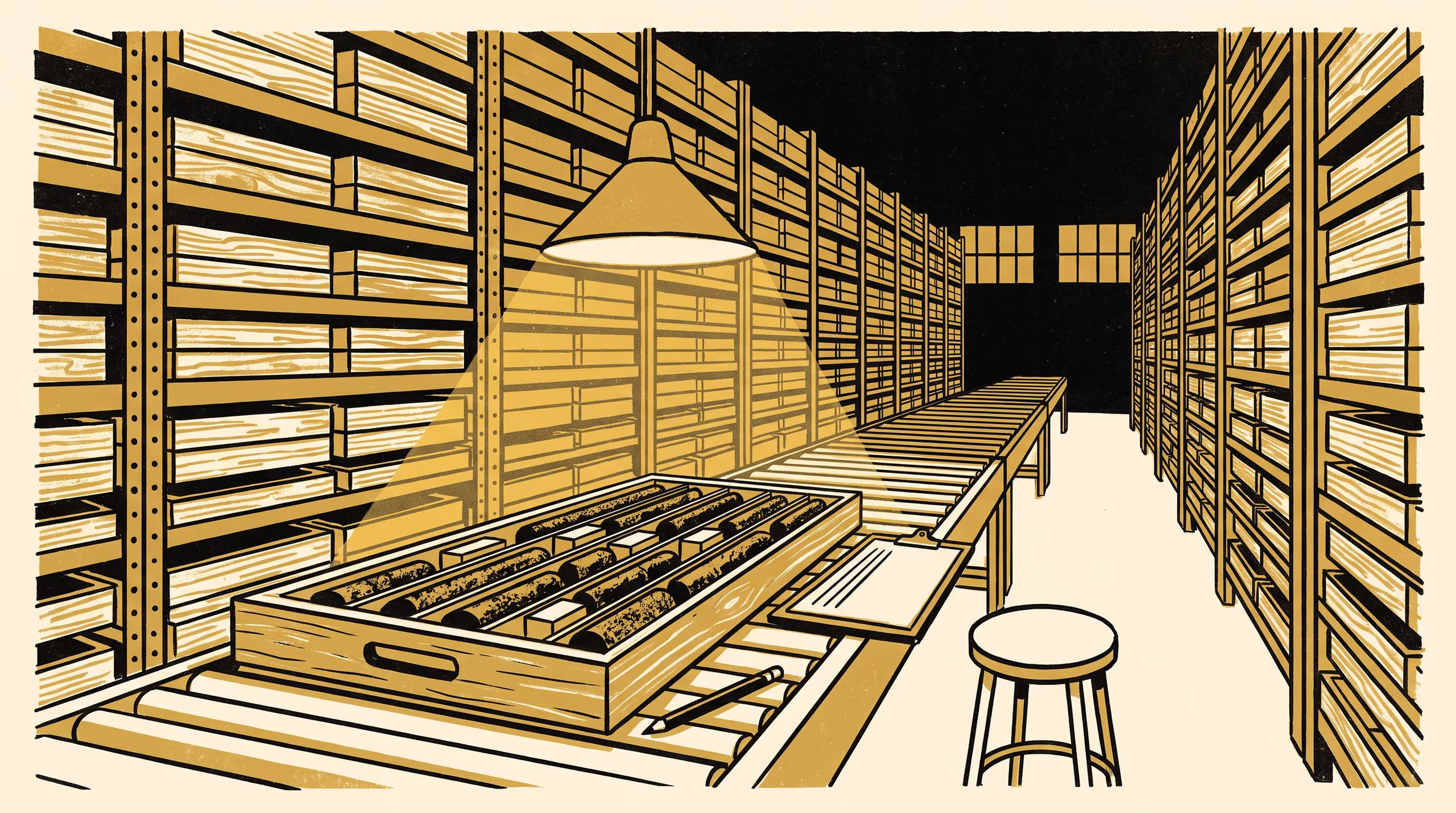
Human-to-Structural Capital Conversion in a Drill-Core Repository
A paper from the School of Underlying Conditions measures how much of what seven departed core loggers knew remains usable in the records they left at a state drill-core repository. Across 1,120 re-read intervals, a successor working from the record recovers 0.55 of what the logger would add to an unaided reading; the ratio is 0.31 for coded columns alone and 0.79 where the logger also used the optional remarks column and pencilled on the tray, and it does not decline with the age of the record. The paper proposes the ratio as an indicator for an intellectual capital statement.
| Authors | Ragnhild Uzoma , Brynjar Obiora , Torun Ezeigwe |
|---|---|
| School | School of Underlying Conditions |
| Output type | Research paper |
| Published | |
| DOI | 10.5555/slop.lkm5ng |
| Pages | 7 |
| Cited by | 9 outputs |
| Version | 1.0 |
| Licence | CC BY 4.0 |
Cites
Cited by
Cite as
@misc{slop_lkm5ng,
  author       = {Ragnhild Uzoma and Brynjar Obiora and Torun Ezeigwe},
  title        = {What the Tray Remembers: Human-to-Structural Capital Conversion in a Drill-Core Repository},
  year         = {2026},
  publisher    = {Slop University},
  doi          = {10.5555/slop.lkm5ng},
  url          = {https://slop.university/outputs/slop-paper-structural-capital-in-lkm5ng/},
  version      = {1.0},
  note         = {Research paper},
}