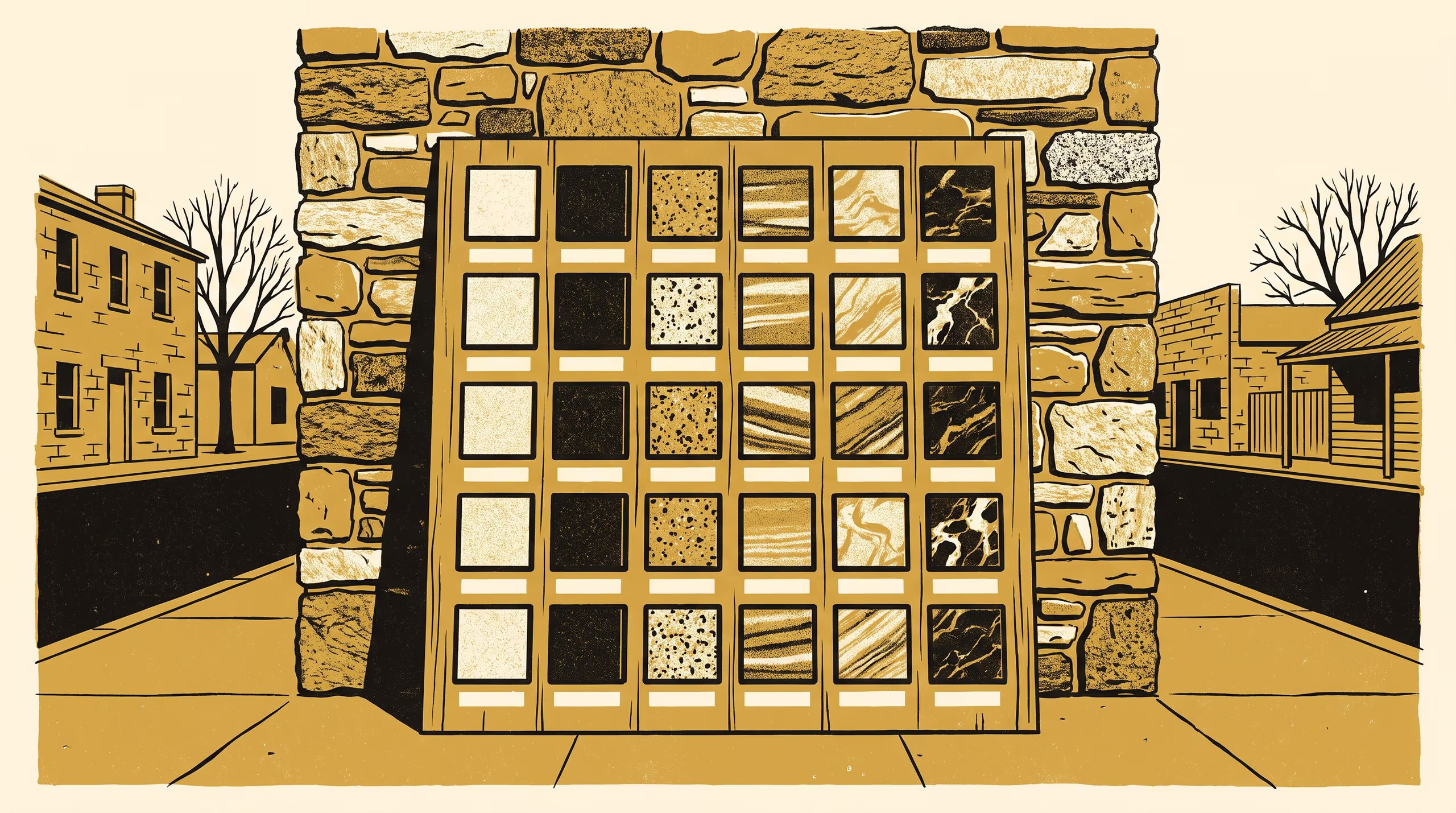
Stone Merchants' Sample Boards as Ex Situ Geoheritage of an Inland Quarry District, Read Against Its Town's Walls
A paper from the School of Emergent Priorities and the School of Underlying Conditions assesses nine stone merchants' sample boards, held in a state library's trade-literature deposit, as ex situ geoheritage for an inland building-stone district in which 17 of the 23 named quarries no longer show a face. Hand-lens comparison assigns 92 of 186 building elements in the district's market town to those lost lithotypes, and a twelve-stop urban geotrail pairs each tile with a wall built from it, showing that the boards displayed each quarry's best bed while most of the town was built from the cheaper ones.
| Authors | Sunniva Balogun , Ragnhild Uzoma |
|---|---|
| School | School of Emergent Priorities |
| Output type | Research paper |
| Published | |
| DOI | 10.5555/slop.65op68 |
| Pages | 6 |
| Version | 1.0 |
| Licence | CC BY 4.0 |
Cites
Cite as
@misc{slop_65op68,
  author       = {Sunniva Balogun and Ragnhild Uzoma},
  title        = {The Best Bed on the Board: Stone Merchants' Sample Boards as Ex Situ Geoheritage of an Inland Quarry District, Read Against Its Town's Walls},
  year         = {2026},
  publisher    = {Slop University},
  doi          = {10.5555/slop.65op68},
  url          = {https://slop.university/outputs/slop-paper-stone-merchants-sample-65op68/},
  version      = {1.0},
  note         = {Research paper},
}