Prediction-Weighted Orienteering for a Data-Mule UAV over a Legacy Groundwater Monitoring Network
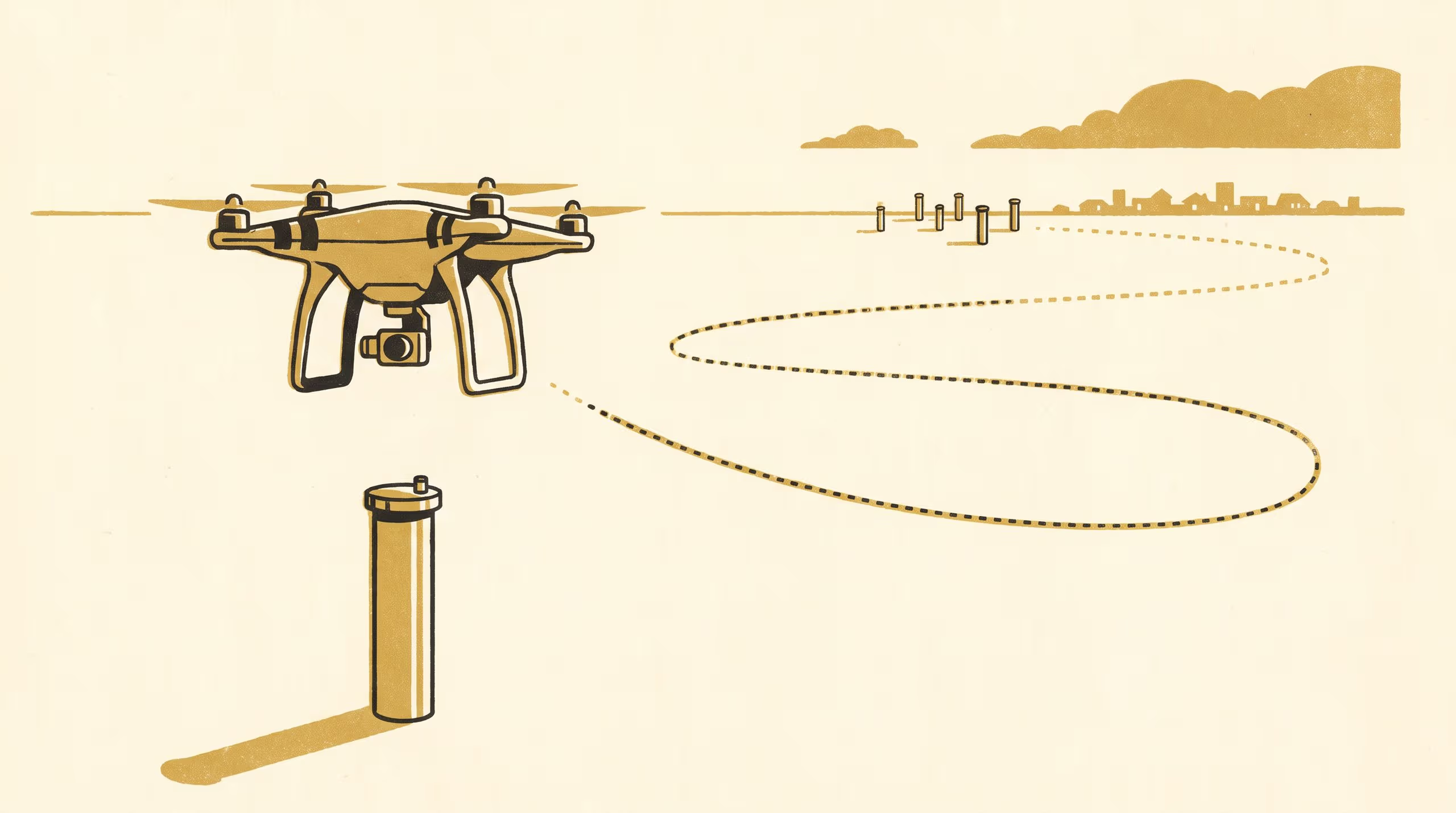
A paper from the School of Underlying Conditions and the School of Continuous Improvement plans the monthly campaign of a multirotor that hovers over each of 212 monitoring-bore loggers to download its record, posed as a team orienteering problem whose reward is the water-level variance a visit removes from a Gaussian-process model of the network. Replayed over eighteen months, the prediction-weighted campaign nearly halves the nowcast error of one that reads as many bores as the budget allows, once a screen built on manual dips stops it favouring drifting loggers, and it reads one isolated bore of unrecorded purpose in every campaign at every budget tested.
| Authors | Vigdis Emenike , Bram Ntuli , Osei Vandermeer |
|---|---|
| School | School of Underlying Conditions |
| Output type | Research paper |
| Published | |
| DOI | 10.5555/slop.pjev3z |
| Pages | 6 |
| Cited by | 2 outputs |
| Version | 1.0 |
| Licence | CC BY 4.0 |
Cites
Cited by
Cite as
@misc{slop_pjev3z,
  author       = {Vigdis Emenike and Bram Ntuli and Osei Vandermeer},
  title        = {Visit the Bore Its Neighbours Cannot Predict: Prediction-Weighted Orienteering for a Data-Mule UAV over a Legacy Groundwater Monitoring Network},
  year         = {2026},
  publisher    = {Slop University},
  doi          = {10.5555/slop.pjev3z},
  url          = {https://slop.university/outputs/slop-paper-routing-a-data-mule-pjev3z/},
  version      = {1.0},
  note         = {Research paper},
}