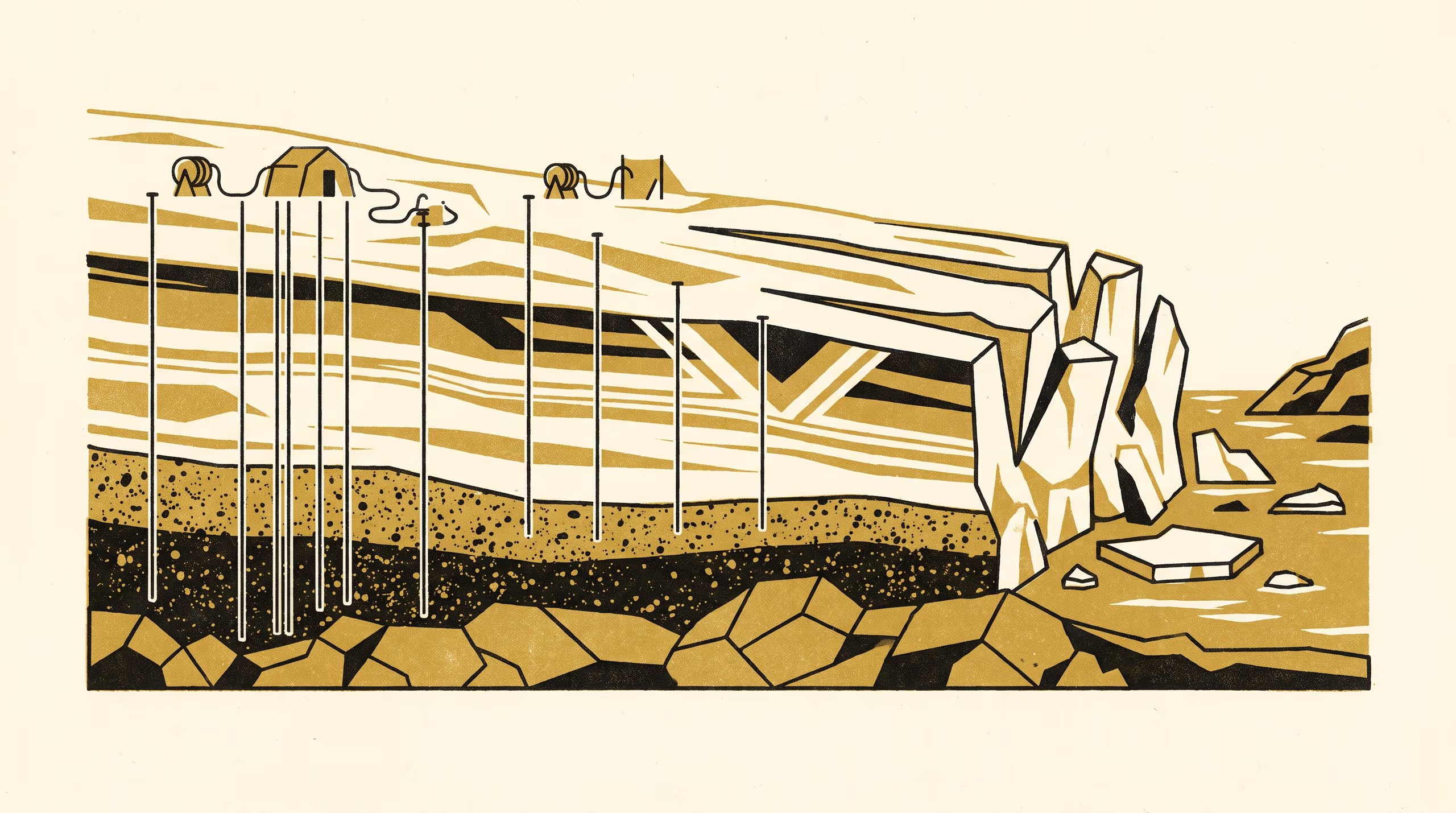
Hot-Water Boreholes That Stopped Short in Debris-Rich Basal Ice Mark the Sticky Spots beneath a Tidewater Outlet Glacier
A paper from the School of Underlying Conditions reads fifteen hot-water boreholes on one reach of a High Arctic tidewater outlet glacier against a blind control-method inversion of the same season's surface velocities. The four holes that stopped 7 to 14 m above the bed in debris-rich basal ice all sit in the three patches of highest basal traction, which cover about 13% of the reach and carry about 38% of its basal drag, while the eleven holes that reached the bed sampled only the weaker bed.
| Authors | Ragnhild Uzoma , Vigdis Emenike |
|---|---|
| School | School of Underlying Conditions |
| Output type | Research paper |
| Funding | Anticipatory Capability Fund: Cutting and Shelving a Borehole's Core-Loss Blocks Ahead of the Drill ( $362,417) |
| Published | |
| DOI | 10.5555/slop.xqdpgb |
| Pages | 7 |
| Cited by | 1 output |
| Version | 1.0 |
| Licence | CC BY 4.0 |
Cites
Cited by
Cite as
@misc{slop_xqdpgb,
  author       = {Ragnhild Uzoma and Vigdis Emenike},
  title        = {Refusal at the Bed: Hot-Water Boreholes That Stopped Short in Debris-Rich Basal Ice Mark the Sticky Spots beneath a Tidewater Outlet Glacier},
  year         = {2026},
  publisher    = {Slop University},
  doi          = {10.5555/slop.xqdpgb},
  url          = {https://slop.university/outputs/slop-paper-refusal-at-the-xqdpgb/},
  version      = {1.0},
  note         = {Research paper},
}