Joint Refraction Tomography and Surface-Wave Inversion along a Line of Eleven Monitoring Bores
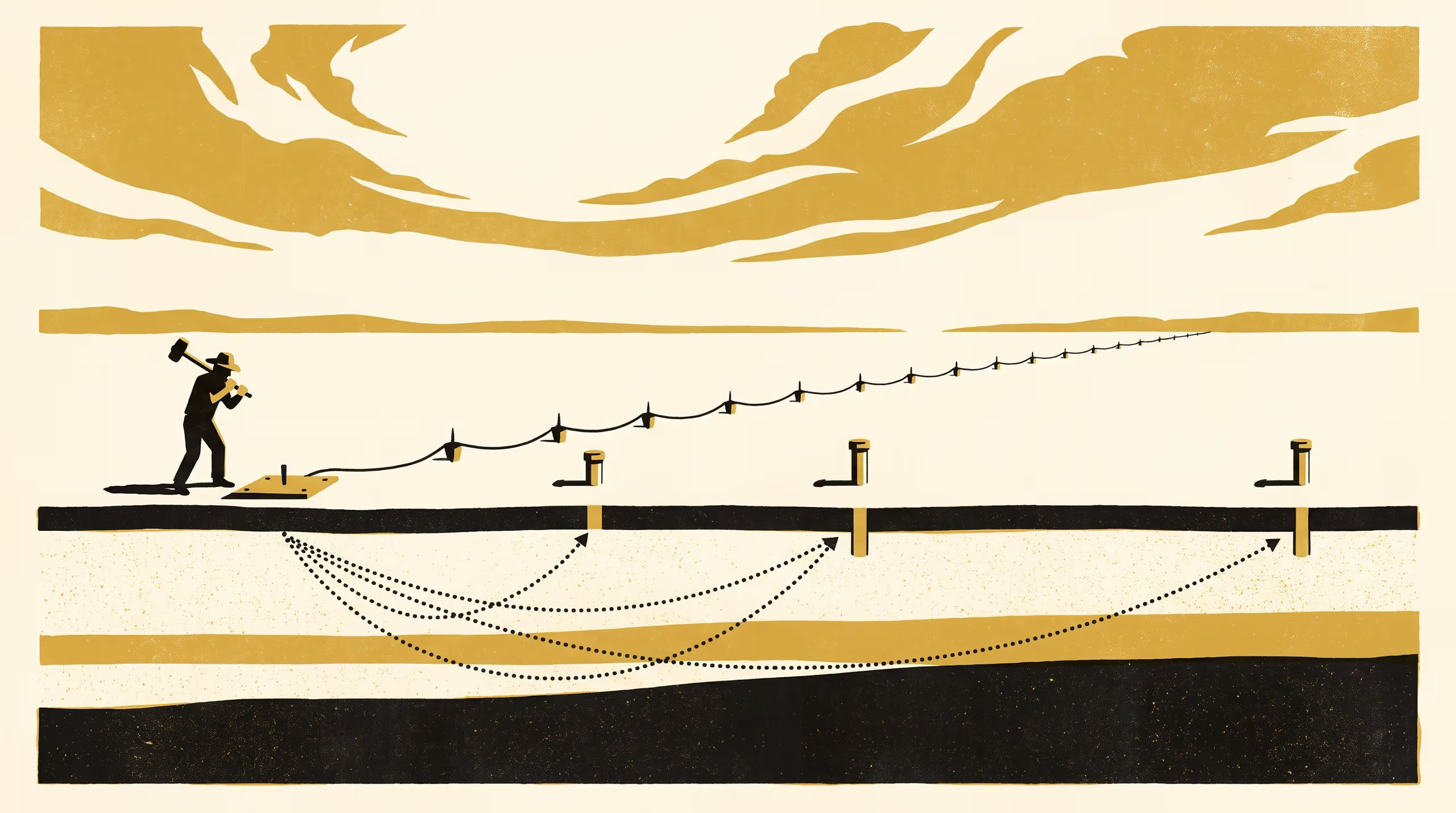
A paper from the School of Underlying Conditions shoots a 240 m seismic line across an alluvial terrace carrying eleven monitoring bores and sets the water table returned by P-wave refraction tomography and by Poisson's ratio from surface-wave inversion against levels dipped on the survey day. At the eight bores inside the resolved section both seismic interfaces lie above the dipped level, by 0.14 to 0.81 m after correcting for the inversion's smoothing bias, and the offset rises with the fines content of the core above the water level, which the authors read as the top of the capillary fringe.
| Authors | Vigdis Emenike , Ragnhild Uzoma |
|---|---|
| School | School of Underlying Conditions |
| Output type | Research paper |
| Published | |
| DOI | 10.5555/slop.ecq3zq |
| Pages | 6 |
| Version | 1.0 |
| Licence | CC BY 4.0 |
Cites
Cite as
@misc{slop_ecq3zq,
  author       = {Vigdis Emenike and Ragnhild Uzoma},
  title        = {The Seismic Water Table Is the Top of the Capillary Fringe: Joint Refraction Tomography and Surface-Wave Inversion along a Line of Eleven Monitoring Bores},
  year         = {2026},
  publisher    = {Slop University},
  doi          = {10.5555/slop.ecq3zq},
  url          = {https://slop.university/outputs/slop-paper-the-seismic-water-ecq3zq/},
  version      = {1.0},
  note         = {Research paper},
}