Lateral Representativeness and Record Length for Single Heat-Flow Probes in Block-Strewn Regolith
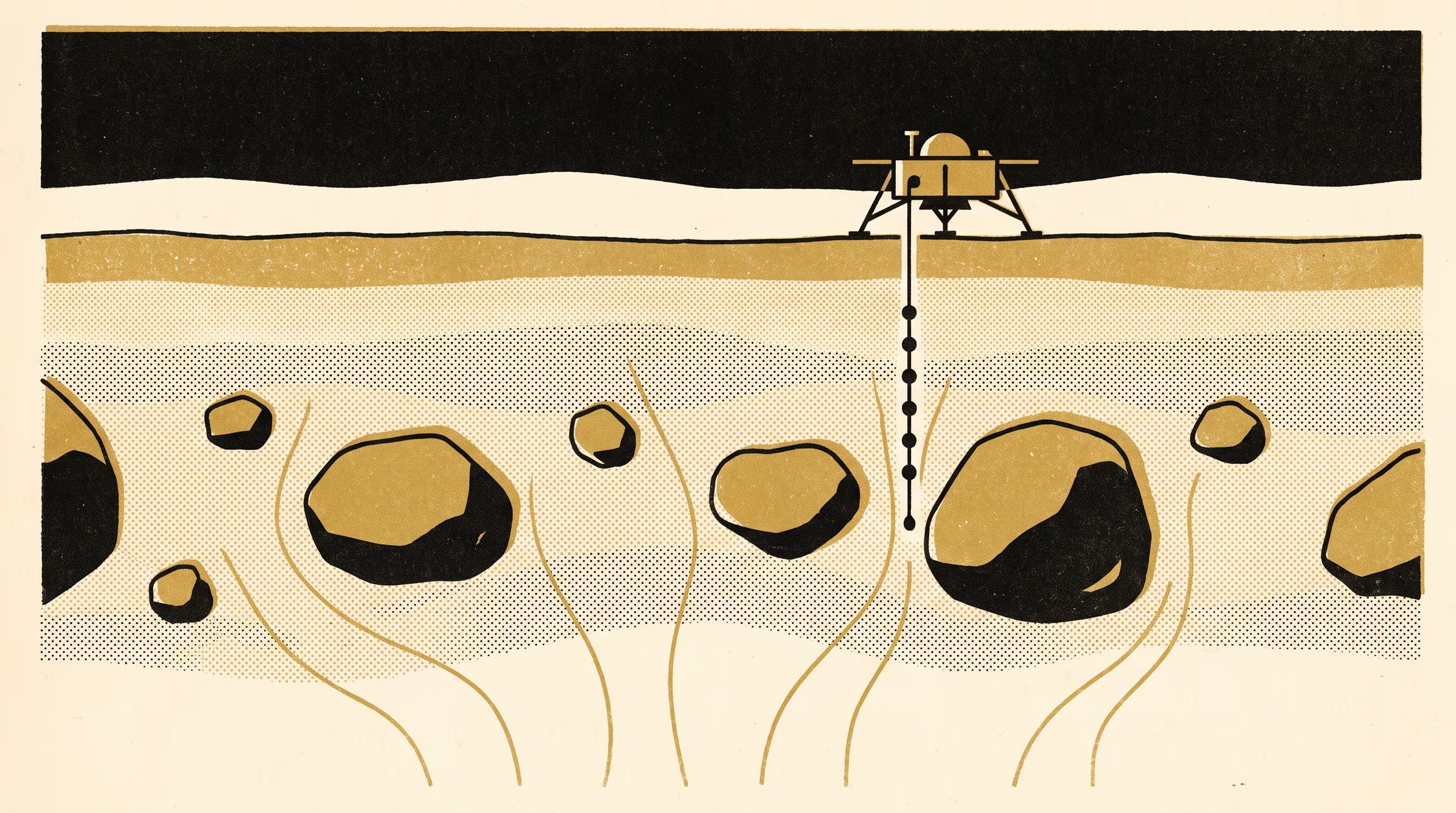
A paper from the School of Underlying Conditions drives a single heat-flow probe into each of 1,500 synthetic regolith sections on an airless body and finds that buried rock biases its reading low, by 10% at a block fraction of 0.05 and 27% at 0.15, close to the dilute-inclusion ratio and invisible from inside the hole. A surface warming at emplacement biases a gradient read straight off the profile by up to 16% per kelvin for two decades, but a fitted disturbance model holds that error to a few percent, so the limit on one station is where it was put rather than how long it records.
| Authors | Vigdis Emenike , Brynjar Obiora |
|---|---|
| School | School of Underlying Conditions |
| Output type | Research paper |
| Published | |
| DOI | 10.5555/slop.h43iob |
| Pages | 7 |
| Cited by | 2 outputs |
| Version | 1.0 |
| Licence | CC BY 4.0 |
Cites
Cited by
Cite as
@misc{slop_h43iob,
  author       = {Vigdis Emenike and Brynjar Obiora},
  title        = {How Far Does One Borehole See?: Lateral Representativeness and Record Length for Single Heat-Flow Probes in Block-Strewn Regolith},
  year         = {2026},
  publisher    = {Slop University},
  doi          = {10.5555/slop.h43iob},
  url          = {https://slop.university/outputs/slop-paper-how-much-of-h43iob/},
  version      = {1.0},
  note         = {Research paper},
}