Rhizome Yield and Phenylethanoid Glycoside Accumulation in a Clonal Medicinal Herb Potted on Crushed Drill Core
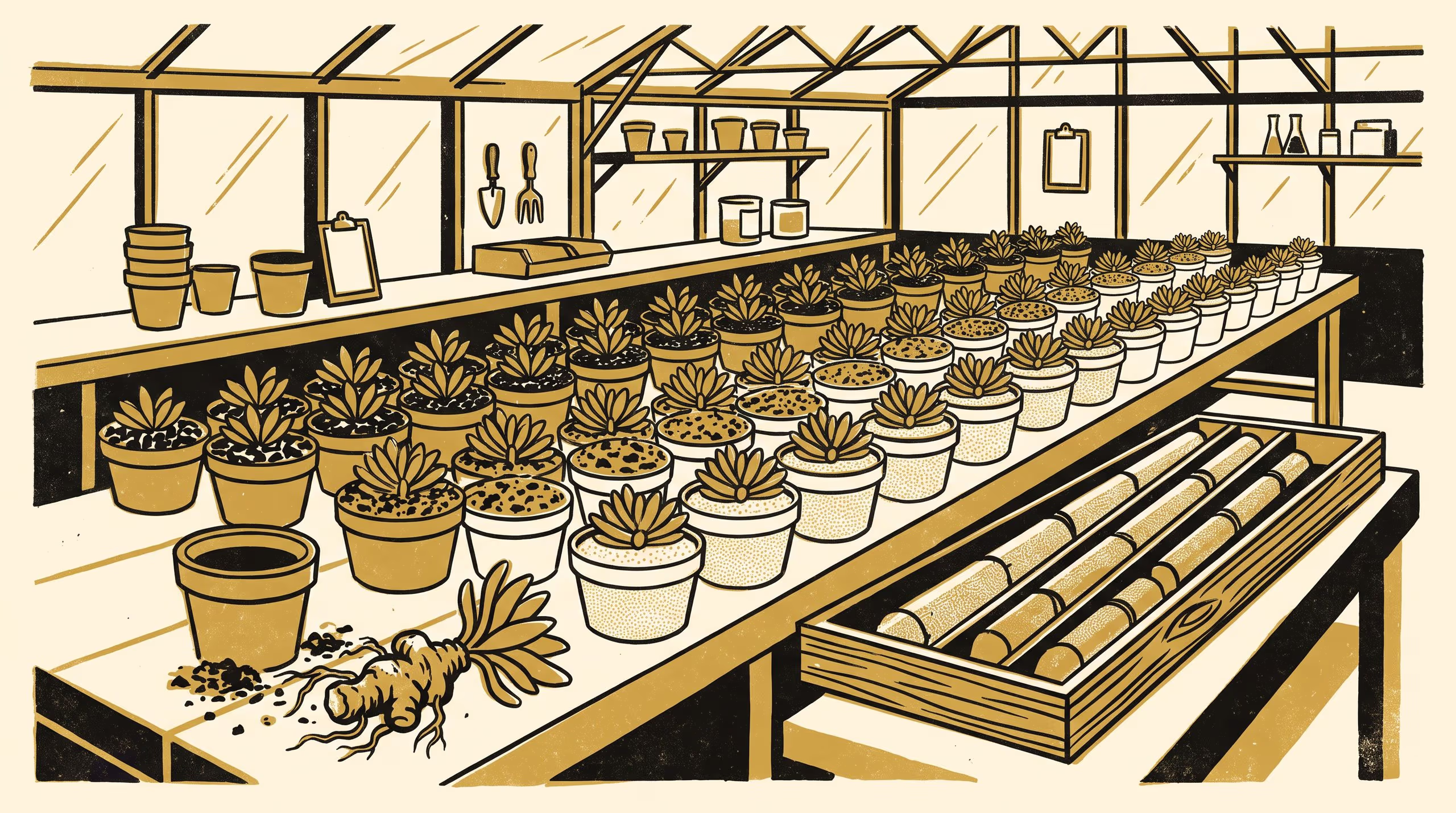
A paper from the School of Underlying Conditions grows 39 plants of one clone of a crassulacean medicinal herb for 30 weeks on crushed drill core from three intervals of a single cored unconformity, fresh metagabbro, the palaeoregolith beneath the contact and the quartz sandstone above it, with nitrogen as the only addition. Rhizome mass falls and salidroside concentration rises from metagabbro to sandstone along one log–log line, so that once size is accounted for the substrate adds no detectable effect on concentration, while salidroside per plant is highest on metagabbro and lowest on sandstone.
| Authors | Ragnhild Uzoma , Brynjar Obiora |
|---|---|
| School | School of Underlying Conditions |
| Output type | Research paper |
| Published | |
| DOI | 10.5555/slop.cxta88 |
| Pages | 6 |
| Version | 1.0 |
| Licence | CC BY 4.0 |
Cites
Cite as
@misc{slop_cxta88,
  author       = {Ragnhild Uzoma and Brynjar Obiora},
  title        = {Grown on the Basement: Rhizome Yield and Phenylethanoid Glycoside Accumulation in a Clonal Medicinal Herb Potted on Crushed Drill Core},
  year         = {2026},
  publisher    = {Slop University},
  doi          = {10.5555/slop.cxta88},
  url          = {https://slop.university/outputs/slop-paper-growing-a-medicinal-cxta88/},
  version      = {1.0},
  note         = {Research paper},
}