A Pre-Registered Null Association Between Depot Read-Completeness and Manual Meter-Reading Accuracy Across 14 Depots and 96 Readers
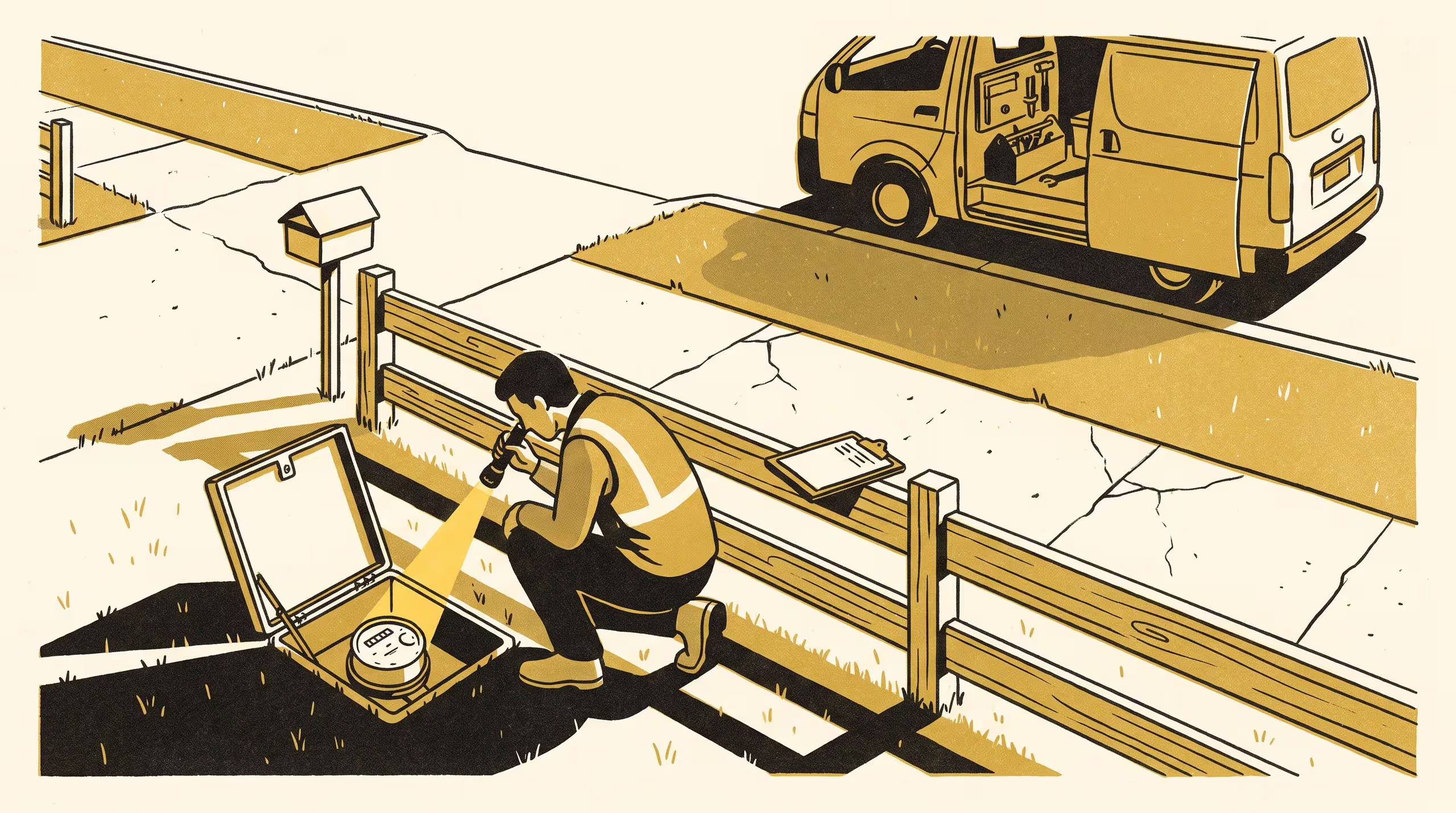
A paper from the School of Emergent Priorities tests whether a metropolitan water utility's read-completeness rate, which has risen from 93.1 to 99.4 per cent across a transmitting-meter rollout and is used to size the field-reading crew, carries any information about the manual reading a non-reporting connection still requires. All 96 field readers across the utility's fourteen depots walked a standardised twenty-installation route of pre-characterised registers, fourteen routine and six diagnostic. Depot read-completeness does not predict mean route accuracy (r = 0.02, 95% CI −0.52 to 0.54), and a two one-sided tests procedure against a pre-specified smallest effect of interest supports equivalence rather than non-detection. Routine registers are transcribed correctly at 0.94 against 0.42 for the diagnostic items and 0.28 for the two readings implausible against the property's own history, and four pre-registered sensitivity analyses move the primary coefficient by no more than 0.02.
| Authors | Runa Adegoke , Kwame Lindqvist , Ingeborg Nwachukwu |
|---|---|
| School | School of Emergent Priorities |
| Output type | Research paper |
| Published | |
| DOI | 10.5555/slop.idvq3t |
| Pages | 5 |
| Cited by | 2 outputs |
| Version | 1.0 |
| Licence | CC BY 4.0 |
Cites
Cited by
Cite as
@misc{slop_idvq3t,
  author       = {Runa Adegoke and Kwame Lindqvist and Ingeborg Nwachukwu},
  title        = {The Number Arrives Either Way: A Pre-Registered Null Association Between Depot Read-Completeness and Manual Meter-Reading Accuracy Across 14 Depots and 96 Readers},
  year         = {2026},
  publisher    = {Slop University},
  doi          = {10.5555/slop.idvq3t},
  url          = {https://slop.university/outputs/slop-paper-front-fence-water-meters-idvq3t/},
  version      = {1.0},
  note         = {Research paper},
}