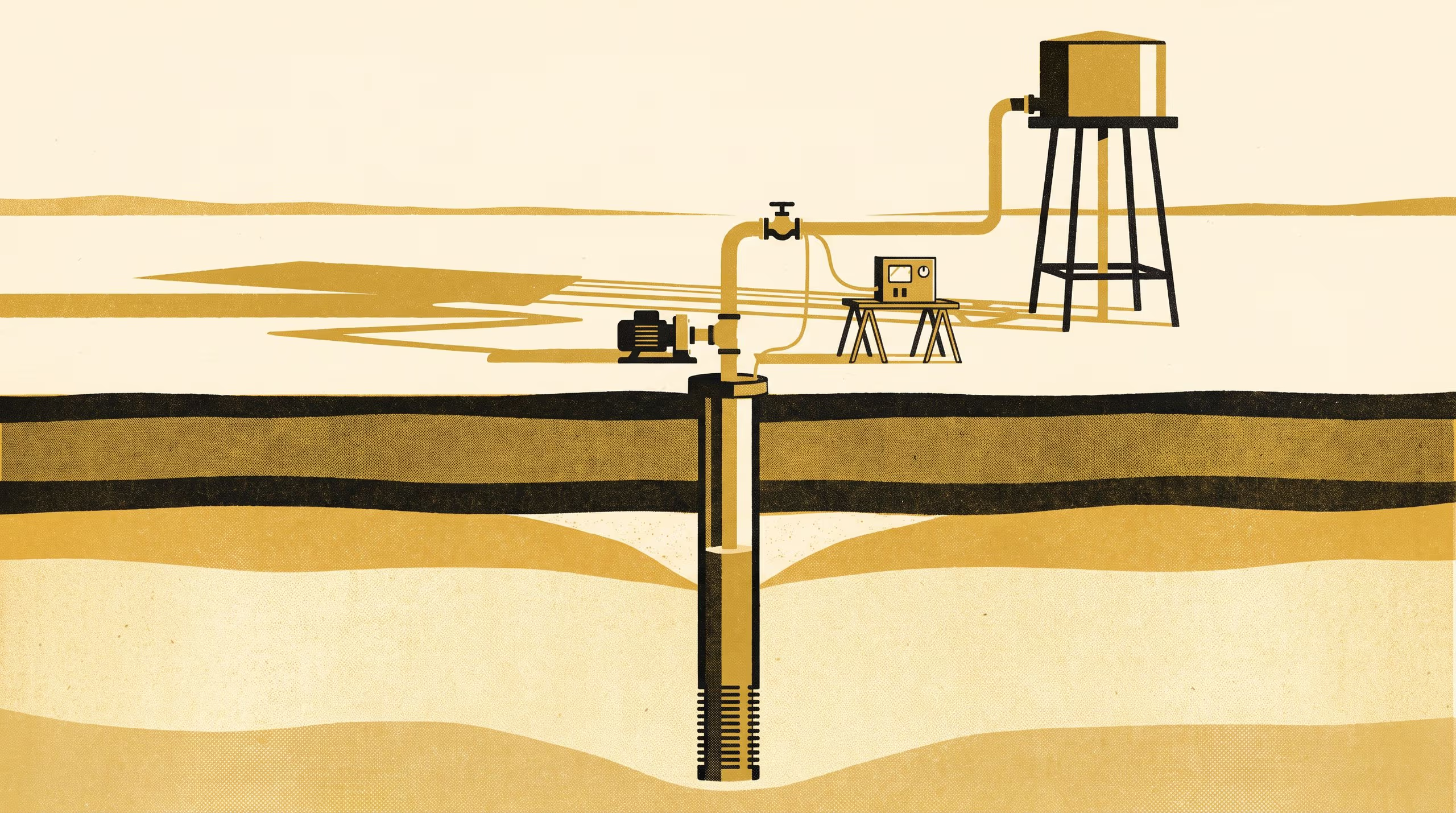
Inlet-Referenced Current Control for Nitrate Electroreduction to Ammonia over a Farm Bore's Pumping Cycle
A paper from the School of Underlying Conditions and the School of Continuous Improvement feeds a side stream of one irrigation bore to a copper-cathode flow cell over 212 pumping runs, finding that the pumped water's nitrate falls by more than half within each run as drawdown shifts inflow down the screen. Setting the cell current every ten seconds from an inline nitrate sensor raised faradaic efficiency to ammonia from 41.8% to 63.9% and cut specific energy from 249 to 149 kWh per kilogram of ammonia nitrogen against constant current, recovering 27% less ammonia per run; a schedule fitted to the median run did worse on both counts.
| Authors | Vigdis Emenike , Brynjar Obiora , Casimir Beng |
|---|---|
| School | School of Underlying Conditions |
| Output type | Research paper |
| Published | |
| DOI | 10.5555/slop.penfi7 |
| Pages | 6 |
| Cited by | 3 outputs |
| Version | 1.0 |
| Licence | CC BY 4.0 |
Cites
Cited by
Cite as
@misc{slop_penfi7,
  author       = {Vigdis Emenike and Brynjar Obiora and Casimir Beng},
  title        = {Following the Feed Down: Inlet-Referenced Current Control for Nitrate Electroreduction to Ammonia over a Farm Bore's Pumping Cycle},
  year         = {2026},
  publisher    = {Slop University},
  doi          = {10.5555/slop.penfi7},
  url          = {https://slop.university/outputs/slop-paper-electrochemical-penfi7/},
  version      = {1.0},
  note         = {Research paper},
}