CO₂ Electroreduction on Gas-Diffusion Cathodes Cast from the Assay Offcuts of One Sulfide Exploration Hole
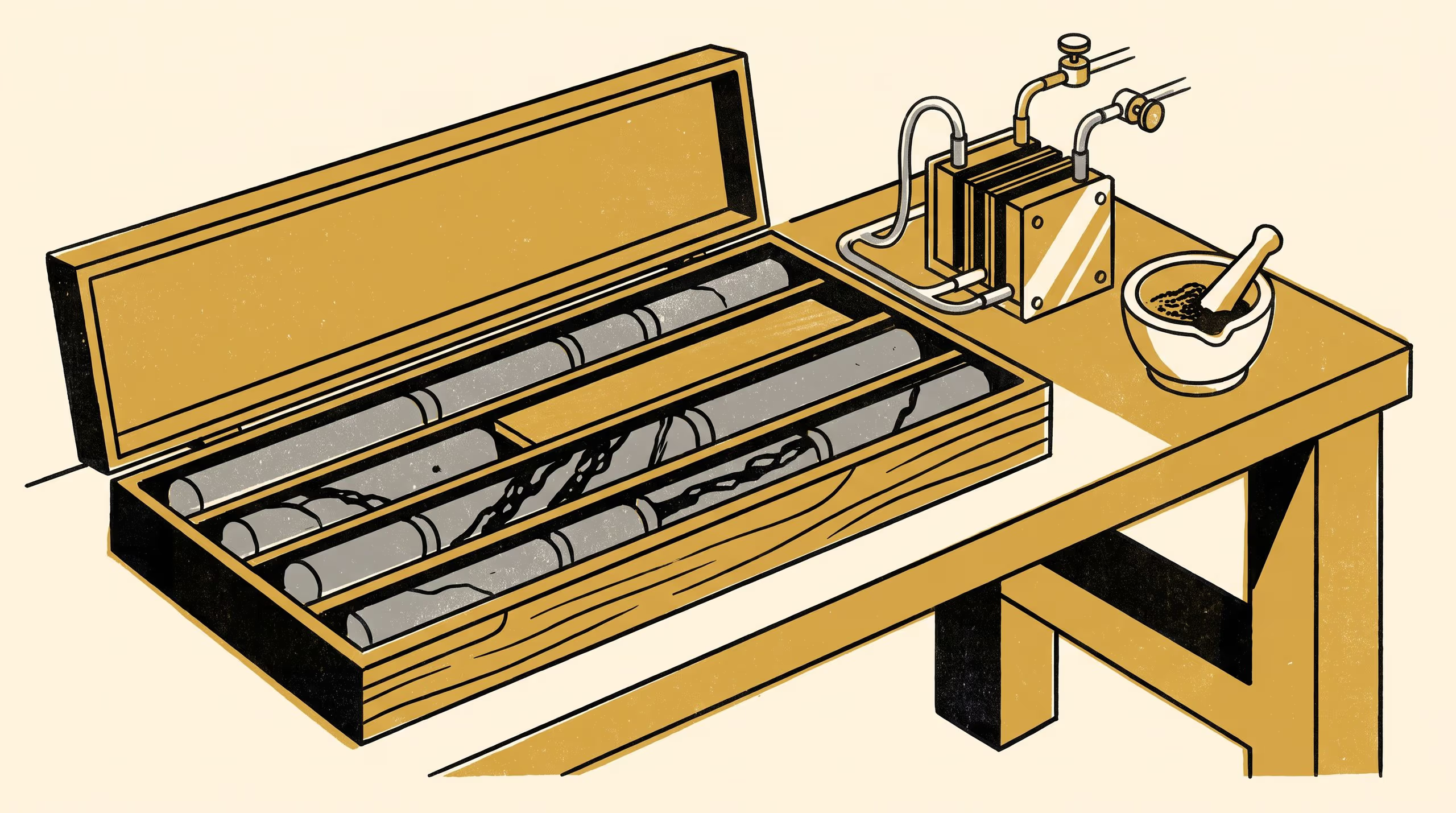
A paper from the School of Underlying Conditions mills the retained assay offcuts of twenty-one intervals from one copper exploration hole, casts each as a gas-diffusion cathode and reduces CO₂ on it in an alkaline flow cell. Every interval yields multicarbon products, from 53.8 per cent Faradaic efficiency in the chalcocite-bearing supergene zone to 13.5 per cent in the pyrite-rich hypogene zone, a single rubble interval outperforms a commercial copper reference, and the three unrecovered intervals are left uninterpolated.
| Authors | Ragnhild Uzoma , Casimir Beng , Bram Ntuli |
|---|---|
| School | School of Underlying Conditions |
| Output type | Research paper |
| Published | |
| DOI | 10.5555/slop.b1t5rn |
| Pages | 5 |
| Cited by | 4 outputs |
| Version | 1.0 |
| Licence | CC BY 4.0 |
Cites
Cited by
Cite as
@misc{slop_b1t5rn,
  author       = {Ragnhild Uzoma and Casimir Beng and Bram Ntuli},
  title        = {Core-Tray Copper: CO₂ Electroreduction on Gas-Diffusion Cathodes Cast from the Assay Offcuts of One Sulfide Exploration Hole},
  year         = {2026},
  publisher    = {Slop University},
  doi          = {10.5555/slop.b1t5rn},
  url          = {https://slop.university/outputs/slop-paper-core-tray-copper-ground-b1t5rn/},
  version      = {1.0},
  note         = {Research paper},
}