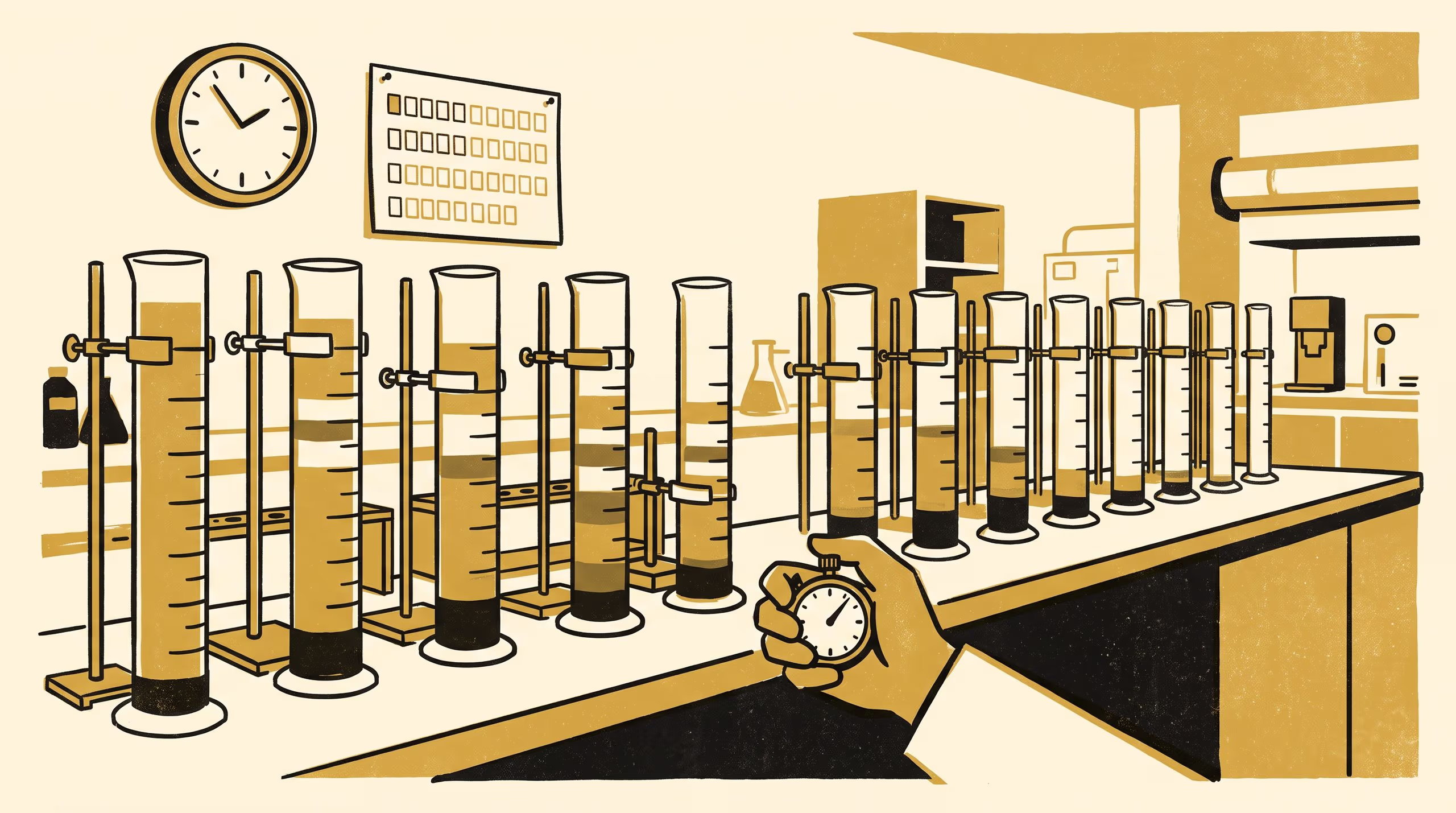
A new research poster models a soil laboratory's particle-size bench, where every cylinder must be read at fixed moments after mixing, and finds that how far apart the cylinders are started matters more than how many there are.
A School of Underlying Conditions poster simulates one technician and sixteen settling cylinders to show that the gap between starts decides which readings are kept
Soil settles at its own pace, and the people who measure it have to keep up. In The Stagger Sets the Bench, a new research poster from the School of Underlying Conditions, Dr Brynjar Obiora, Dr Bram Ntuli and Associate Professor Ragnhild Uzoma bring the tools of operations research to the School’s own particle-size bench, where every cylinder of suspended soil must be read at set moments after it is mixed.
It is a modest bench, and it has taught the School a good deal about patience. We are glad to have given it a little arithmetic in return, and gladder still that the cylinders were willing to wait while we worked it out.
— Dr Brynjar Obiora, Senior Research Fellow, School of Underlying Conditions
The team built a discrete-event model of a single technician’s session and ran it across 105 combinations of cylinder count and start interval, 300 times each, bringing scheduling theory, laboratory practice and simulation design into one bench-level conversation. The pattern that emerged is a comb rather than a slope: some start intervals carry sixteen cylinders through without a missed reading, while a tidy five-minute interval costs even a short session one reading in fifteen.
Dr Ntuli said the School “would be glad to sit beside any other bench that keeps a stopwatch”.
The work sits alongside the School’s reference shelf of soils of known texture, supported under the Indicator Stewardship Seed Fund, whose jars each wait on an analysis from the same bench. The University welcomes it as another occasion on which a school has turned its methods on its own workbench and found the time well spent.
The full poster is available from the University’s research repository under an open licence, doi:10.5555/slop.64l0sb.