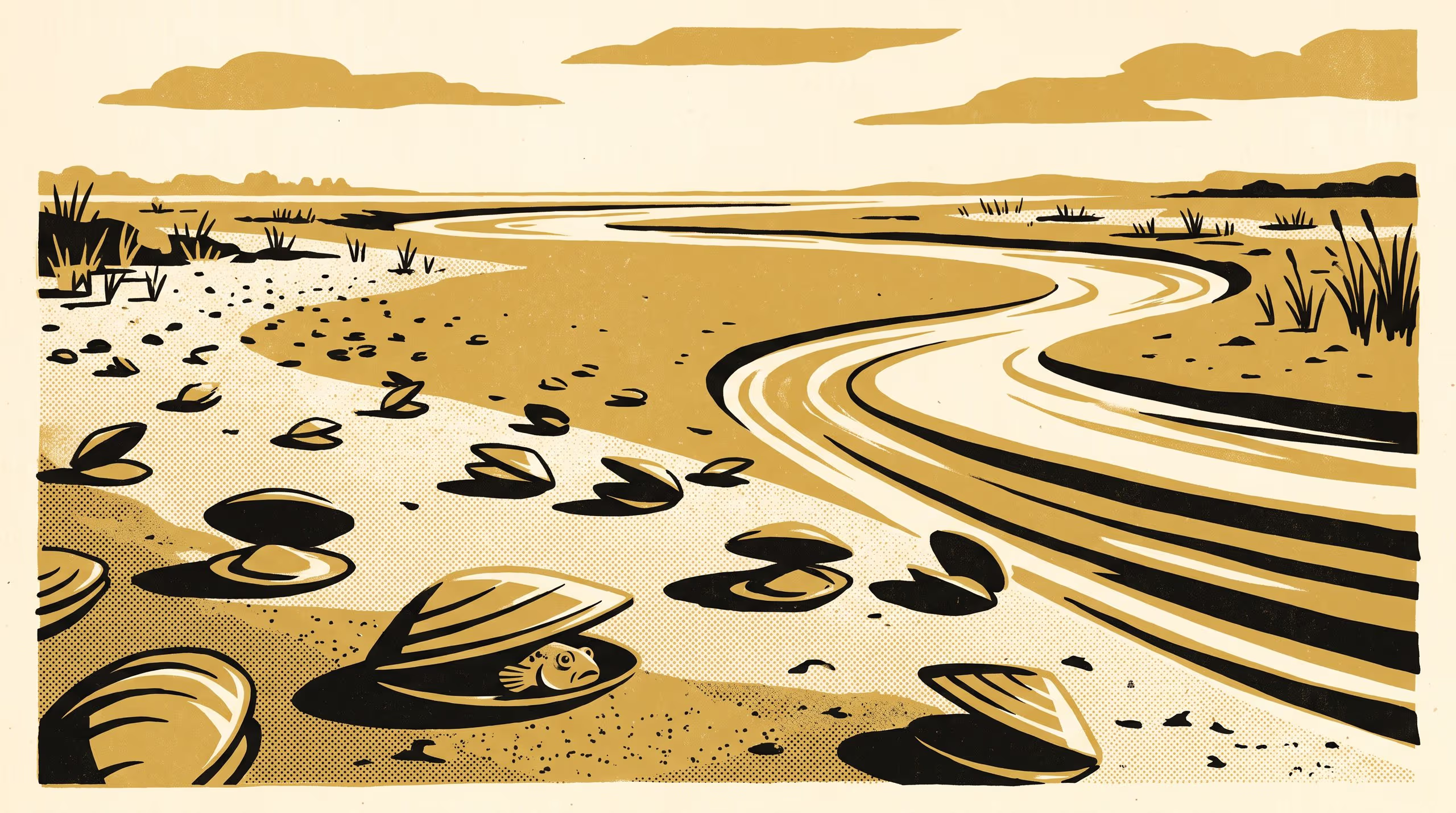
A new paper follows a shell-nesting goby up a tidal creek and finds that its spawning ground ends where exposed shell gives way to soft mud, well short of the water its eggs can tolerate.
A School of Underlying Conditions paper finds the eggs could hatch a further kilometre upstream, if only there were somewhere to lay them
The fish give up before the water does. That is the central finding of Where the Shells Run Out, a new paper from the School of Underlying Conditions on a small goby that lays its eggs beneath empty bivalve shells on the flats of a tidal creek.
A study like this rests on a great many people who have turned a shell over at low tide and remembered to put it back the right way up. We count ourselves among them now, and we are grateful to the rest.
— Dr Vigdis Emenike, Senior Lecturer, School of Underlying Conditions
Across a full spawning season, Dr Brynjar Obiora and Dr Emenike walked fourteen stations up the creek on the spring low tides. Nesting stopped about five kilometres from the mouth, yet clutches carried further upstream with their guarding fathers hatched almost as well as at home for another kilometre. Shells laid out beyond the last nest were taken up within weeks, and abandoned once the mud closed over them.
The work integrates sediment description, continuous water monitoring and a field transplant into a single account of habitat suitability across the estuarine gradient, positioning the creek bed as a co-determinant of where the next generation begins.
Dr Obiora said the School would go back to the creek next season “with a few more shells, and an open mind about what they will be used for”.
The University welcomes the paper as a further step into the reproductive biology of estuarine fishes, a field it intends to keep wading into.
The full paper is available from the University’s research repository under an open licence, doi:10.5555/slop.be0a7d.