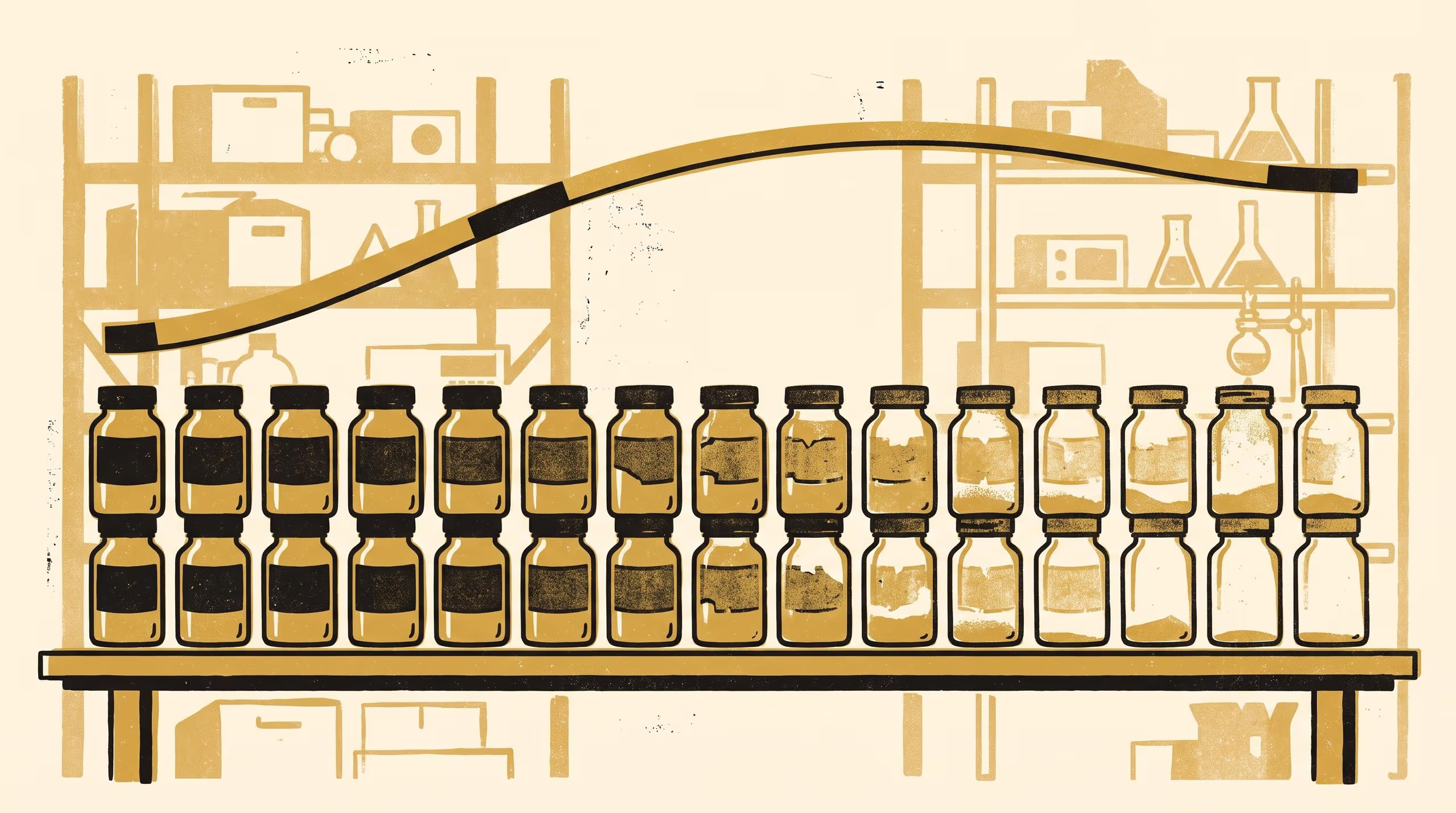
A new research poster brings fourteen retained lots of one dried leaf extract out of storage and onto a single set of culture plates, and finds the older lots reach half their effect at the same concentration as the new ones but stop short of their full effect.
A School of Underlying Conditions poster re-assays nine years of retained lots on the same plates, and finds storage takes efficacy rather than potency
The School of Underlying Conditions has always kept what it measures. Its latest research poster asks what the kept things have been doing since.
In They Flatten, They Don’t Shift, Dr Brynjar Obiora, Associate Professor Ragnhild Uzoma and Dr Vigdis Emenike re-assay fourteen retained lots of one dried leaf extract, released over nine years, side by side. The concentration at which each lot reaches half its effect has barely moved. The most it can do has: the oldest lots stop between 13 and 25 points short of where they began.
A soil surveyor learns early that a sample in a bag is a sample of the day it went into the bag. We have simply gone back to the bags, with better manners and a plate reader.
— Dr Brynjar Obiora, Senior Research Fellow, School of Underlying Conditions
The team brought the retained lots out of the cabinet and onto a single set of culture plates, aligning a cell-based inflammation assay with a chromatographic fingerprint of every lot to build an integrated picture of how a botanical extract’s activity profile evolves across its storage life. A minor late-eluting fraction emerged as the likely carrier of what the years remove.
The University counts the poster among the most careful acts of housekeeping its laboratories have yet undertaken. “We keep a great many things here in case they are needed,” said Associate Professor Uzoma. “It is reassuring to learn that most of them are still themselves, and useful to know roughly when they begin not to be.”
The full poster is available from the University’s research repository under an open licence, doi:10.5555/slop.ffguo5.