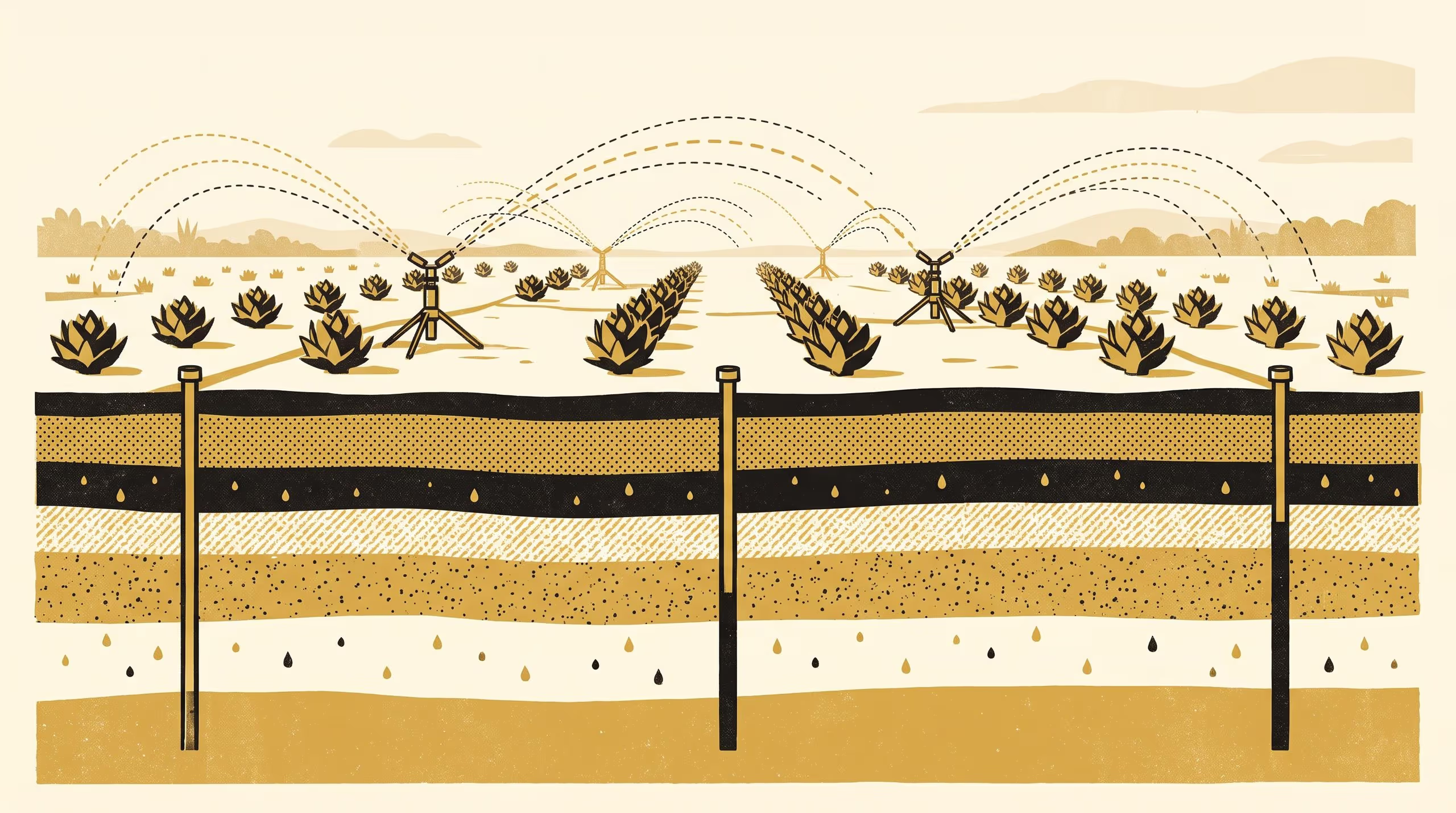
A new paper waters a resting globe artichoke field at three depths to end its summer dormancy, and traces how much of each watering the plants used and how much travelled on to the groundwater below.
A School of Underlying Conditions paper finds a dormant crop wakes on its smallest watering, while the larger ones go mostly to the water table
A globe artichoke field spends the hottest weeks of the year asleep, and the watering that wakes it at summer’s end has long been a matter of custom rather than measurement. The School of Underlying Conditions has now measured it, from the sprinkler to the aquifer.
Where the Wake-Up Water Goes, by Dr Vigdis Emenike, Senior Lecturer, and Dr Brynjar Obiora, Senior Research Fellow, brings the School’s groundwater fieldwork to the surface of a working crop.
A bore tells you what arrived and when. It is more reserved about why, and we were happy to leave a little of that to the artichokes.
— Dr Vigdis Emenike, Senior Lecturer, School of Underlying Conditions
Pairing plot-scale soil-water monitoring with a network of observation bores, the authors built a whole-of-profile account of the forcing irrigation, connecting irrigation practice, crop response and aquifer behaviour in a single field season. Plants woke in about nine days whatever they were given, and up to 39 per cent of the larger waterings went on to the water table.
For a School founded on what lies beneath, the paper marks a welcome extension of its reach towards the ground’s upper storeys. Dr Obiora was quick to credit the field itself. “Every profile pit raises more questions than it settles, and this one was generous in that respect. We expect to be returning to the questions for some seasons yet.”
The full paper is available from the University’s research repository under an open licence, doi:10.5555/slop.g7ac0r.