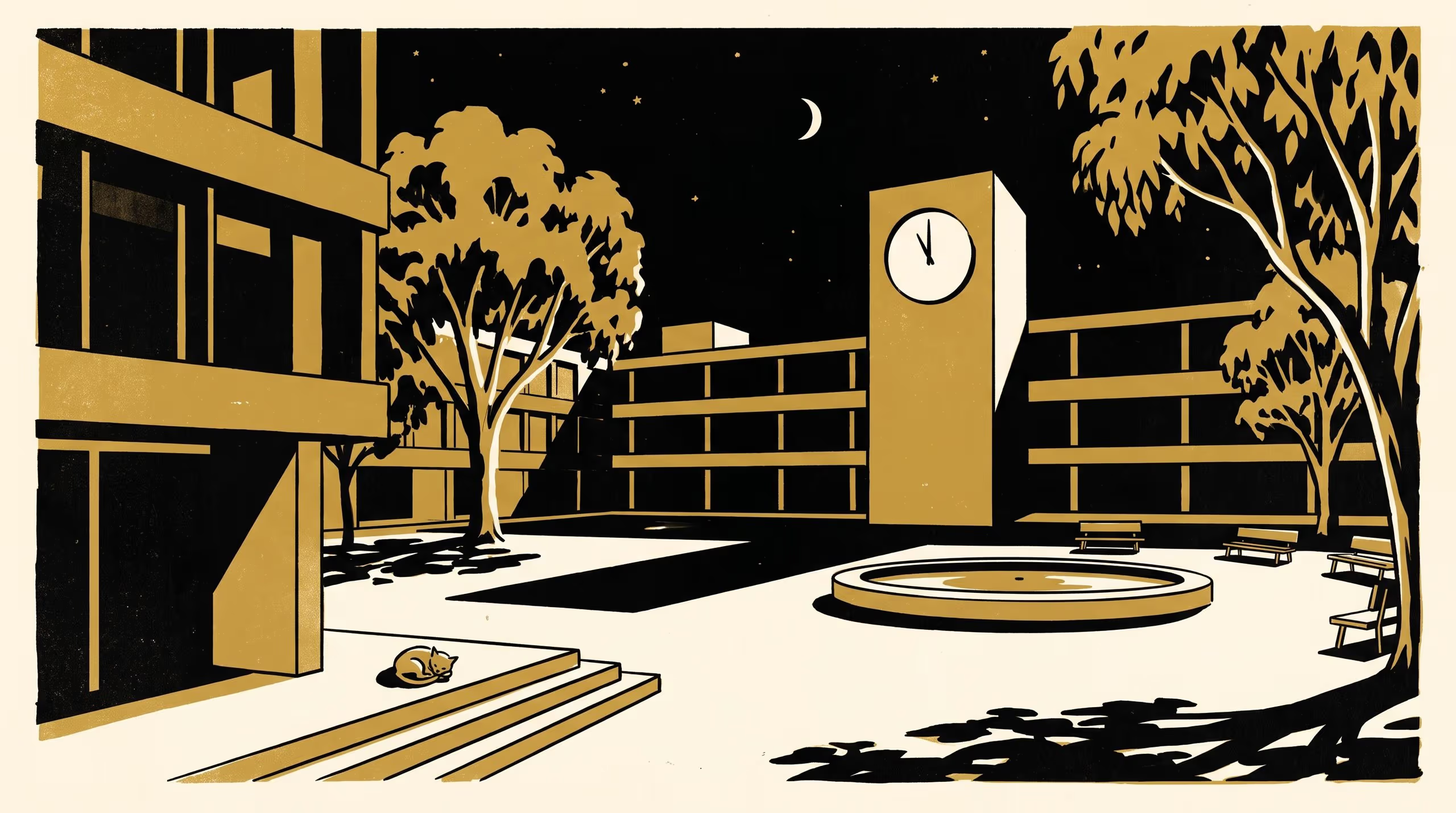
Slop University's Strategic Plan 2026-2031 makes the neuroscience of respiration and sleep a cross-school research priority, and commits the University to a nightly quiet interval in which it sends no institutional correspondence.
Breath and sleep become a research priority, and the University settles when it will stop writing to its own people
A plan like this is mostly a promise about when we will be quiet. I expect the people who keep the overnight rosters will read it more closely than anyone, and they are the readers we had in mind.
— Associate Professor Ragnhild Uzoma, Lead, Basement Relations Group
The Quiet Interval, the University’s Strategic Plan 2026-2031, brings the study of how breathing is generated and how sleep reshapes it into the centre of the University’s research agenda. It was prepared by Associate Professor Ragnhild Uzoma and Dr Vigdis Emenike of the School of Underlying Conditions, with Associate Professor Kwame Lindqvist, Director, Master of Priority Studies.
Across five focus areas, the plan aligns overnight recording capability, a cross-school doctoral pathway and the long-term stewardship of whole-night records behind a single institutional ambition. It also turns the field’s attention back on the University, settling a nightly quiet interval for institutional correspondence and a recovery period after each major review cycle, both to be made and maintained by the Department of Policy Settings.
The plan sits comfortably within the University’s habit of building slowly on what its schools already do well. Associate Professor Lindqvist described its phasing as “unhurried by design, which seems right for a field that does so much of its best work after dark”.
The full Strategic Plan is available from the University’s research repository under an open licence, doi:10.5555/slop.5hk8oh.