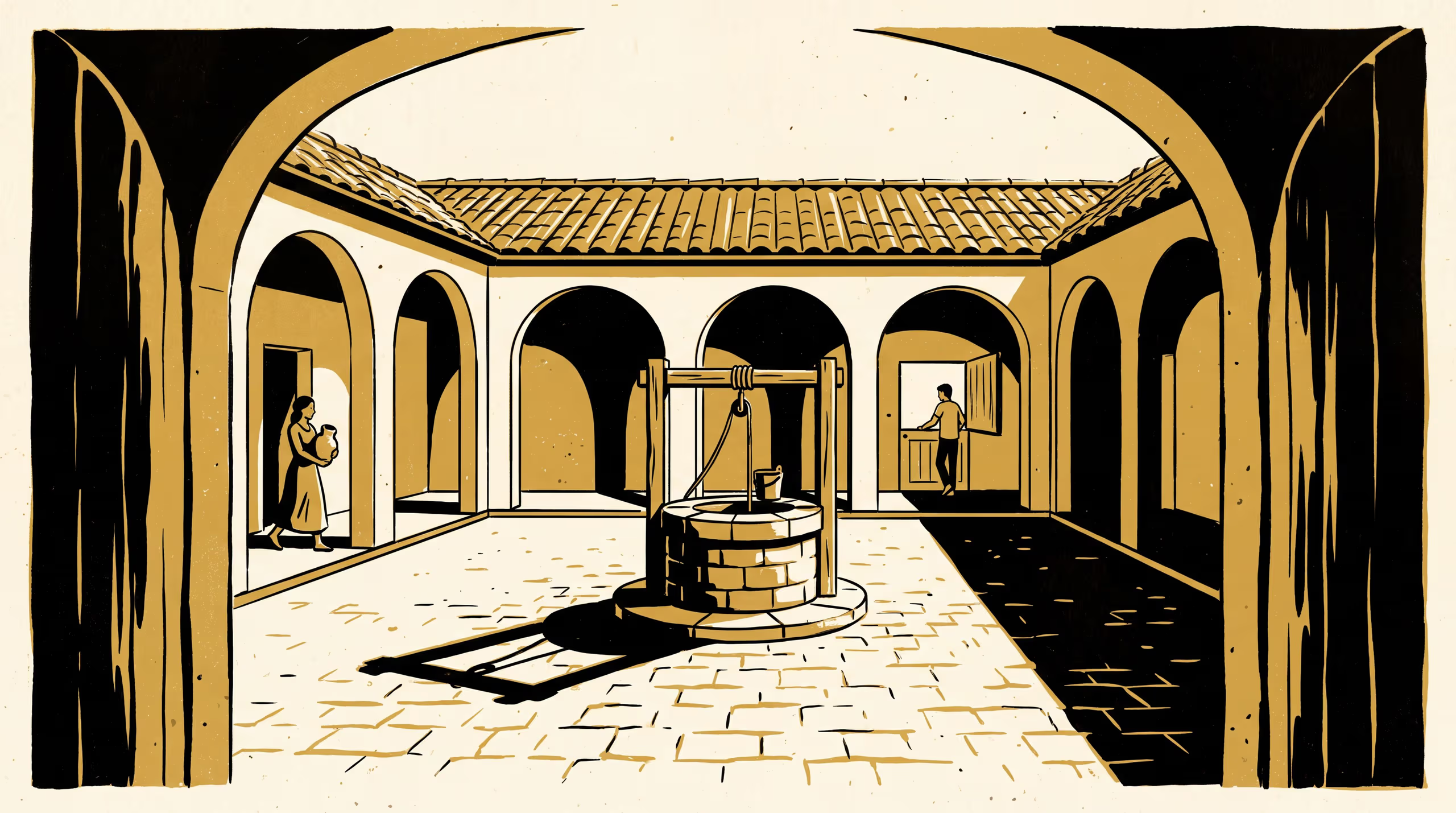
A new research poster from the School of Underlying Conditions reads the courtyard wells of sixty-four manuscript verse romances as architecture, and finds the suitor's way to the water is the one the house was never drawn with.
A research poster turns sixty-four manuscript romances into floor plans and asks where each one keeps its water, and who it lets near
Where should a house keep its water, and who should be allowed to reach it? The School of Underlying Conditions has put that question to an unexpected body of evidence in Two Steps from the Gate, a new research poster by Dr Vigdis Emenike, Mr Eivind Onwuka and Ms Sunniva Balogun.
A monitoring bore and a courtyard well have more in common than you might expect. Each was put somewhere for a reason, and each goes on being visited long after anyone can say what the reason was. The School is still working out what that tells us.
— Dr Vigdis Emenike, Senior Lecturer, School of Underlying Conditions
The team approached sixty-four verse romances from a single manuscript collection as a body of buildings rather than a body of stories, translating each text’s comings and goings into a plan of the household it describes and mapping the routes its people take to the water. Across 212 scenes at the well, servants, daughters and travellers keep broadly to the house as drawn. Suitors do not: in most of their scenes the way in is a door, a gap in a wall or a channel that the plan has never shown before and never shows again.
Ms Balogun, a Doctoral Candidate in the School of Emergent Priorities, said the project had raised “more questions about what a page is holding back than any of us expected to be asked, and we would rather keep asking them than settle them early.”
The poster joins the School’s growing practice of reading plans for what they leave out, and reflects a readiness to follow its questions wherever the water has been put.
The full poster is available from the University’s research repository under an open licence, doi:10.5555/slop.5alyje.