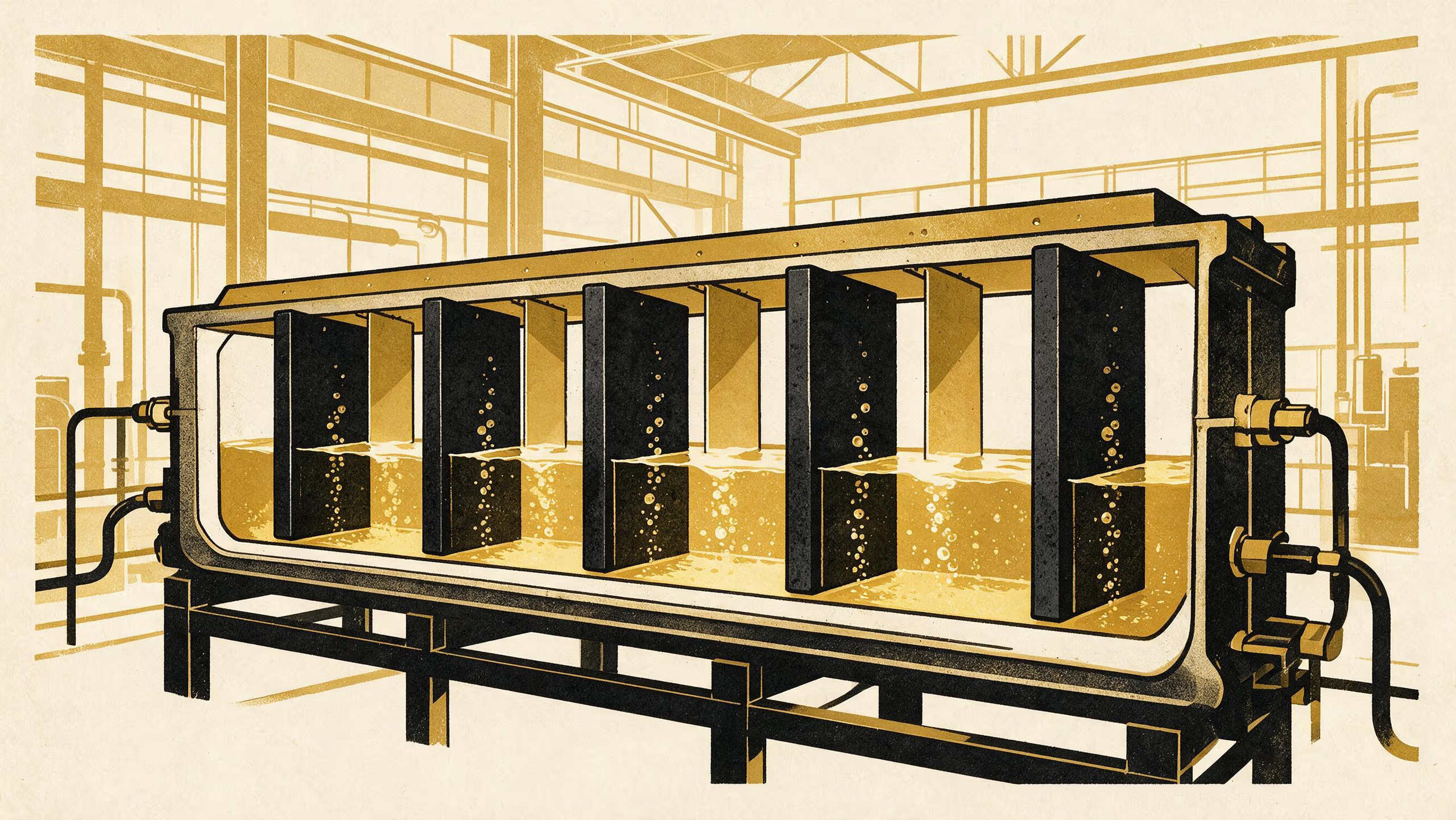
A new research poster from the School of Underlying Conditions finds a best depth for the ceramic baffles that keep stray current out of the shared melt of a bipolar magnesium electrolysis cell.
A School of Underlying Conditions pilot cell lets least current slip round its plates with baffles dipped 60 mm, and makes less metal when they go further
The ceramic baffles that hang between the compartments of a bipolar molten salt cell do their best work at a middle depth, according to a new research poster from Slop University. Lowered 60 millimetres into the melt, they held the current slipping round the cell’s plates to 2.2 per cent; lowered further, they saved little more current and cost the cell some of its metal.
The Current That Goes Round, by Dr Brynjar Obiora of the School of Underlying Conditions with Dr Bram Ntuli and Associate Professor Casimir Beng of the School of Continuous Improvement, brings pilot-scale electrochemistry, network modelling and careful weighing together into one account of where a cell’s current goes when it is not making metal.
Every setting on this poster meant a baffle cut, fitted, run for a day and cut again. The School’s workshop did that at every depth without complaint, and the result belongs to them as much as to us.
— Dr Brynjar Obiora, Senior Research Fellow, School of Underlying Conditions
The work extends the School’s attention to boundaries into the operational realities of electrolytic production, pairing an instrumented pilot cell with a model of the melt’s leak paths to surface the routes current takes between its plates. The University counts work of this kind, patient and close to the equipment, among the quieter foundations of its research culture.
Dr Ntuli, Lecturer and Convenor, Improvement Grand Rounds, said the team was content to leave one question standing. “We have a reading of why the deeper baffles cost metal, and not yet a test of it. We would rather say so on the poster than find out at the next tapping.”
The full poster is available from the University’s research repository under an open licence, doi:10.5555/slop.qr2tqp.