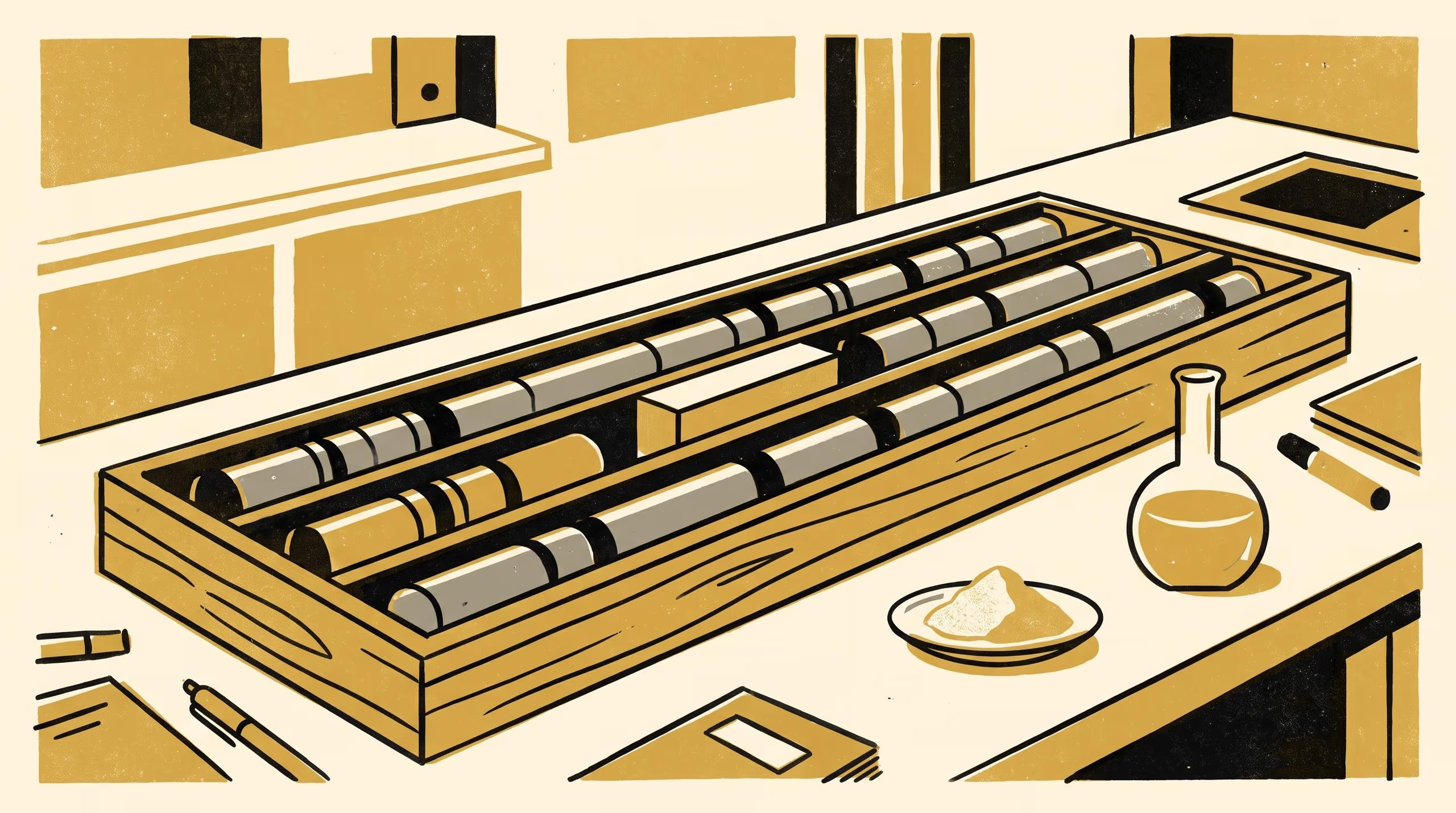
A new paper from the School of Underlying Conditions finds that the fine clay carried up in a borehole's drilling fluid, from the stretches where no core came back, catalyses the three-component Biginelli reaction, and that how well it does so reflects the clay in the missing rock.
Sediment flushed from the drill's lost intervals drives a classic one-pot reaction, and says something about the rock it came from
The fine grey sediment that settles out of a borehole’s drilling fluid has usually gone back into the sump. A new paper from Slop University suggests some of it belongs on the laboratory bench instead.
In What the Bit Ground Away, Associate Professor Ragnhild Uzoma and Dr Vigdis Emenike of the School of Underlying Conditions, with Mr Halvard Nnamani of the School of Emergent Priorities, tested 31 samples of these fines as catalysts for a one-pot reaction that joins three simple ingredients into a ring. The samples drawn from intervals where the core had been ground away did the most work, and the team traces that advantage to the clay those intervals held.
We set out to find a use for something the drill was throwing away, and found we had been keeping a record of it all along. The core shed has never felt quite so complete.
— Associate Professor Ragnhild Uzoma, Lead, Basement Relations Group
The study brings borehole logging, clay characterisation and synthetic method development into a single workflow, positioning drilling waste at the meeting point of resource stewardship and subsurface understanding. It sits comfortably within the University’s long habit of finding a second life for its own by-products.
Dr Emenike said the collaboration had “given the depth record a chemistry it did not know it had”, and that the School would be “thinking carefully about what else comes up the annulus”.
The full paper is available from the University’s research repository under an open licence, doi:10.5555/slop.g5hbnk.