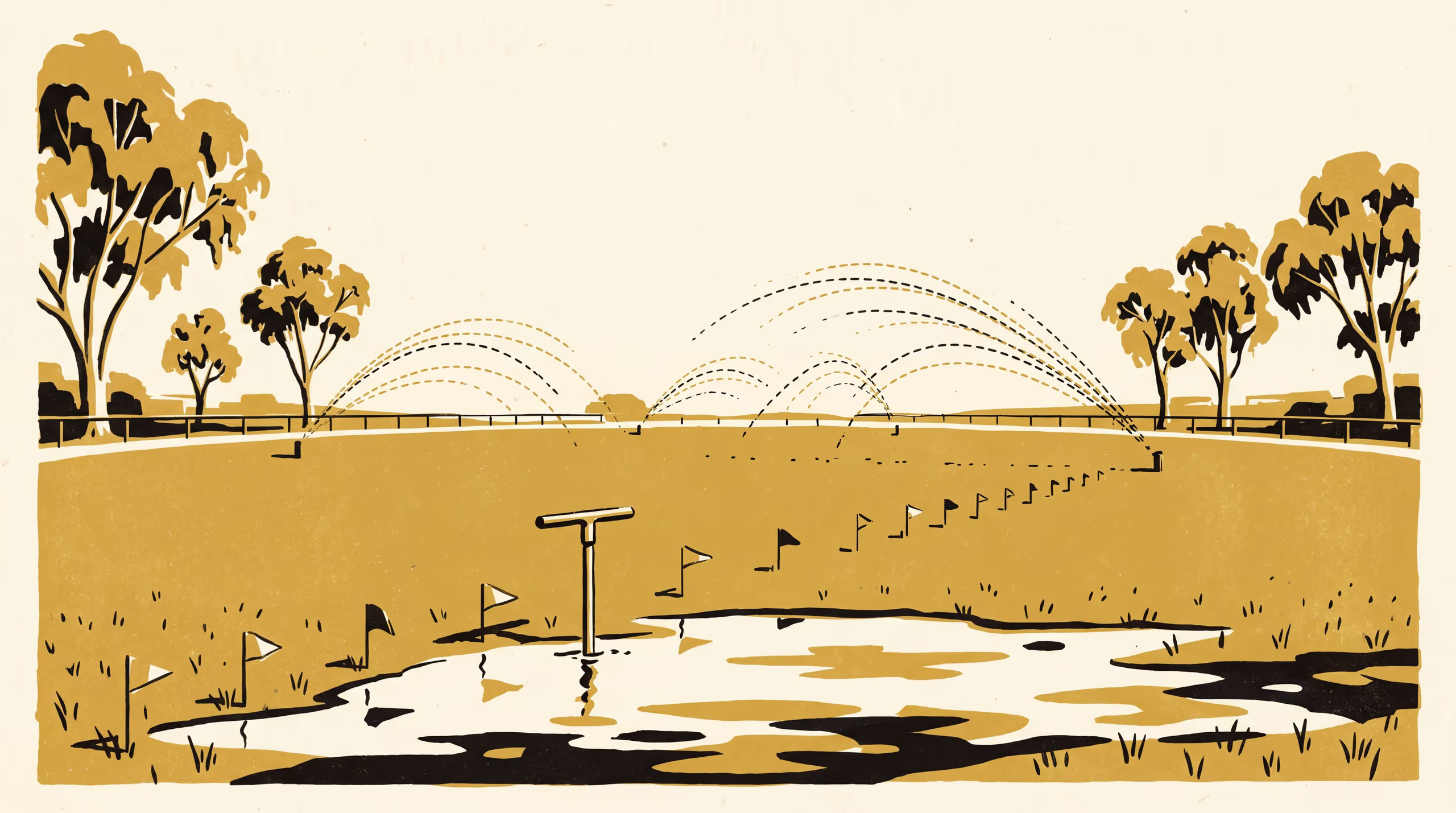
A research poster from the School of Continuous Improvement traces pharmaceutical residues and antibiotic resistance genes from the crown of recycled-water-irrigated sports grounds to their lowest corners.
A School of Continuous Improvement poster finds pharmaceutical residues and resistance genes gathering where community sports grounds drain
The recycled water that keeps a suburban football ground green does not stay where the sprinklers put it. That is the central finding of The Low Corner, a new research poster from the School of Continuous Improvement, which follows trace pharmaceutical residues and antibiotic resistance genes downhill across sixteen community grounds, from the crown of each field to the corner where its water comes to rest.
The poster is led by Mr Eskil Nwabueze, a doctoral candidate in the School, with Dr Brynjar Obiora and Dr Vigdis Emenike of the School of Underlying Conditions.
The people who mark out and water these grounds every week knew where the puddle forms long before we arrived with a corer. Most of what we did was ask them, and then believe them.
— Mr Eskil Nwabueze, Doctoral Candidate, School of Continuous Improvement
The study brings soil survey practice, laboratory chemistry and molecular methods together into a single account of how shared community infrastructure redistributes what passes through it, and situates the humble playing field within a wider conversation about water reuse, soil health and the stewardship of public open space. Dr Obiora said the grounds had “a profile worth respecting”, and that the School of Underlying Conditions was glad to have lent its augers to it.
For the University, the poster belongs to a quieter tradition of scholarship that begins at the boundary fence and works inwards, and the School extends its thanks to the grounds staff of every participating club.
The full poster is available from the University’s research repository under an open licence, doi:10.5555/slop.5n147t.