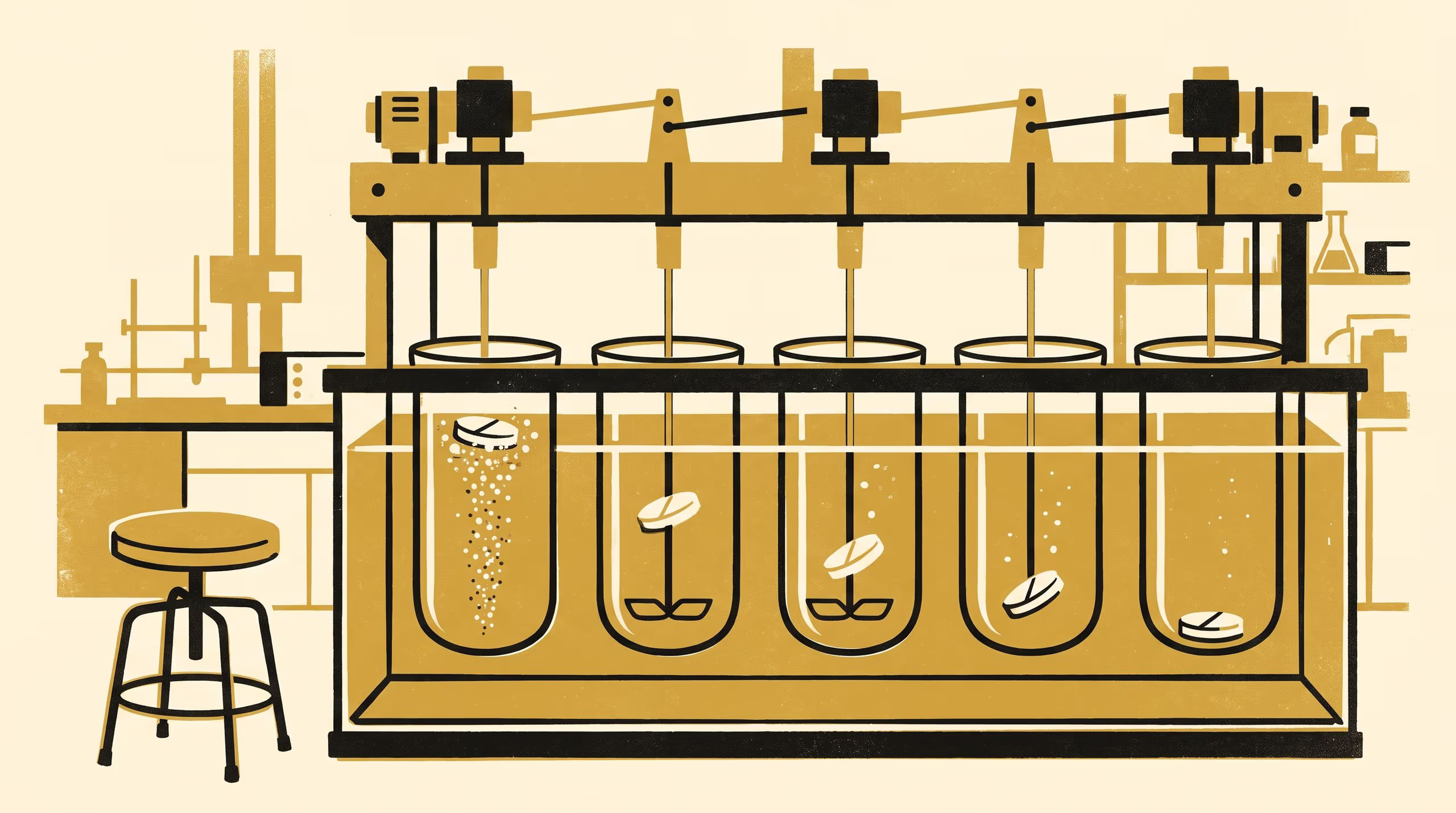
A new research poster from the School of Underlying Conditions follows 120 floating matrix tablets through twelve hours each and finds the pressing conditions under which they stay up.
A School of Underlying Conditions poster maps late buoyancy loss across compaction pressure and gas generant
A tablet that floats is only half a formulation, according to The Second Sinking, a new research poster from Dr Brynjar Obiora and Associate Professor Ragnhild Uzoma of the School of Underlying Conditions. The other half, the authors suggest, is what happens around hour four.
The School has always been most at home below the surface. It has been instructive to spend a season working out what keeps something on top, and for how long.
— Dr Brynjar Obiora, Senior Research Fellow, School of Underlying Conditions
The poster brings tablet compaction, buoyancy monitoring and side-on video together into a single integrated account of late-stage floating performance. Across 120 tablets pressed under twenty combinations of conditions, it surfaces two distinct pathways by which a floating matrix returns to the floor of its vessel, and identifies a band of formulation settings in which all eighteen tablets tested stayed afloat to the end of the run.
Associate Professor Uzoma described the study as a natural companion to the pair’s earlier sectioning work on spent matrix tablets. “We have now looked at these tablets from the inside and from the side,” she said. “There is every reason to think they have more to show us.”
The work extends the School’s growing practice in formulation science, and the University is glad to see a School founded on what lies underneath take such careful interest in what rises.
The full poster is available from the University’s research repository under an open licence, doi:10.5555/slop.qxg1yd.