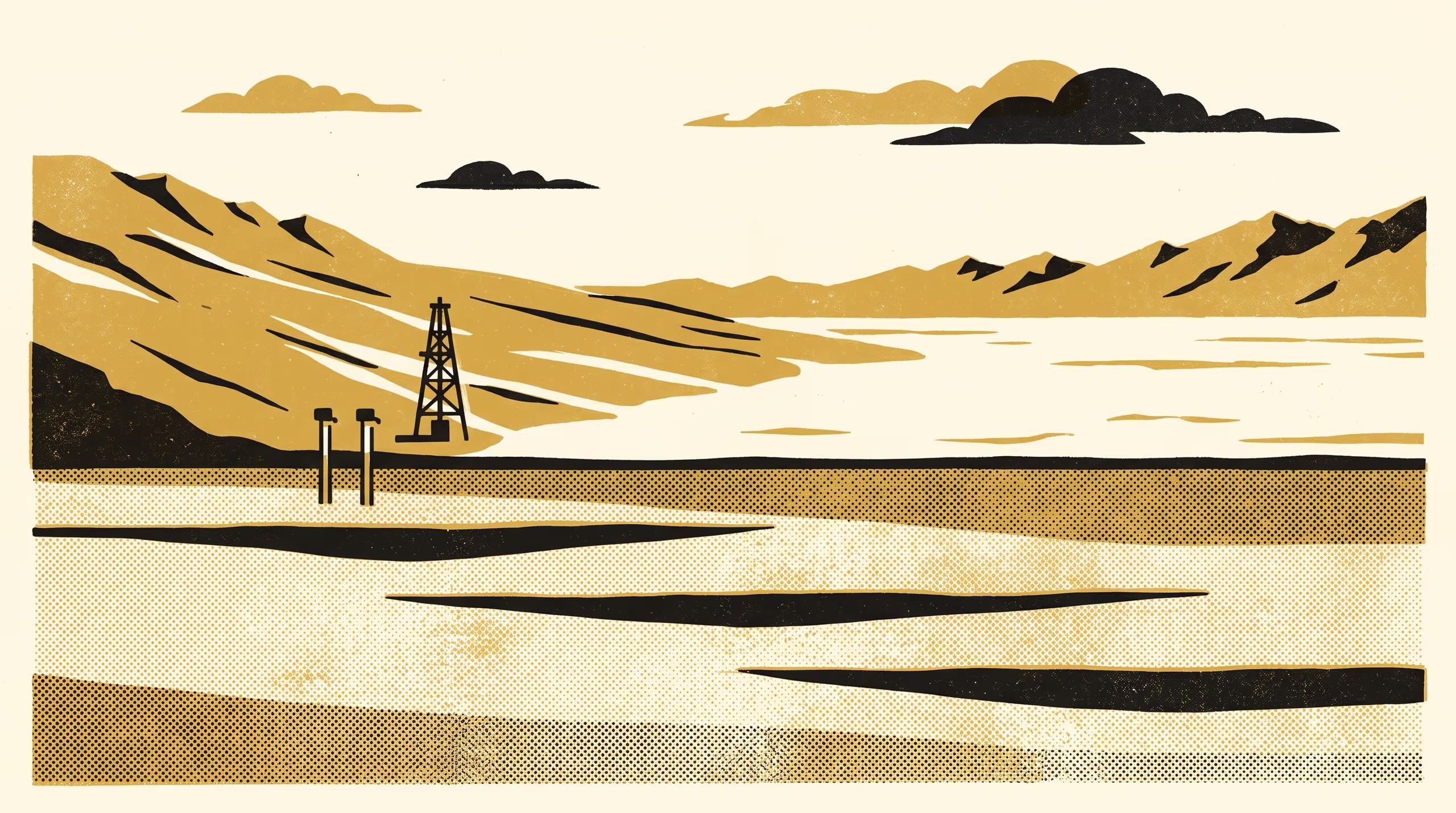
A new paper from the School of Underlying Conditions resolves a confining clay at the edge of a dry lake into three lenses, and shows where the aquifers above and below it meet.
A School of Underlying Conditions paper finds three stepped lake clays where a groundwater model drew one layer
How many layers of clay lie beneath the place where a desert fan runs out onto a dry lake? The regional groundwater model says one. Shingled, Not Sheeted, a new paper from the School of Underlying Conditions, counts three.
Led by Dr Vigdis Emenike with Associate Professor Ragnhild Uzoma and Dr Brynjar Obiora, the study brings core, borehole logs and two years of water levels into a single account of the clay along a 6.2 km line from fan to lake floor. Each of the three lenses records a time when the lake spread towards the fan, and each later lens reaches a little further up the slope than the one before. Where two lenses overlap, the aquifers above and below stay apart; in the two gaps where no clay was laid down, they behave as one.
This paper stands on decades of logs kept by drillers who never expected anyone to read them twice. We owe them the care we tried to bring to every line.
— Dr Vigdis Emenike, Senior Lecturer, School of Underlying Conditions
The work aligns the School’s coring, logging and monitoring capability around one shared question, and it takes its place in the University’s patient effort to describe, layer by layer, what lies under its feet. Associate Professor Uzoma, Lead of the Basement Relations Group, said the study “sets a steady pace for the correlation work the Group has ahead of it.”
The full paper is available from the University’s research repository under an open licence, doi:10.5555/slop.2urnlu.