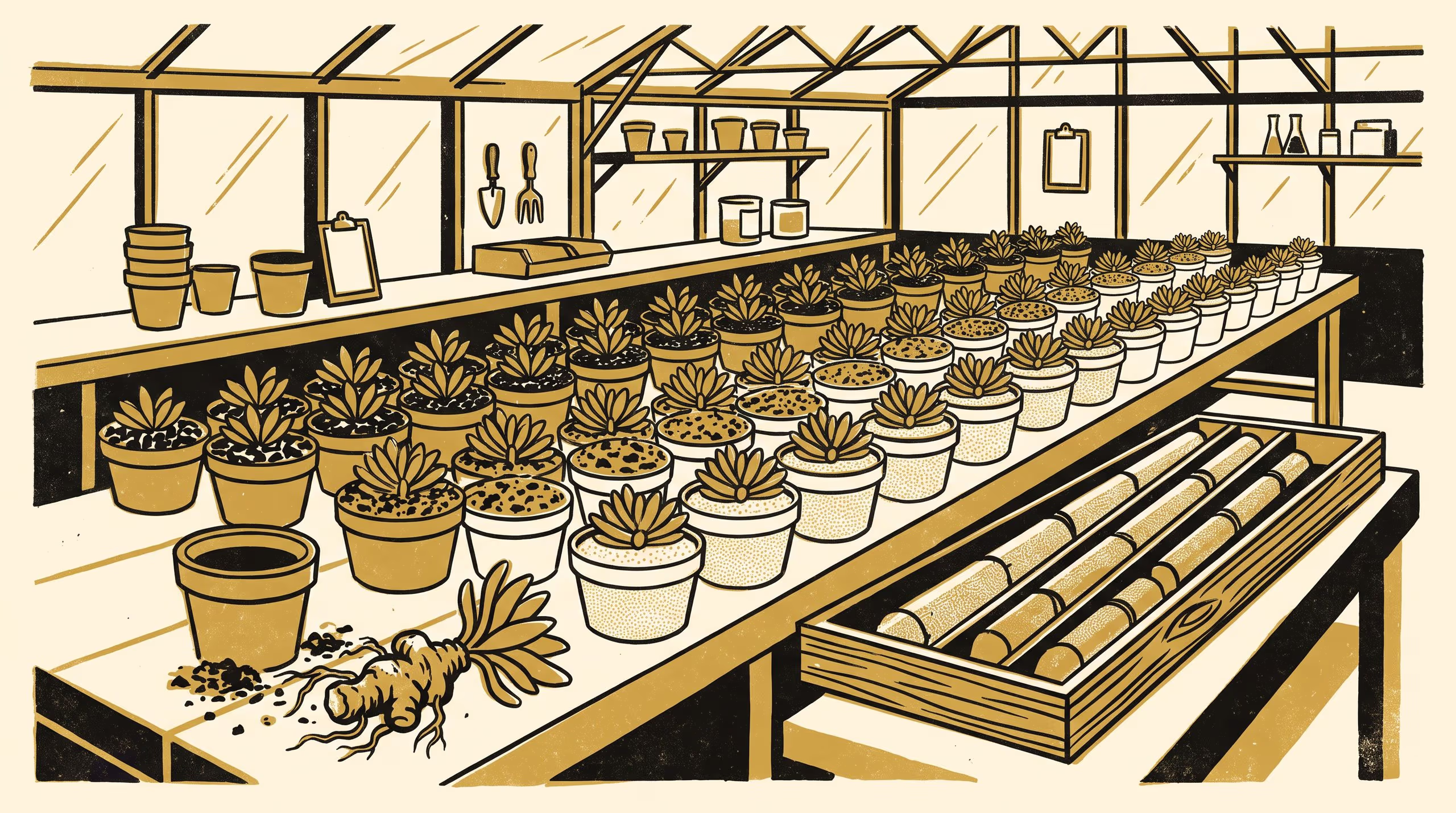
A new paper from the School of Underlying Conditions grows a single clone of a medicinal herb on crushed core from three intervals of one borehole and follows the rock's influence through to the chemistry of the harvested root.
Rock from one borehole sets how large each root grows, and the root's size sets how concentrated its glycosides become
A bench in the University’s glasshouse has spent thirty weeks growing a medicinal herb in rock. Grown on the Basement, a new paper by Associate Professor Ragnhild Uzoma and Dr Brynjar Obiora of the School of Underlying Conditions, potted 39 plants of a single clone in crushed drill core from three intervals of one borehole, and traced what each rock made of the root harvested from it.
The core store holds the School’s whole account of what lies beneath us, and most of it waits in its trays for the next question. It has been a pleasure to watch three of its intervals answer one we had never thought to put to them.
— Associate Professor Ragnhild Uzoma, Lead, Basement Relations Group
The study brings geochemical characterisation, tissue analysis and glycoside profiling together into a single substrate-to-rhizome pathway, positioning the contact between the crystalline basement and its sedimentary cover as a resource for the plant sciences as much as for the earth sciences. Its central finding is that the rock governs how large each rhizome grows, and that size, more than the rock itself, accounts for how concentrated its glycosides become.
Dr Obiora said the trial had given a soil surveyor “a good deal to think about, beginning well before there was any soil to survey.”
The University sees in the paper a fresh demonstration that the collections its schools keep for one purpose can sustain inquiry well beyond it.
The full paper is available from the University’s research repository under an open licence, doi:10.5555/slop.cxta88.